CamaroFacts

Rare & significant

The factory back-channel cars, the dealer-tuner specials and the one-offs.

1969 COPO 9560 ZL1

The all-aluminum 427 Camaro, ordered through GM's Central Office Production Order channel by Fred Gibb Chevrolet for NHRA Super Stock. Chevrolet built 69, and documented cars now sell for well over $1 million.

In the summer of 1968 Fred Gibb, a Chevrolet dealer in La Harpe, Illinois, asked Vince Piggins, Chevrolet's head of product performance, for a purpose-built car for NHRA drag racing. The regular Camaro engine catalog did not offer the 427, so Piggins used the Central Office Production Order system, GM's channel for fleet and special orders outside the catalog. The order was COPO 9560, and the engine was the ZL1: a 427 with an aluminum block and heads.

NHRA's Super Stock class required at least 50 cars. Chevrolet built 69: 50 for Gibb, in five colors with four automatics and six four-speeds in each, and 19 for other dealers.

The price was the problem. The ZL1 package nearly doubled the cost of the base car, and most of Gibb's cars were redistributed to other dealers. One of the first two went straight to Dick Harrell's Kansas City shop to be readied for the AHRA Winternationals.

Chevrolet reused both names in 2012, on a supercharged production ZL1 and on the modern COPO race car.

Did you know

  • The first two ZL1s were a rush job. Chevrolet built two identical Dusk Blue automatics and shipped them to La Harpe on New Year's Eve 1968; the body-broadcast copy on one carries the note "Ship 1230, Estes request, red hot pilot 427." It was 22 below zero that day and neither car would start.
  • The price wrecked the plan. Fred Gibb was told the option would run about $2,000, but the ZL1 engine unit alone listed at $4,160.50, and with the mandatory disc brakes and transmission a finished car ran past $7,300. Dealers found them sale-proof, and some pulled the aluminum engines to sell them separately. The Camaro Research Group says Gibb sold 13 in all.
  • How to spot one: assembly workers wrote '427' in crayon inside the fender extensions so the fenders wouldn't be pierced for engine emblems, leaving only a plain 'Camaro' badge. ZL1s got the 'BE' 4.10 axle (bigger pinion, stronger Posi) instead of the usual 'BV' code, had no choke because the intake wasn't heated, and most got a 780-cfm Holley 4346 rather than the 850-cfm 4296 listed on the AMA sheet.
  • The paperwork never says 'ZL1.' Factory documents carry the option as 9560AA for a four-speed and 9560BA for an automatic, and the ZL-1 name appears on none of the surviving order paperwork CRG has located.
  • The ZL1 story survives because of one forgotten file. Vince Piggins had recorded every ZL1 Camaro VIN; when Bill Porterfield found car #3 in 1981, Piggins produced the list and Super Chevy printed it in August 1981. CRG counts 50 of the 69 as known to exist today, and warns that unpublished dealer paperwork can disprove attempts to build a clone from one of the 69 VINs.
  • Even the ZL1 engine count is unsettled. CRG's COPO report tallies 182 assembled engines: 80 'ME' and 14 'MG' (Corvette four-speed and automatic), 54 'ML' and 34 'MM' (Camaro four-speed and automatic), plus loose blocks and heads. Its model overview says about 90: 69 in Camaros, 2 in Corvettes, 2 in the COPO 9567 prototypes and about 17 sold as crate engines.
  • At Mecum's Indianapolis sale in May 2026 the second ZL1 built, Dusk Blue VIN 124379N569359 and one of Gibb's first two cars, sold for $1.43 million with premium, which press reports called the most ever paid for a ZL1. It has a correct replacement engine and just over 18,000 miles.
Sources for these details
  • All-aluminum 427; ~$4,160 over base price
  • 50 to Fred Gibb + 19 other dealers
  • First two arrived Dec 31, 1968; prepped by Dick Harrell
1969 COPO 9561 (L72 427)
A Yenko/SC Camaro; the visible exterior alone cannot establish a specific COPO order code. Photo: Sicnag, CC BY 2.0, via Wikimedia Commons

1969 COPO 9561 (L72 427)

The iron-block 427 Camaro, built on the factory line in 1969 because Don Yenko pushed Chevrolet to do it. The Camaro Research Group counts 997 finished cars; the often-quoted 1,015 counts engines, not cars.

Before the 1969 factory COPO 427 orders, dealers created 427 Camaros by replacing the original engine; the starting car was not always an SS396. Don Yenko, with Dick Harrell involved, pushed Chevrolet to do the job on the assembly line instead. The Central Office Production Order system, GM's route for special orders outside the catalog, made a factory-installed 427 available outside the regular Camaro engine catalog. The order was COPO 9561, and the engine was the iron-block L72 427, rated at 425 hp.

The 1,015 figure counts L72 engines: 822 with the four-speed "MN" code and 193 with the automatic "MO" code. The gap between that and 997 is spare and service engines, not missing cars.

Yenko sold 198 of the cars by the Research Group's count, as Yenko Super Camaros. Berger Chevrolet in Grand Rapids ordered 50, and other dealers took the rest. From the outside a COPO car looks like any big-block SS; the cowl tag, the engine stamping and the dealer paperwork are what establish one.

Did you know

  • CRG counts Yenko's own output at 54 cars in 1967 and 64 in 1968. For 1969, other accounts give 201 against CRG's 198, a gap that looks like ordered-versus-delivered counting.
  • A quick authenticity test: a Camaro with original factory air conditioning cannot be a COPO 427, a Z/28 or an L78 SS, because GM did not install A/C with solid-lifter engines.
  • COPO 9737, the 'Sports Car Conversion,' could only be ordered on top of 9560 or 9561, hence the term 'double COPO.' It listed at $126.40, then $160.10, then $184.35 once a factory tachometer was included. Yenko had it to himself in 1968, bundled with a 396 (unique 'MV' engine code); in 1969 Berger, Jack Douglass and Emmert ordered it too, and at least two ZL1s got it.
  • Why some 'Douglass Yenkos' aren't on Yenko's own inventory lists: Jack Douglass of Hinsdale, Illinois, a Yenko franchise dealer, spotted the COPO paperwork in one of his first Yenko cars and ordered his own directly from Chevrolet around March 1969. He and Yenko struck a deal, and Douglass sold the cars as Yenkos with his own stripes and badges; the Pennsylvania-built cars are sometimes called 'Canonsburg Yenkos.'
  • Emmert Chevrolet of Detroit had only about 20 L72 Camaros, but several came in special-order paint borrowed from other GM divisions: Nugget Gold (Oldsmobile), Verdoro Green (Pontiac) and Can-Am White (Corvette).
  • CRG's 997 comes from Chevrolet's 1969 engine-size table, and it exposes an error in a better-known number: SS production was 34,932, but 22,339 L48 cars plus 13,659 396 cars total 35,998, a surplus of 1,066 engines. Take out the 69 ZL1s and 997 remain, and the printed 4,889 L78 total must include the COPO cars; real L78 production is about 3,823.
Sources for these details
  • Iron L72 427/425 hp
  • 997 cars per CRG (1,015 engines)
  • Yenko sold ~198–201; Berger 50

Baldwin-Motion Phase III

Joel Rosen's extreme dealer-tuner Camaros (1967–74): an SS-396 re-engined with a 427 or 454 and sold with a written money-back guarantee of an 11.50-second quarter at about 120 mph, which reportedly never once paid out.

Joel Rosen's Baldwin-Motion Phase III sat at the far end of the dealer-tuner spectrum from 1967 to 1974 (see the people behind the car for the Rosen and Baldwin Chevrolet partnership). A Phase III Camaro started as a customer-ordered SS-396. The 396 came out, and in went a Corvette L72 427/425hp, an aluminum-head L88 427/430hp or a worked 454 LS6, backed by an M21 four-speed and a 12-bolt Positraction rear with 4.10 gears. Output was 500+ hp.

The signature was the written, money-back guarantee: Rosen warranted every Phase III 427/454 to run an 11.50-second quarter at about 120 mph with an approved driver on a sanctioned strip. By Baldwin-Motion's own account, not one customer ever came back to collect.

Historical commentary often puts genuine period Phase III Camaros in the single digits to low double digits, which makes them among the rarest and most valuable of all dealer-tuner Camaros.

Did you know

  • Baldwin-Motion says it never re-badged a factory COPO 427 Camaro or Chevelle, unlike some dealers of the day. Genuine cars started as new-car orders at Baldwin Chevrolet, were converted by Motion Performance, then delivered and financed by Baldwin, with sales handled by Rosen at Motion or Ed Simonin and Dave Bean at the dealership.
  • According to the company's own history, the end came through the press. A Car Craft feature on a 454 Motion Super Vega set off alarms at the EPA in 1974, and Rosen was served a cease-and-desist: $10,000 per emission device removed, or $50,000 per V-8 Vega. He settled in 1975 with a $500 fine, after which every car was invoiced 'For Export' or 'For Off Road Use Only.'
  • Believed to be the last Phase III Motion Camaro ever built, a 1973 car was assembled at Motion by Rosen's mechanic, Dominick LoPinto, from a stock 350 Camaro for his own use, then sold off the Motion lot for $8,000 (a plain V8 Camaro that year was about $3,300) to Butch Ongaro, who raced it for about a decade. It sold at Mecum Harrisburg on August 3, 2019, for $90,200 with premium.
  • Baldwin-Motion cars went worldwide: company records show deliveries to Switzerland, Germany, Norway, the Dominican Republic, Haiti, Jamaica, Puerto Rico, Iran, Kuwait, Lebanon and Saudi Arabia, plus Hawaii, Canada and Mexico. Marty Schorr's agency wrote the aggressive ads and produced the 1968 and 1969 catalogs, now collectibles themselves.
  • Baldwin Chevrolet was run by Ed Simonin (son of founder August 'Gus' Simonin) and his brother-in-law Dave Bean. Motion Performance began as a Brooklyn Sunoco station in the late 1950s, installed a Clayton chassis dyno in 1963 and moved to 598 Sunrise Highway in Baldwin in 1966. Rosen and Marty Schorr, working with Baldwin parts manager John Mahler, pitched the specialty-car program to Simonin and Bean shortly after the 1967 Camaro appeared.
  • Baldwin-Motion built at least one ZL1 Camaro: Drag Racing magazine had the shop build one and ran it in 11.48 at 122 mph.
Sources for these details
  • 500+ hp, guaranteed 11.50 @ ~120 mph
  • Never a comeback on the guarantee (company's claim)
  • Built 1967–74 in tiny numbers

Dana Chevrolet 427

A Los Angeles dealership that built 427-powered Camaros before the factory COPO program existed, with Dick Guldstrand (later “Mr. Corvette”) as lead engineer. Only about six are known to survive with documentation.

Dana Chevrolet was owned by Paul Dombroski and Peyton Cramer, who had previously worked for Shelby American. Its lead engineer, Dick Guldstrand, was a West Coast SCCA racer and builder; VetteFacts tells his story from the Corvette side, including this same shop's Corvette and Le Mans work.

Dana Camaros used the Corvette L72 427 at 425 hp with Doug's Headers as standard, and offered a Corvette tri-power setup or the high-compression L88 427 as options. About 50 were built from 1967 to 1969. With only around six surviving with their paperwork, they are rarer today than the better-known Yenko and COPO cars.

Did you know

  • While waiting for the Z/28 to reach production, Dana and Dick Guldstrand took an early-delivery Camaro SS 350 and built their own Z/28-style Trans-Am car around a Traco-built 305. It debuted at Sebring with Bob Bondurant, and Guldstrand and Tom Payne won the Mont-Tremblant 4 Hours in Canada on May 21, 1967. Dealer listings call it a Trans-Am race, but CRG says it was not an official Trans-Am event until 1968. CRG credits Guldstrand as the first man to win a race with a Z28.
  • Guldstrand's name survives in the 'Guldstrand Mod': relocating the stock upper control-arm pivots about 3/4 inch lower and the spindle 1/4 inch rearward, which takes four drilled holes, raises the roll center and adds caster. It applies to 1967-69 Camaros and Firebirds and 1968-74 Novas and is credited with helping Camaros and Firebirds dominate Trans-Am.
  • Dana Chevrolet was in South Gate, California, and its High-Performance Center, run by Peyton Cramer with Guldstrand managing, is the same shop that took an L88 Corvette to Le Mans in 1967. It clocked 171.5 mph on the Mulsanne, a GT-class record, before the engine failed around half distance.
  • 'First 427 Camaro' is a contested title. A newspaper column calls Dana 'truly the first 427 Camaro ever,' a Dana replica listing claims only that it was the first West Coast dealership to offer one, and Nickey's own history claims the first for itself. West Coast first is the safest reading.
Sources for these details
  • Corvette L72 427; L88 optional
  • ~50 built 1967–69
  • Engineered by Dick Guldstrand

1969 Z10 “pace car coupe”

A rare RS/SS hardtop in the pace car's Dover White with Hugger Orange stripes, a coupe cousin to the Z11 convertible replicas, sold regionally in the Southwest.

Besides the well-known Z11 pace-car replica convertibles (see the first generation), Chevrolet built a much rarer hardtop cousin. RPO Z10 put the pace car's Dover White paint, Hugger Orange stripes and white rockers on an RS/SS coupe. An estimated 450 to 500 were built, and the Camaro Research Group knows of just under 200. They were sold in the Southwest: Texas, Oklahoma, New Mexico and Arizona, with others in Louisiana, Arkansas and Tennessee.

According to the Camaro Research Group, no known Z10 paperwork mentions the Indianapolis 500 or the pace cars at all. "Pace car coupe" is what enthusiasts call the look, not a factory name.

Did you know

  • Every Z10 was built at Norwood in a two-week window: from the third week of April (build code 04C) to the first week of May 1969 (05A). None has ever turned up from Los Angeles, which was in the middle of a strike.
  • On the window sticker a Z10 reads only 'Special Accent Striping' at $36.90, the same price as the Z11's 'Indy 500 Pace Car Accents.' Chevrolet's February 4, 1969 product bulletin introduced the Z11 as the 'Indy Sport Convertible' option.
  • None of the Z10s found so far has the orange houndstooth (code 720) that came in every pace-car replica. About 40% have the ivory standard interior (727); the rest are split among black standard (711), black deluxe (712), black houndstooth (713) and ivory houndstooth (729).
  • Most Z10s are L48 350/300-hp cars. Among the 396s, most were the L35 325-hp engine, and CRG knows of at least one L78 396/375-hp Z10. About 60% are automatics and 40% manuals, and roughly half have air conditioning.
  • The cowl-induction ZL2 hood was mandatory on both the Z10 and the Z11, and together they account for about 4,100 of the 10,026 ZL2 hoods built, slightly over 40%. That leaves only about 5,900 hoods for all other SS and Z/28 cars, so most 1969 SS and Z/28 Camaros did not have one.
  • The Z10's convertible sibling is easier to count: Chevrolet's own 1969 production table gives 3,675 Indy Sport (Z11) convertibles, and CRG also counts 3,675, a figure that includes the courtesy and track cars at the race.
Sources for these details
  • ~450–500 built (estimate), Southwest US
  • Most were small-block cars
  • “Pace car coupe” is enthusiast, not factory, terminology

The 1968 Z/28 convertible

The Z/28 was never offered as a convertible in 1968, but one was built anyway, for Chevrolet general manager Pete Estes. The Camaro Research Group lists it as the only first-generation Z/28 convertible.

Vince Piggins needed racing parts approved for production so they could be homologated for SCCA racing, and approval ran through Pete Estes, Chevrolet's general manager and a convertible lover. So Piggins had a Z/28 convertible built for him. It was assembled at Norwood, Ohio, on July 15, 1968, in Fathom Green with power windows, a blue-light AM/FM stereo, auxiliary gauges and Positraction. The GM Technical Center then added four-wheel disc brakes, Koni shocks, a prototype fiberglass cowl-plenum hood, a cross-ram intake and tube headers.

GM sold it to an employee in December 1968. Auctioneer Dana Mecum found it around 1990 and had it restored; it sold for $172,000 in 1991, was offered at $1 million at Auburn in 2004 without selling, and later returned to Mecum's own collection. The full story is in the Z/28 convertible that wasn't supposed to exist.

Did you know

  • Chevrolet used the Estes convertible as a show car at Trans-Am events late in 1968, wearing the cowl-induction hood and cross-ram carburetion, so the hood's first public appearance was on a 1968 Camaro even though it was never a 1968 option. The dealer letter announcing the ZL2 hood is dated November 25, 1968, and the earliest documented production installations, a Van Nuys Z/28 and ZL1 #1, were built in December.
  • The cross-ram intake and its two 600-cfm carburetors reached dealers for the 1968 race season and could be ordered through any parts department, but no assembly plant ever installed one and none shipped in a trunk. That is why the convertible's cross-ram setup had to be added by hand at the Tech Center.
  • The convertible's four-wheel discs predate the production option. Chevrolet released a four-wheel disc system as over-the-counter heavy-duty service parts in March 1968; JL8, the production option, appears in the 1968 assembly manual but was not a 1968 option, and was built only from February to May 1969, 206 units.
  • Only 87 of the 7,199 Z/28s built in 1968 had both the plenum-air intake and headers (the 'Z28-4' package, $858.40), which were dropped January 19, 1968. The 1968 body tag carries no Z/28 code at all.
Sources for these details
  • Built at Norwood, July 15, 1968, in Fathom Green
  • Ordered by Vince Piggins for Pete Estes
  • Only first-generation Z/28 convertible (Camaro Research Group)
Berger Chevrolet and the GMMG cars
A 2002 GMMG-built Berger Hot Rod Edition, identifiable by its white hash stripes and "435 HP" badge. Photo: Mr.choppers, CC BY-SA 4.0, via Wikimedia Commons

Berger Chevrolet and the GMMG cars

Berger Chevrolet of Grand Rapids, Michigan, family-owned since 1925, was the second-biggest COPO 427 dealer after Yenko. It is also one of the few 1960s performance dealers whose Camaro story runs into the modern era, with the GMMG-built Berger SS.

Dale Berger ordered about 50 of the 1969 COPO 427 Camaros. By the late 1960s the dealership's High-Performance Parts Department was a nationally known mail-order operation, reportedly answering 50 catalog and parts letters a day by 1967.

Berger came back to the Camaro, which most of its contemporaries never did. In 2000–2002 it worked with GMMG Inc., a specialty assembler in Marietta, Georgia, on the Berger SS Camaro: fourth-generation SS cars ordered through Berger and upgraded by GMMG, starting with 31 cars, prototypes included, in 2000. The later Berger Hot Rod Edition made considerably more power than Chevrolet ever advertised for the car. GMMG-built Berger cars now have their own registry.

Dale Berger Jr., who started the performance-parts business, died in 2018. The dealership marked its hundredth year in 2025.

Did you know

  • Berger was the original home of ZL1 #3, a Daytona Yellow four-speed it ordered new. Hi-Performance Cars tested #3 in August 1969 (13.16 at 110 mph on E70x15 street tires with closed exhaust and an AIR pump). Bill Porterfield found it in 1981 with 18,000 miles, never cut or repainted though carrying a different engine.
  • Berger's roughly 50 L72 Camaros included several nicely optioned cars with Rally Sport equipment, a special front bumper and COPO 9737. Its Hot Rod magazine ads featured parts manager Jim Luikens.
  • Berger sold 'Prescribed Power' packages that boosted horsepower on Chevelles, Novas and Camaros, and several race cars carried a 'Prescribed Power by Berger' logo. Its custom Chevrolets appeared in the enthusiast magazines, and GM made a training film about the parts department.
  • NADA's centennial feature on Berger says the dealership closed its High-Performance Parts Department in 1978, as rising gas prices and the small-car boom pushed it toward wholesale parts.
Sources for these details

The 1969 Yenko COPO prototype

The car Don Yenko used to sell Chevrolet on the COPO 427 idea. In January 2026 it became, by press accounts, the most expensive Camaro ever sold at auction.

Every 1969 COPO big-block Camaro traces back to one argument: that Chevrolet could build a 427 Camaro on its own assembly line if the order came through the Central Office Production Order channel. Don Yenko made that argument with this car, described at its sale as "the car that turned a loophole into legend."

It crossed the block at Mecum Auctions in Kissimmee, Florida, on January 17, 2026, and sold for $1.65 million hammer, $1,815,000 including the buyer's premium. The production cars it made possible are described under COPO 9561.

Did you know

  • Ed Hedrick drove the prototype for Super Stock & Drag Illustrated in 1969, making six passes with only slicks and open headers for a best of 11.94 seconds at 114 mph. On street tires, period tests put the Yenko cars at about 5.4 seconds to 60 mph and 13.5 seconds at 105 mph.
  • The prototype wears Olympic Gold with white graphics, one of only ten Yenkos in that color, and is the only one known with dealer-installed 15x7 Atlas cast mag wheels. It still has its original L72 427/425 engine and BE rear axle, was restored by Musclecar CPRx, and has appeared on the covers of Muscle Car Review, Super Chevy and Drag Times.
  • The $1,815,000 price included a 10 percent buyer's premium and put the prototype ahead of the Motion-built 1969 SS454 LS7 cars. Second on that list is a ZL1 that sold at Mecum Indianapolis in May 2026 for $1.43 million.
  • Mecum's catalog copy called the prototype '1 of only 201 Yenko Camaros built for 1969.' CRG counts 198 Yenko-sold COPO 9561 cars, so the number attached to the car depends on whose tally you use.
Sources for these details

Modern licensed “Yenko/SC” continuation cars

The Yenko name did not end with Don Yenko in 1987. Since 2015 SVE of Toms River, New Jersey, has built licensed "Yenko/SC" Camaros sold through Chevrolet dealers: modern conversions under a rights agreement, not vintage cars and not unlicensed clones.

SVE, Specialty Vehicle Engineering, is the later name of SLP Engineering, Ed Hamburger's company behind the Firebird Firehawk and the fourth-generation Camaro SS. Its Yenko/SC Camaros are built under an agreement for the Yenko name and sold through Chevrolet dealerships as GM-authorized conversions of new cars.

They are a different thing from the many unlicensed "Yenko tribute" cars that have circulated since the 1990s: cosmetic clones with no rights to the name, which sell for a fraction of what an original 1969 Yenko/SC or a licensed continuation car brings. For the original cars, see COPO 9561 and Don Yenko.

Did you know

  • Yenko continuation Camaros predate SVE. At the 2008 SEMA Show, Classic Automotive Restoration Specialists of North Carolina won the Original Restoration award from SEMA's restoration council for its 1969 Yenko Camaro Continuation Series.
  • SVE's own history says Ed Hamburger formed SLP (Street Legal Performance) in 1987, added limited-production specialty vehicles sold through GM dealers in 1992, and adopted the Specialty Vehicle Engineering name in late 2014.
  • For 2023, SVE priced the 1,150-hp Stage II Yenko/SC Camaro at $85,995 not counting the donor car, with a 1,100-hp Stage I below it; each version was limited to 50, Stage I automatic-only and Stage II manual-only, coupes only, sold through GM dealers in the U.S. and Canada.
  • The last Yenko/SC Camaros, announced in October 2023 for the 2024 model year, came with more power: a 1,150-hp Stage I and a 1,200-hp Stage II, 50 of each, sharing a 6.8-liter LT1-based engine. The new Stage III added a 7.0-liter iron-block supercharged V-8 rated at 1,500 hp, 100 planned, on a Camaro SS 1LE, though it makes that number only on race fuel.
  • The Yenko/SC name has outlived the Camaro program: SVE's own site now lists 2026 Yenko/SC packages for the C8 Corvette E-Ray (1,564-hp Stage III) and for Silverado pickups.
Sources for these details
The 1967 Z/28
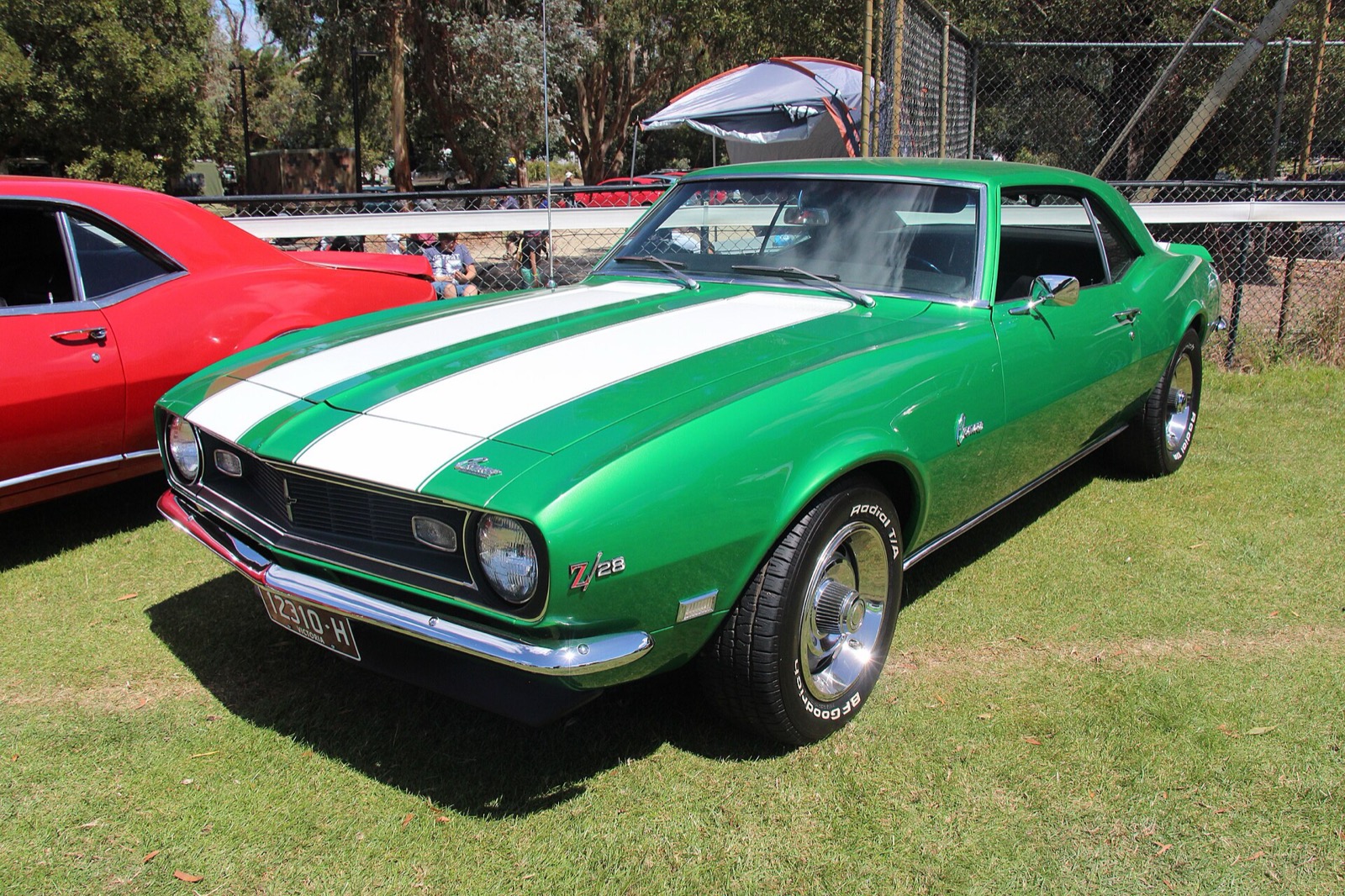
A 1968 Z/28, the package's second year, shown because it looks nearly identical to the 1967 car. Photo: Sicnag, CC BY 2.0, via Wikimedia Commons

The 1967 Z/28

The first Z/28 was a homologation special Chevrolet barely told anyone about. Only 602 were built, and its 302 V8 existed to fit SCCA Trans-Am's five-liter limit.

The Z/28 was created to race. SCCA's Trans-Am series capped engines at five liters, 305 cubic inches, so Chevrolet built a 302 by combining the 327's bore with the 283's stroke. It was rated at 290 hp, a figure widely regarded as conservative.

Chevrolet did not advertise the package as "Z/28" at first; early cars are sometimes described as a Camaro Sport Coupe with the Z/28 Special Performance Package. The 602 built for 1967 fell well short of the 1,000 cars SCCA nominally required for homologation, but SCCA accepted the car anyway, and Roger Penske and Mark Donohue won the manufacturers' championship with it in 1968 and 1969.

Once people knew it existed, the package took off: 7,199 for 1968, and 19,014 or 20,302 for 1969, depending on the source. That leaves the 1967 cars as the rarest regular-production Z/28 of the first generation. The first-generation package table sets their counts beside the Rally Sport and SS.

Did you know

  • Chevrolet introduced the Z-28 to dealers in a Chevrolet Motor Division letter dated December 9, 1966, signed by E. E. Buckler, manager of merchandising for the New Car Department. It calls the Z-28 the latest factory option package, available only on Camaro coupes, says ordering procedures are still being finalized, and specifies a close-ratio four-speed with a 2.20 low gear, a 3.73 axle, and power-assisted front discs ordered separately.
  • A 1967 Z28 package cost $358.10; the plenum-air intake made it $437.10, headers alone $779.40 and both $858.40. Both extras were supplied loose rather than installed at the plant, and the 1967 headers came from Bill Thomas Race Cars (Kustom supplied them in 1968).
  • No 1967 Z28 wore a Z28 or engine-size emblem; rally stripes were the only exterior clue. The very first cars, built in late December 1966, carried a '4P' firewall-tag code that soon became '4L'; engine codes were MO (standard) and MP (smog equipment). The earliest cars went to performance-minded dealers and well-known racers.
  • Dave and Ben Wenzel bought a new 1967 Z28 and took it almost straight to the track, winning the stock class at the NHRA Nationals in Indianapolis on Labor Day weekend 1967, the first Camaro to win an NHRA stock-class national event. CRG says they were still racing it as of 2025.
  • The 302 combined a 4.002-inch-bore 327 block with a 3.005-inch forged, Tufftrided crank. It used the 'Duntov 30/30' solid-lifter cam (named for the .030-inch valve lash, and previously used in fuel-injected Corvettes), camel-hump heads with 2.02/1.60 valves, 11:1 forged pistons, a 780-cfm Holley and small-journal two-bolt mains, and was rated 290 hp at 5,800 rpm.
  • RPO J56, heavy-duty front discs with metallic linings and rear drums, was offered only on the 1967 Z28; Chevrolet's records show 205 sold. The Z28 also required the M21 close-ratio four-speed, J50 power brakes and either J52 or J56 front discs.
Sources for these details
The 1LE homologation package (1988–1992)
A 1989 IROC-Z displayed with its 1LE equipment. Photo: Stephen Foskett, CC BY-SA 3.0, via Wikimedia Commons

The 1LE homologation package (1988–1992)

The third-generation Camaro's stock brakes weren't up to road racing, and 1LE was the fix: Corvette calipers, bigger rotors, a baffled tank and an aluminum driveshaft. Its hardware appears in Chevrolet's factory specifications. Reported 1988–1992 counts total fewer than about 1,500 cars.

1LE was aimed at SCCA Showroom Stock and IMSA racers. A team that included Camaro-Firebird powertrain manager Ray Canale and Chevrolet engineer John Heinricy (far better known for his Corvette work and SCCA championships) paired the Caprice's larger front rotors with Corvette two-piston calipers and a new proportioning valve. They added a baffled fuel tank so the engine would not starve in long corners, a close-ratio transmission with a shorter fifth gear, recalibrated suspension and the Corvette's aluminum driveshaft.

The factory paperwork does name 1LE: Chevrolet's 1990 MVMA sheet identifies optional heavy-duty brakes. That is distinct from an ordering recipe. The December 1987 guide page for the 1988 IROC-Z lists G92 and related options without a separate 1LE line; the January 30, 1989 G92 line explicitly requires C60. Retrospectives describe early hardtop orders through G92, G80 and C41 air-conditioning delete, with a reported price around $700. The August 1989 dispatch instead gives explicit with/without-C60 G92 prices for model year 1990. Neither that later sheet nor the retrospective recipe establishes every earlier ordering revision or an individual car's build specification.

Production grew as the recipe spread: about four in the United States in 1988, 111 in 1989, 62 in 1990, 478 in 1991 and 705 in 1992, a count that includes 589 B4C police-package cars, which took the 1LE brakes that year. The package carried no badging, so a 1LE today is proved by its equipment and paperwork, not its looks.

RPO 1LE stayed on Chevrolet's order guide through the fourth generation. The name was revived on the fifth-generation SS for 2013 and eventually reached every engine in the sixth-generation lineup.

Did you know

  • Take the 589 B4C police cars out of 1992's 705 and only 116 were standalone 1LE cars. Most were sparsely equipped, with a base interior and no power options; 201 even had the radio deleted. The figures come from Mike Antonick's Camaro White Book, as cited by Wikipedia.
  • GM's own brake specification for the 1LE lists front rotors 301 mm (11.86 in) by 26.2 mm thick with two 38-mm caliper pistons per side, and rear rotors 296 mm (11.65 in). A stock 1990 IROC-Z has 267 mm (10.5 in) front rotors and a single 64-mm-piston caliper, so the 1LE's gain was up front; the 11.65-inch figure seen in some write-ups matches the rear rotor, which is the same size as the optional rear disc.
  • Out of 6,813 1991 Z28 coupes built with the G92 performance axle, only 478, about 7%, skipped air conditioning and so triggered the 1LE. G92 with A/C cost $466 and added an engine oil cooler, four-wheel discs and dual-converter exhaust; without A/C it cost $675 and added heavy-duty front brakes, an aluminum driveshaft and spare wheel, special shocks and fuel pickup and a fuel-tank baffle, and the fog lamps were deleted for weight and cooling.
  • GM's 1989 dealer book counts 111 cars built with 1LE equipment. Ordering G92 forced an engine oil cooler, four-wheel disc brakes, dual-converter exhaust and P245/50ZR16 tires, on either the 305 LB9 with the five-speed or the 350 B2L with the automatic; those cars got 145-mph speedometers and 5,500-rpm-redline tachometers, and without A/C the build added the 1LE parts.
  • The 1LE did not vanish after 1992. GM's 1994 order guide lists RPO 1LE at $310 on the Z28 coupe, and the 1999 kit still lists it as the Performance Suspension Package, 'engineered specifically for professional racing,' with Koni double-adjustable shocks, a 32-mm front bar and stiffer bushings. DrivingLine counts fewer than 600 fourth-generation cars.
  • 'Feels Neolithic, with the suspension compliance of a pool table,' Road & Track wrote of a 1988 1LE in a recent drive, as quoted by The Autopian, which could not find a period review of the package.
Sources for these details
B4C: the police-package Camaro (1991–1992)
A 1991 Camaro RS in Nevada Highway Patrol livery. Police paint alone doesn't make a car B4C-equipped; the package is established from documentation. Photo: Noah Wulf, CC BY-SA 4.0, via Wikimedia Commons

B4C: the police-package Camaro (1991–1992)

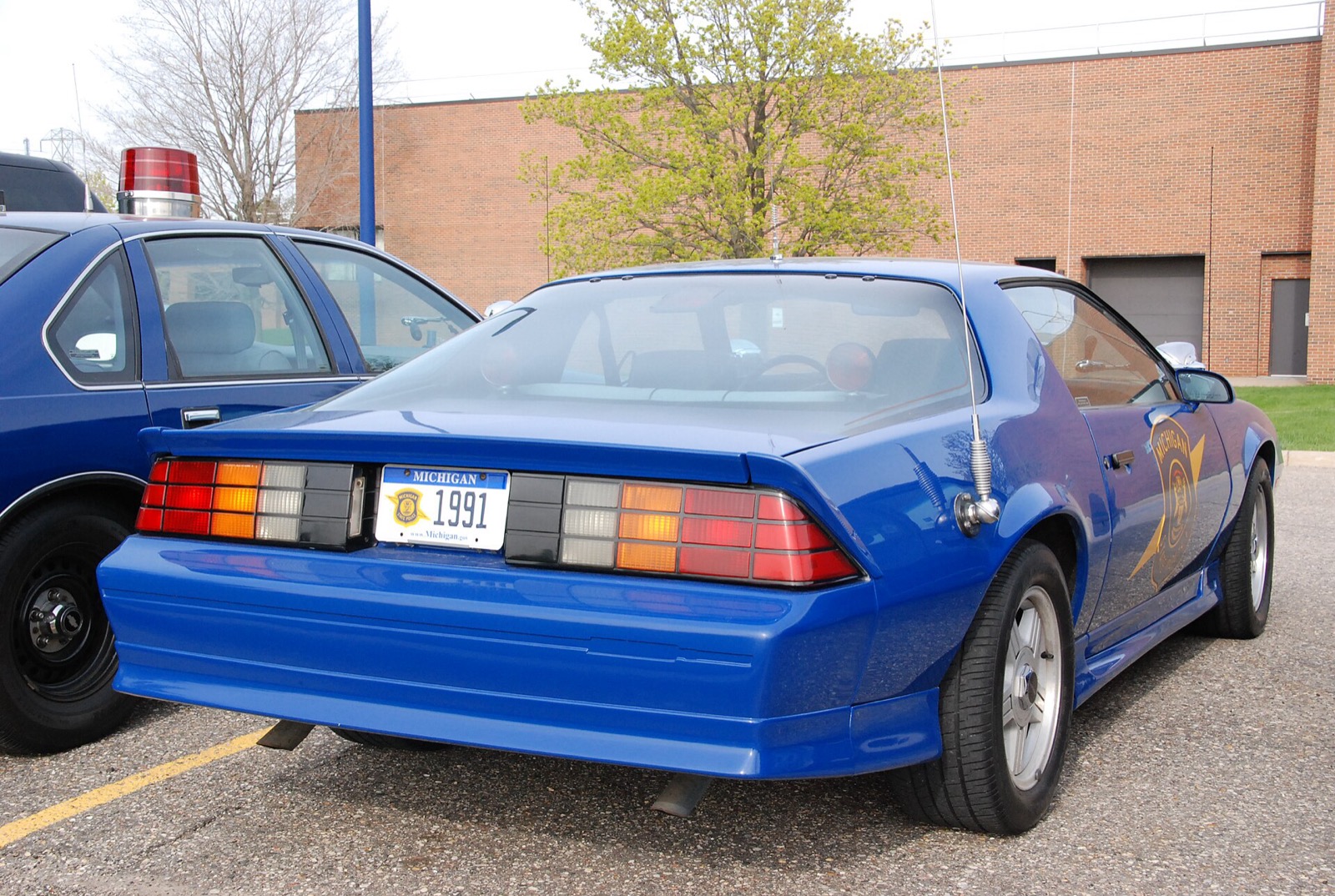
B4C was Chevrolet's factory police package, introduced for 1991 and built on the RS hardtop for highway patrols, sheriff's departments and government fleets.

B4C put performance hardware into a plain RS coupe for police work. For 1991, Chevrolet's special-service brochure lists air conditioning with B4C. The dated Z28 Coupe order guide describes the special front brakes, aluminum driveshaft and other G92 equipment without air conditioning; that is a separate configuration from the RS-based B4C. The two shared performance equipment without matching each other's specification.

Retired cars have reached private owners through police auctions over the years, and they are now uncommon.

The 1991 special-service brochure recommends highway traffic law-enforcement use and says the car did not meet GM's durability requirements for police packages. That stated limit belongs with its equipment description; the police-package nickname alone does not describe the intended duty.

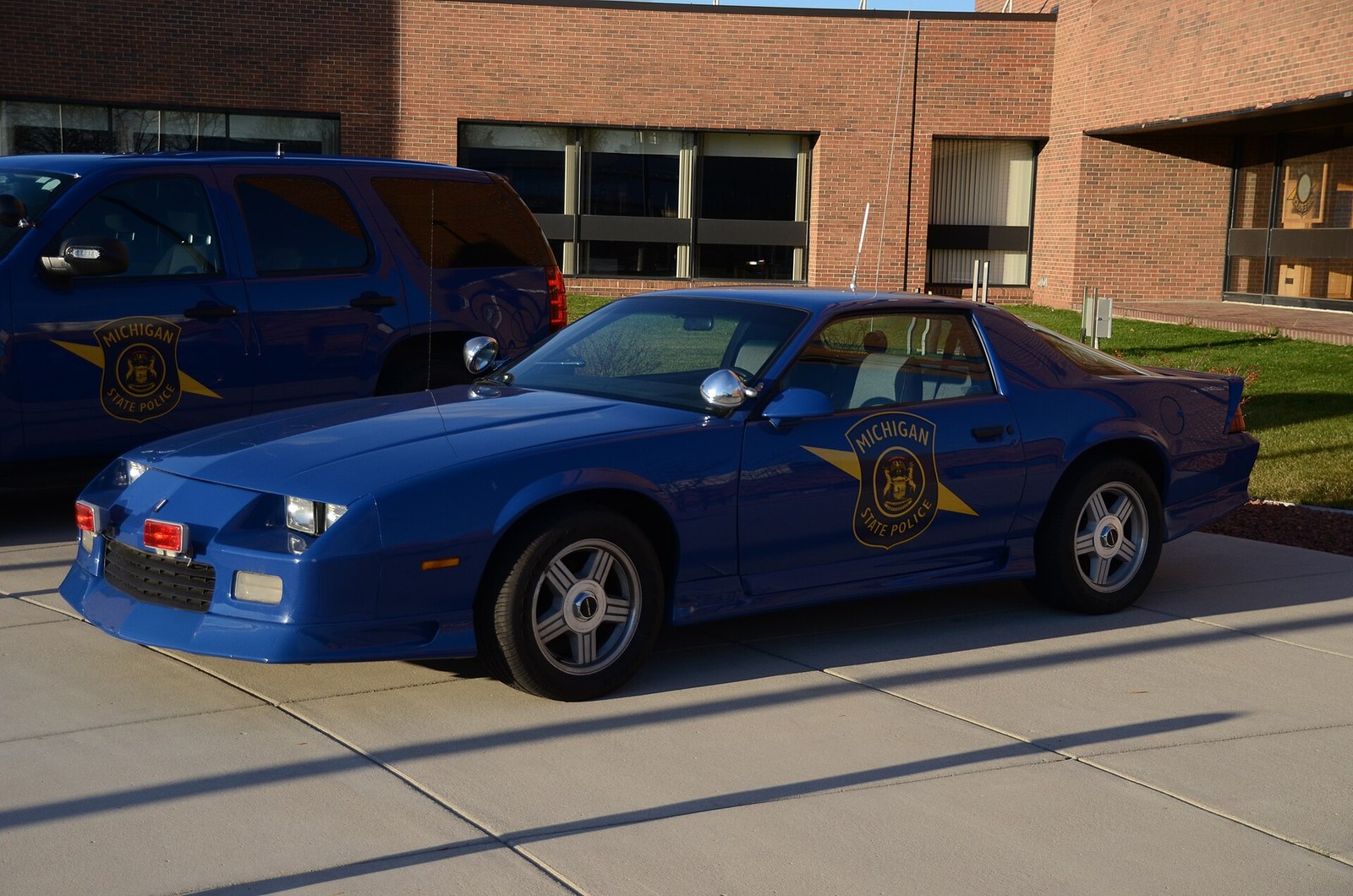
Blue Michigan State Police 1991 Camaro coupe with door seal livery
Blue Michigan State Police 1991 Camaro coupe with door seal livery, front three-quarter view, parked in front of a brick building Photo: Joe Ross, CC BY-SA 2.0, via Wikimedia Commons Original photograph License
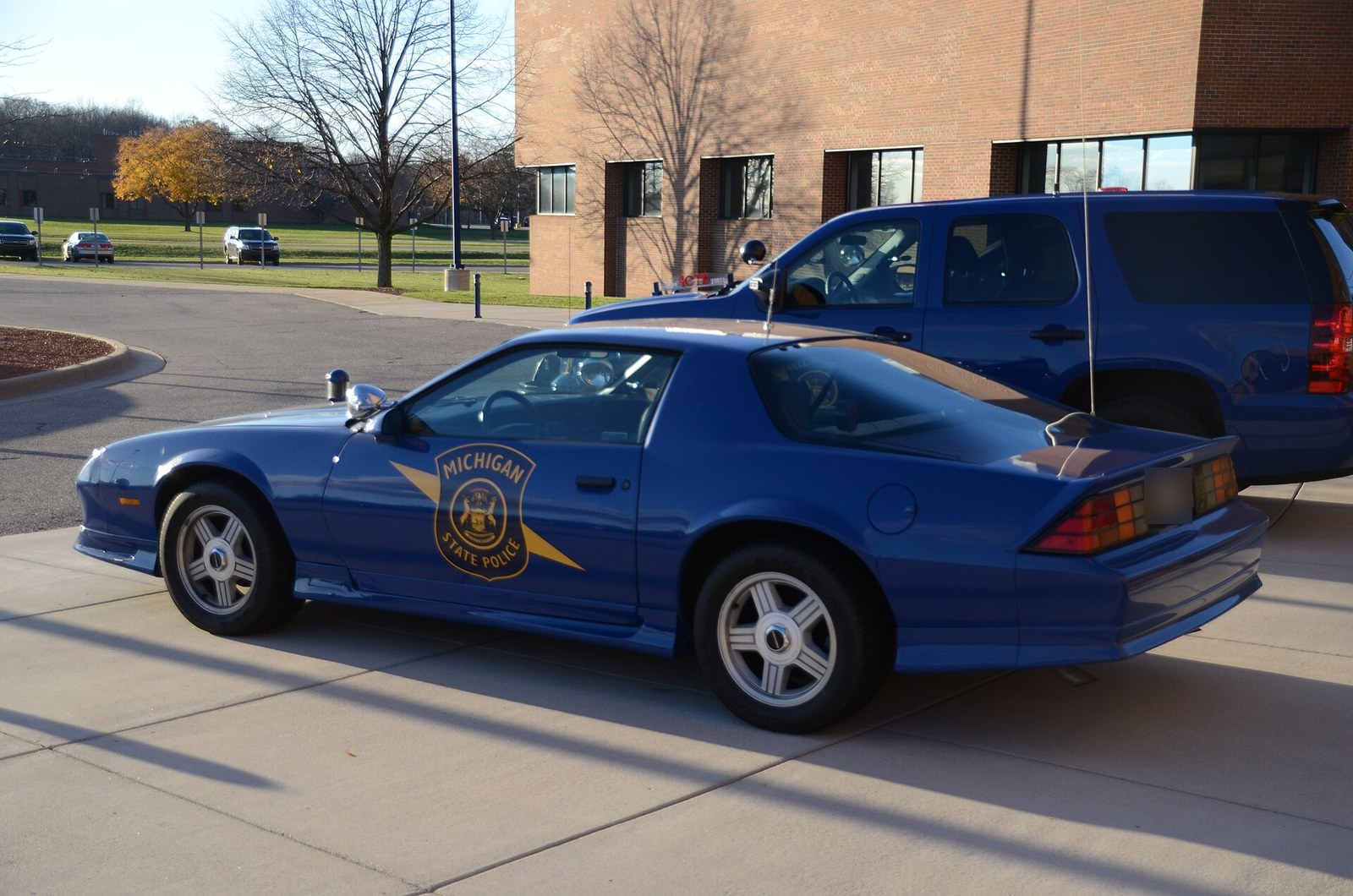
Blue Michigan State Police 1991 Camaro coupe with door seal livery
Blue Michigan State Police 1991 Camaro coupe with door seal livery, rear three-quarter view, parked beside a police SUV in front of a brick building Photo: Joe Ross, CC BY-SA 2.0, via Wikimedia Commons; licence plates blurred Original photograph License
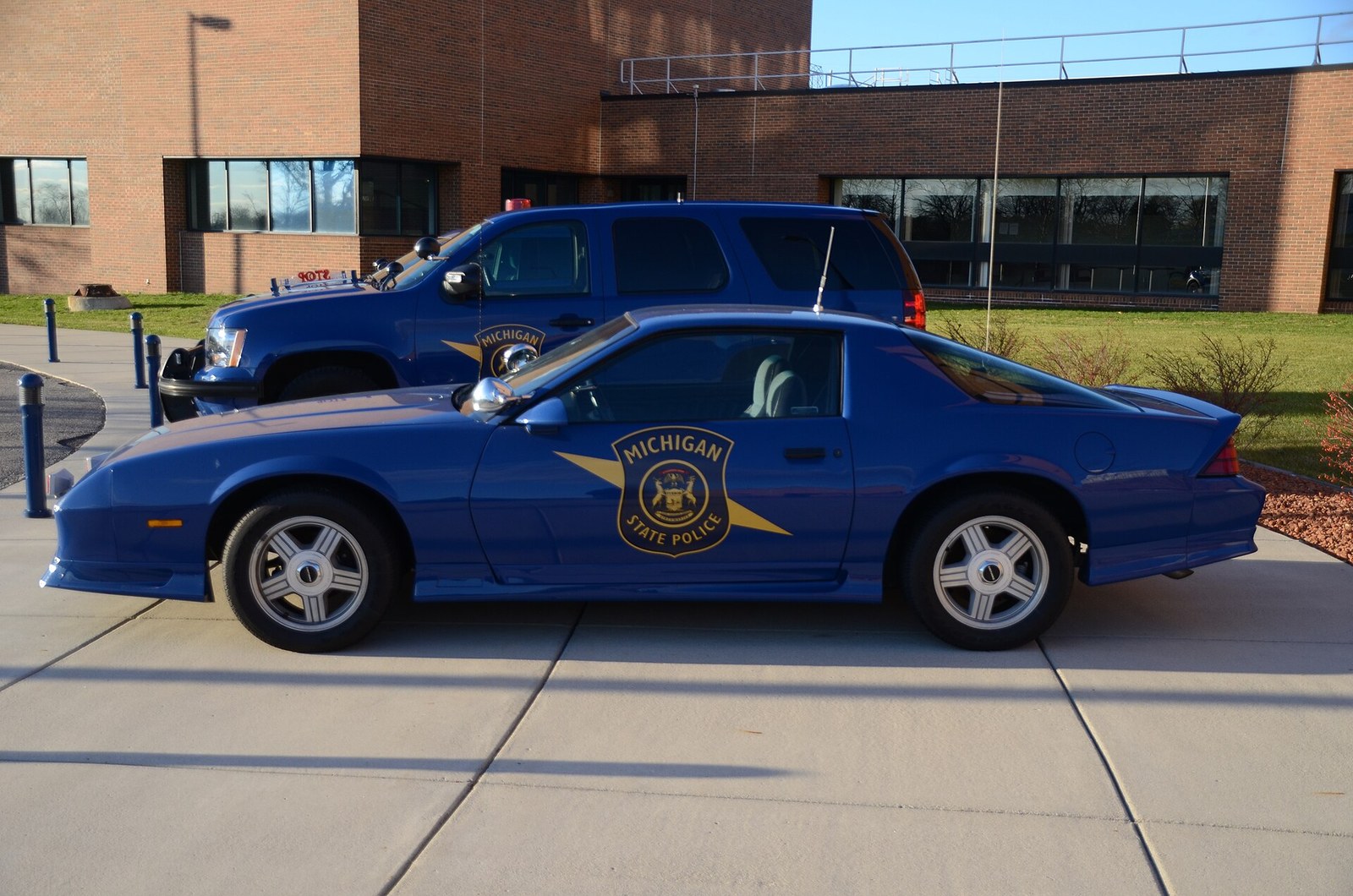
Blue Michigan State Police 1991 Camaro coupe with door seal livery
Blue Michigan State Police 1991 Camaro coupe with door seal livery, side profile, parked in front of a brick building beside a police SUV Photo: Joe Ross, CC BY-SA 2.0, via Wikimedia Commons Original photograph License
Blue 1991 Camaro in Michigan State Police livery, rear three-quarter at the MSP Training Academy
1991 Camaro, Michigan State Police (B4C-era police service) Photo: Corvair Owner, CC BY-SA 2.0, via Wikimedia Commons Original photograph License

Did you know

  • The White Book reprint reports 592 B4Cs for 1991, a secondary count rather than a GM production ledger. The Special Service Package cost $3,135 ($3,950 with the 350 and automatic) on top of an RS coupe, roughly what a $15,445 Z28 coupe cost. It bundled dual-converter exhaust, 16-inch wheels with 245/50ZR16 tires, four-wheel discs, an engine oil cooler, a 105-amp alternator, a 145-mph speedometer, A/C, a rear compartment shade, a 630-cold-crank-amp battery, special suspension and a limited-slip axle.
  • The White Book describes B4C as RS-coupe-only, with the 350 V8 (B2L, 245 hp) paired with the automatic, and says the standard UM7 radio could be deleted for credit but other radios could not be ordered. Its statement that all interiors, including leather, were available conflicts with the special-service brochure's cloth/custom-cloth-only seat chart. No exact changeover date or all-year B4C leather availability is established by those two sources.
  • In 1992 the police package picked up the 1LE's brakes, which is why that year's 589 B4Cs are also counted in the 1LE's 1992 total. The figure comes from Mike Antonick's Camaro White Book, as cited by Wikipedia.
  • B4C returned in the fourth generation. GM's 1999 and 2000 kits list it with the 305-hp LS1, a 155-mph speedometer, 16-inch aluminum wheels, a six-speed or four-speed automatic, the performance handling suspension and a power-steering cooler; in 2001 the LS1 was rated 310 hp, and GM described B4C as several Z28 ingredients on a Camaro coupe platform, 'available only to law enforcement agencies.'
Sources for these details
The modern COPO Camaro (revived for 2012)
A 2018 COPO Camaro factory drag car. These are built as race cars and are not street legal. Photo: Michael Rivera, CC BY-SA 4.0, via Wikimedia Commons

The modern COPO Camaro (revived for 2012)

In 2012 Chevrolet Performance revived COPO as a factory-built drag car for NHRA racing and built 69 of them, a deliberate echo of the 69 ZL1s of 1969. It is not street legal. The familiar 69-car quota was not stated consistently in Chevrolet's later 2022 material.

The original COPO Camaros of 1969 went through a back channel to get race-legal big blocks past GM's own rules. The modern COPO is the same idea made official: a Camaro built by Chevrolet Performance purely for drag racing, for NHRA Stock and Super Stock classes.

The first run, for 2012, was 67 coupes and 2 convertibles. Another 69 followed for 2013, and later cars also raced in NMCA Factory Super Cars and NHRA Factory Stock Showdown. Bruno Massel scored the modern program's first NHRA national-event win at the 2014 U.S. Nationals.

Chevrolet's July 30, 2021 announcement said production would not be capped for 2022 and orders would be filled first come, first served. The 2022 Chevrolet Performance catalog (P/N 19432904, printed page 24), read in a motorsport supplier's copy, still says 69 production race cars. The publications do not resolve which policy was applied or the actual 2022 build total, so 69 is not presented here as a fixed quota for every year.

The same year the COPO returned, the ZL1 name came back on a supercharged 580 hp production Camaro. For the program's fiftieth anniversary Chevrolet built the electric eCOPO concept, shown at SEMA in 2018.

Did you know

  • The 2012 COPO Camaro started at $89,000. It was sold with a sequenced build number matched to its engine rather than a VIN, so it can't be registered for the road; it came in five colors (Flat Black, Summit White, Victory Red, Silver Ice Metallic, Ashen Gray Metallic), and a collector's package offered all three engines, each serial-matched to the car.
  • The 2012 cars offered three engines: a naturally aspirated 427, a 327 (5.3-liter) with a 2.9-liter supercharger and a 327 with a 4.0-liter Whipple supercharger, NHRA-certified at 550 hp. All were hand-assembled at GM's Performance Build Center in Wixom, Michigan, where the Corvette LS7 and LS9 were built. Chevrolet ordered a second run because more than 3,000 people raised their hands for one after SEMA.
  • The last 2012 COPO, No. 69, was an Inferno Orange Metallic convertible, the only 2012 painted that color and the only one with a Turbo 400 automatic; its top works but NHRA rules keep it up when racing. Chevrolet sold it at Barrett-Jackson Scottsdale on January 20, 2013 for $400,000, donated to the American Heart Association; the other convertible, No. 68, went to the GM Heritage Center.
  • By 2020 a base COPO Camaro (naturally aspirated 427, standard color) cost $117,500 and a fully optioned car (supercharged 350, custom color) could reach $170,000. Cars are built at the GM-managed COPO Build Center in Oxford, Michigan, and buyers register on Chevy.com or at the SEMA and PRI shows for a lottery chance to buy one.
  • The 2020 COPO's supercharged 350-cubic-inch LSX ran 12.5:1 compression and revved to 9,500 rpm, with a 2.65-liter Eaton supercharger based on the Corvette C7 ZR1 unit (repackaged by Magnuson), an ATI-built TH400 and a solid rear axle with a Strange aluminum third member.
Sources for these details
The 2019 eCOPO electric drag concept
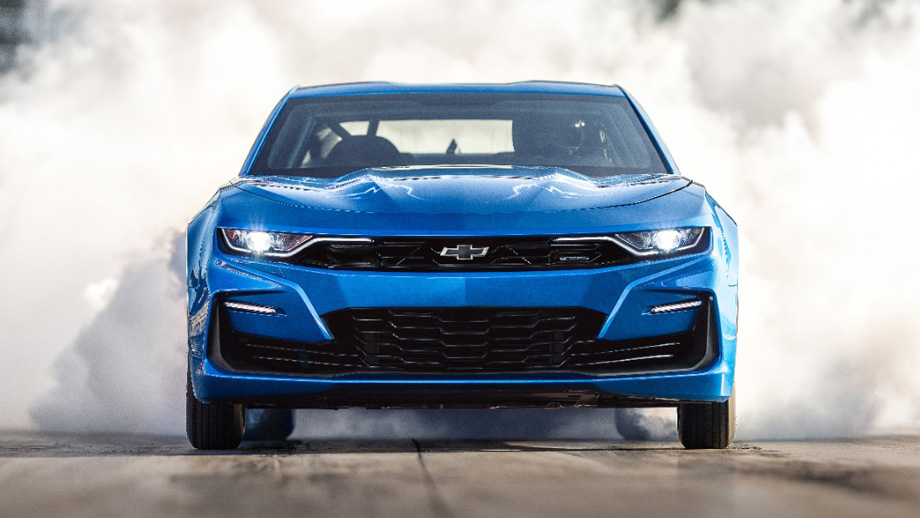
The eCOPO Camaro concept doing a burnout at SEMA 2018, in the Electric Blue it was shown in. Photo: Chevrolet / General Motors, used with permission

The 2019 eCOPO electric drag concept

An all-electric drag concept based on the 2019 COPO Camaro, developed by GM with Hancock and Lane Racing and announced for SEMA on October 29, 2018 in Electric Blue. The Chevrolet release published by NHRA describes more than 700 hp and 600 lb-ft and estimates a quarter mile in the nine-second range while testing was ongoing.

The COPO Camaro has always been built to a rulebook rather than a market. The eCOPO asked what happens when the rulebook hasn't been written yet.

General Motors built it with Hancock and Lane Racing, a team already racing electric drag cars. Two BorgWarner HVH 250-150 motor assemblies make 300 lb-ft each, fed by an 800-volt battery pack. The voltage was chosen with a drag meet in mind: the constraint is how fast you can recharge between elimination rounds, not range.

Behind the motor sits a conventional racing-prepared Turbo 400 automatic, driving the same solid rear axle as the gas COPO race cars. That makes it an electric drivetrain bolted to a drag racer's driveline rather than a clean-sheet EV.

Russ O'Blenes, GM's director of performance variants, parts and motorsports, framed it as continuity: the original COPO program was about pushing the envelope, and this was an exploration in the same spirit.

It remained a concept. Camaro production ended after 2024 without an electric version, and the reported successor is internal combustion; see the Camaro that has not been announced. The eCOPO went to Russo and Steele's Monterey sale in August 2019 and did not sell.

Did you know

  • The eCOPO's 800-volt pack is four 200-volt modules of about 175 pounds each: two in the rear-seat area and two in the trunk (one in the spare-tire well, one over the rear axle). The placement gives the car more than a 56 percent rear-weight bias to help it launch.
  • GM picked Hancock and Lane partly because of its link to Patrick McCue, the driving force behind the record-holding 'Shock and Awe' electric drag car, and to his Bothell High School (Seattle area) automotive technology program; more than a dozen students helped develop and assemble the car.
  • The eCOPO's motor shares its bellhousing pattern and crankshaft flange with the LS-family engines in Chevrolet's crate engine catalog, so it bolts to nearly any GM transmission.
  • Russ O'Blenes said the eCOPO pointed toward a future that 'could include electric crate motors for racing, or even your street rod,' though he added GM wasn't there yet. Chevrolet tied it to its own history: it pioneered the high-performance crate engine around the time of the original COPO Camaros.
  • Fox News reported a 9.51-second best at 140 mph, wheelies and Hancock and Lane ownership on August 12, 2019. Its 800-volt lithium-ion pack was described by GM as four roughly 175-pound modules, about 700 pounds combined. The reported result is separate from the launch estimate.
  • Hancock and Lane consigned the eCOPO to Russo and Steele's Monterey sale on August 16, 2019, with an undisclosed reserve and a $425,000 to $525,000 estimate. It failed to sell; Motorious reports the high bid was $250,000. GM told the press it wasn't involved in the sale.
Sources for these details
Nickey Chevrolet 427 Camaros
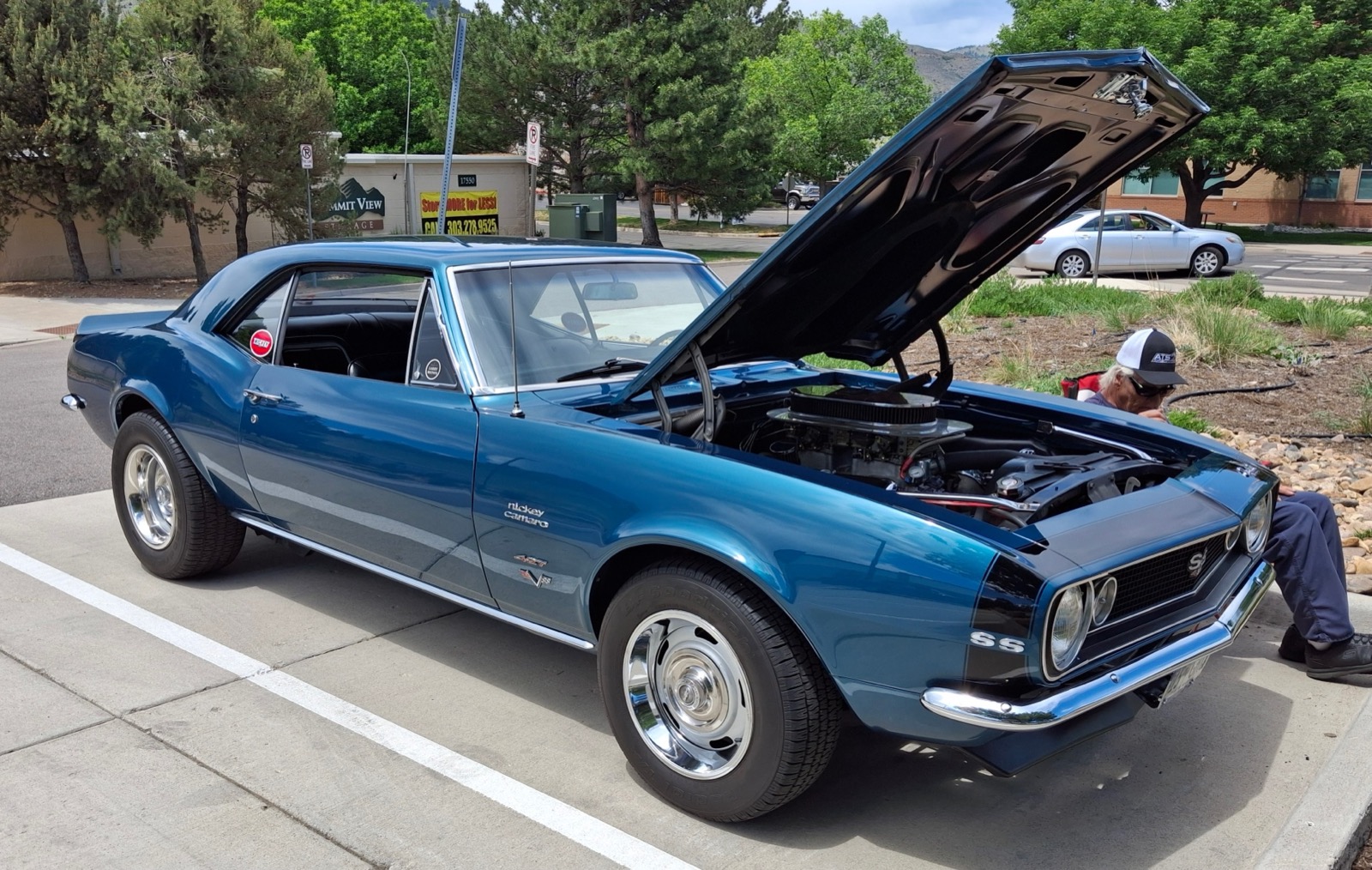
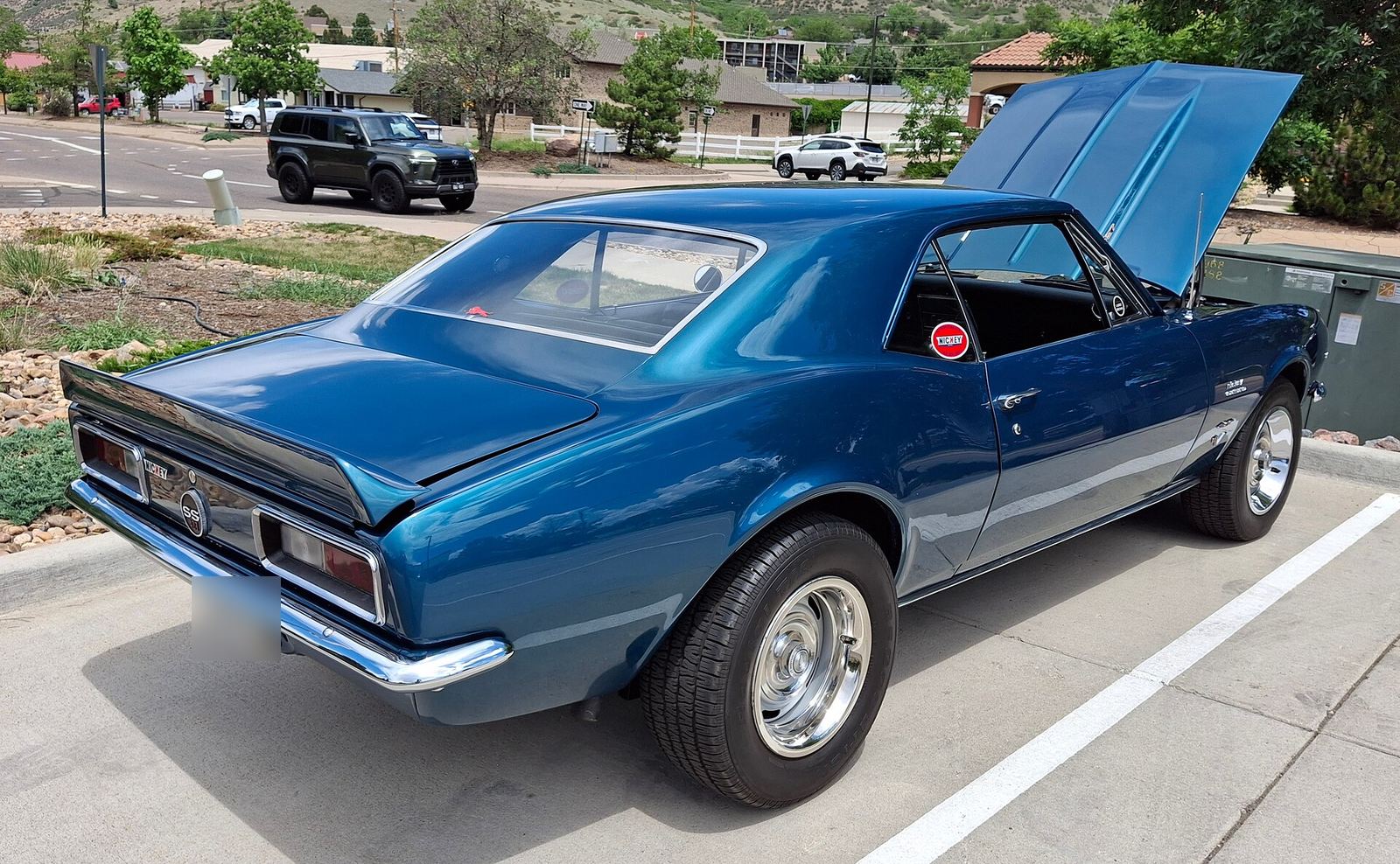
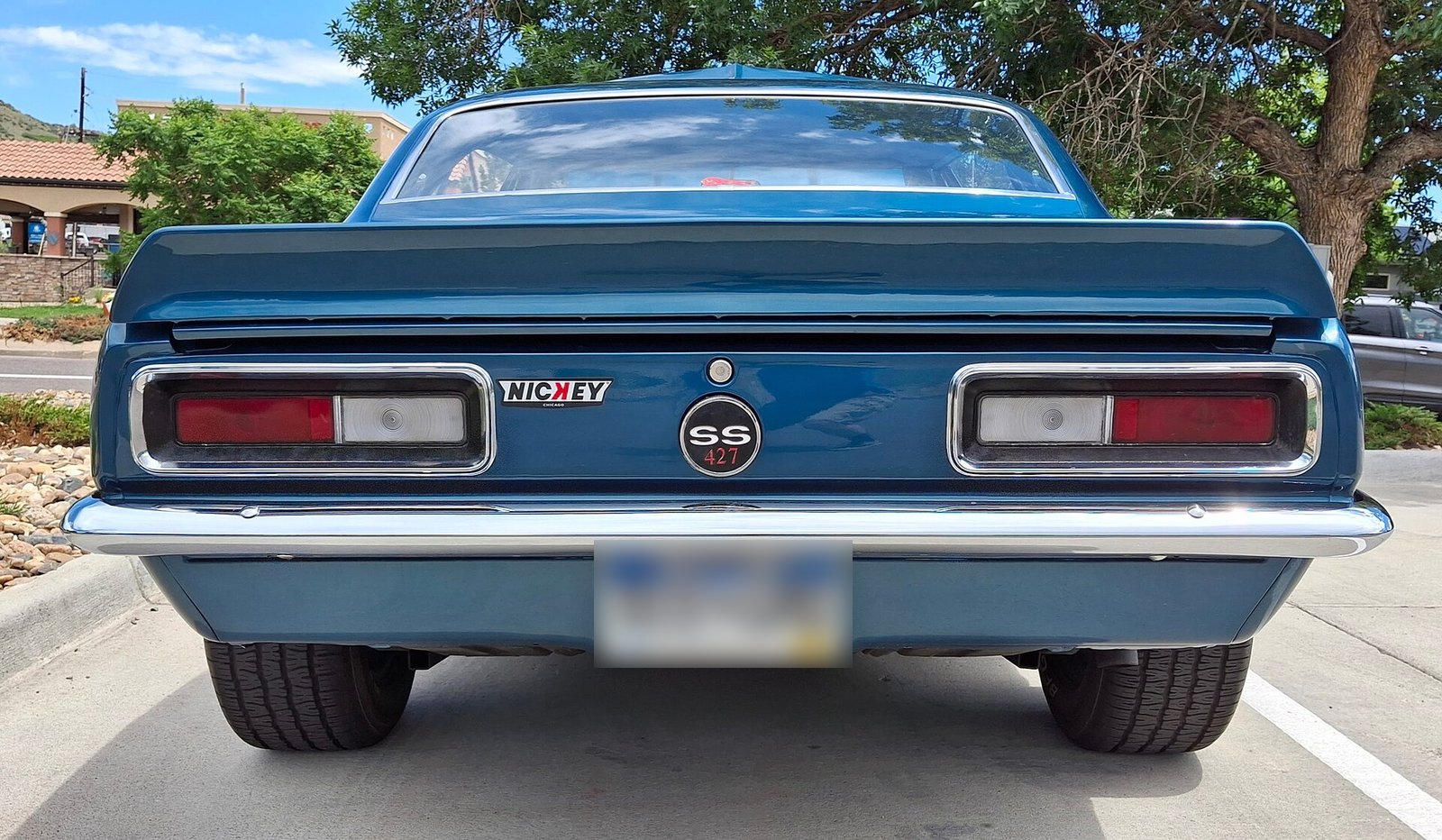
A 1967 Camaro SS 427 with Nickey badging. It is a modern Nickey-badged build photographed in 2026, not a period dealer car, so it shows what the conversion looked like rather than a 1967 original. Photo: Xnatedawgx, CC BY-SA 4.0, via Wikimedia Commons

Nickey Chevrolet 427 Camaros

Nickey Chevrolet of Chicago, founded in 1925 by brothers E.J. and Jack Stephani, grew into one of the largest high-performance parts operations in the country. Its dealer-converted 427 Camaros involved builders in Chicago and California; the often-repeated first-conversion claim remains disputed.

Much of the engineering came from outside the dealership. Nickey worked with Bill Thomas Race Cars of Anaheim, California, and Dick Harrell began engineering and building high-performance cars for its Chicago operation in 1966, according to the revived Harrell brand's history. Schorr recalls Thomas building for California customers. These accounts describe a partnership, not a single builder for every car. The Stage I, Stage II and Stage III names describe graduated conversion packages, not identical equipment on all cars.

The "first 427 Camaro" title is shakier than it sounds. Harrell's modern history hedges the 1967 Nickey claim as believed, and Dana Chevrolet has a competing claim. Neither is settled. HOT ROD's 2018 account of January 1967 archive photographs documents a Nickey/Thomas booth and Camaro at the trade show. That establishes a public partnership by that date, not an exclusive first or a complete build ledger.

Nickey Chevrolet was sold in 1973 and became Keystone Chevrolet. The revived brand's own history associates its relaunch with the 2010 Camaro and reuses the Stage I, II and III names. That account does not date every step in the business revival. A modern Nickey badge or registry entry alone does not establish that a car was converted by the original dealership.

Blue 1967 Camaro SS 427 coupe with Nickey badges
Blue 1967 Camaro SS 427 coupe with Nickey badges, rear spoiler and hood raised, rear three-quarter view in a parking lot cruise Photo: Xnatedawgx, CC BY-SA 4.0, via Wikimedia Commons; licence plates blurred Original photograph License
Blue first-generation Camaro SS 427 coupe with Nickey badge and rear spoiler
Blue first-generation Camaro SS 427 coupe with Nickey badge and rear spoiler, rear view, in a parking lot cruise; model year not confirmed, 1967–69 Photo: Xnatedawgx, CC BY-SA 4.0, via Wikimedia Commons; licence plates blurred Original photograph License

Did you know

  • Colin Comer's February 2009 Sports Car Market profile gives an estimated 14 Nickey 427 Camaros for 1967. It describes the Tahoe Turquoise Stage III as one of three 435-hp L89 aluminum-head Tri-Power cars and reports $446,250 with premium at Mecum in St. Charles, Illinois, on October 5, 2008. Those rarity statements are profile claims, not a surviving build ledger.
  • Former owner Comer recalls paying $67,000 at Mecum in November 2000 against a $150,000 reserve. He describes a small-block project restored as a Stage III, an initial NICB destination away from Nickey, a later shipment he interpreted as a possible dealer trade, Swiatek's inspection and affidavit, and Delgado's recollection of the color and L89 equipment. We have not seen those records; this is the car's reported history.
  • In a later memoir extract, Martyn L. Schorr recalls driving Thomas's first SS427 around Orange County in early 1967: a Bolero Red SS350 donor retaining its 350 emblems. He cites August 1967 Speed and Supercar coverage, $3,711 for a basic 427/425 and about $4,300 for his demonstrator with Cragars, traction bars, headers, 4.88 gears and dual Carter AFBs. Williams and LaFon reported consistent 11.40s to him; Schorr explicitly says he did not run the car at the track.
  • Supercars.net quotes a 1967 Car and Driver report giving $3,891 to begin a custom Nickey/Thomas build and warning that $3,900 was usually only a starting point. The same modern page lists 12.3 seconds at 113.21 mph. The original magazine issue and test conditions were not inspected here, so these are attributed historical figures, not a verified specification for every conversion.
  • Supercars.net reports a $400,000 sale for a Bolero Red Nickey/Bill Thomas Stage III at Mecum Indianapolis in May 2011. Its reproduced catalog description says the car was built at Thomas's Anaheim shop from one of 1,138 4K-code L78 donors, converted to L72 427/450-hp Stage III form, and supported by Nickey Registry certification and an original-owner affidavit. The original lot file and those documents were not inspected here.
Sources for these details
The SLP-built SS, and the 106 LT4 cars
The LS1 engine bay of a 1999 Camaro SS, an SLP-completed car. From outside, an SLP SS and an ordinary Z28 look so alike that the bodywork tells you little. Photo: Thesazi, CC BY-SA 3.0, via Wikimedia Commons

The SLP-built SS, and the 106 LT4 cars

The fourth-generation SS was built by SLP Engineering on top of a Z28, the only SS in the nameplate's history that Chevrolet did not assemble itself, though Chevrolet listed it in its own order guide as RPO WU8.

SLP Engineering ("Street Legal Performance", of Troy, Michigan, led by Ed Hamburger) already had a relationship with GM's performance channels through the Firebird Firehawk conversions that began in 1992. In 1996 Chevrolet approved SLP to build an SS package on top of the Z28: Chevrolet supplied LT1-equipped Z28s, SLP fitted the specific hood, wheels, suspension and in some years exhaust and engine upgrades, and the finished cars went on to dealers.

That ended a 24-year absence; the SS name had last appeared in 1972. 1996 SLP SS production is cited at 2,263 cars.

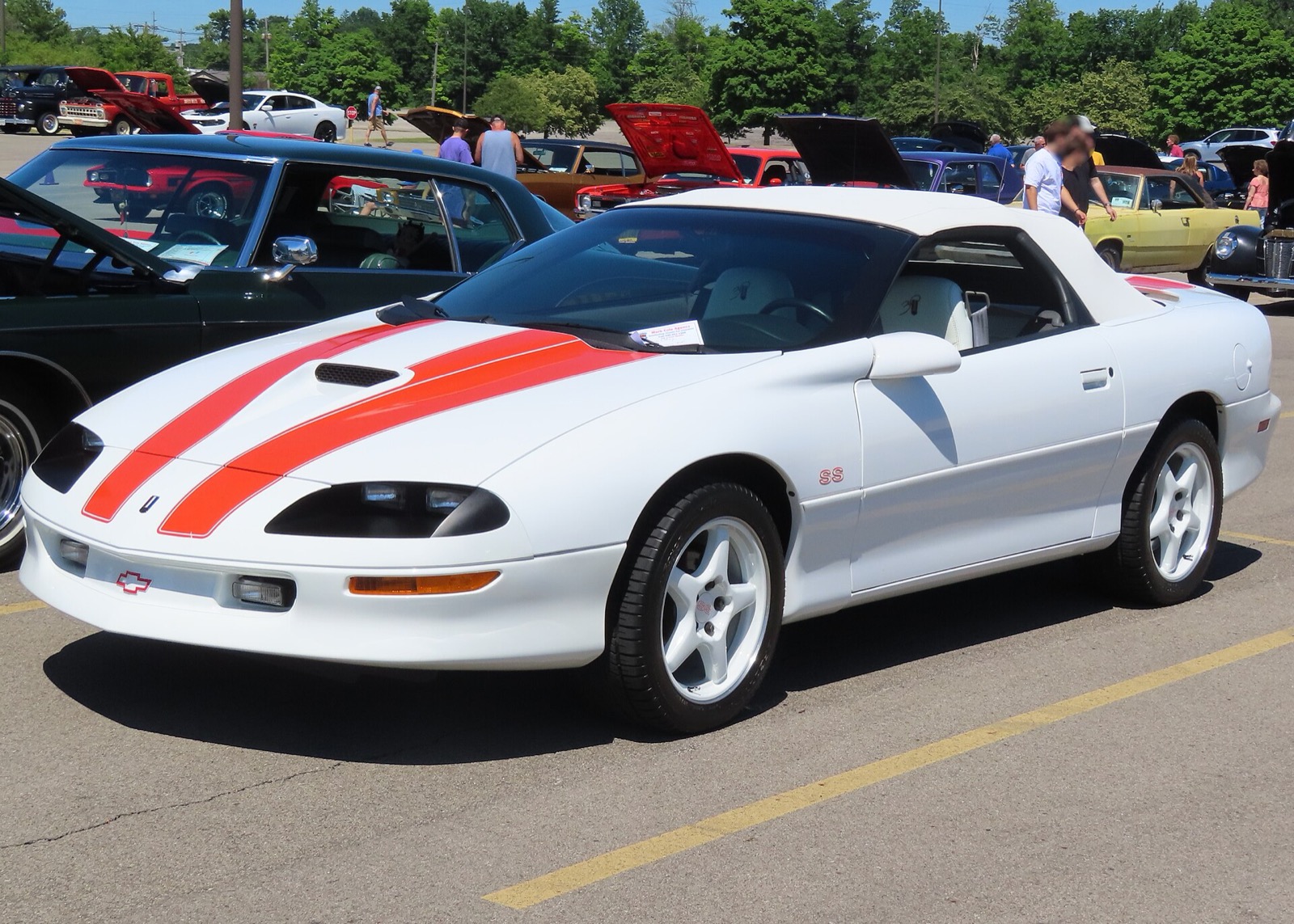
The rarity inside the rarity is the 1997 30th Anniversary edition. Every one wore Arctic White with Hugger Orange stripes and white leather, with optional houndstooth cloth inserts in a nod to the 1969 pace car's interior. 4,533 were sold at a $575 premium, and a reported 957 combined the anniversary package with the SS.

SLP built 106 of those with the LT4, the 330 hp high-output small-block from the 1996 Corvette Grand Sport, 25 hp more than the standard LT1 SS. They are among the rarest and most valuable fourth-generation Camaros, and because they look almost identical to an ordinary 30th Anniversary SS, documentation matters more than appearance.

See the fourth generation for the rest of the SLP story.

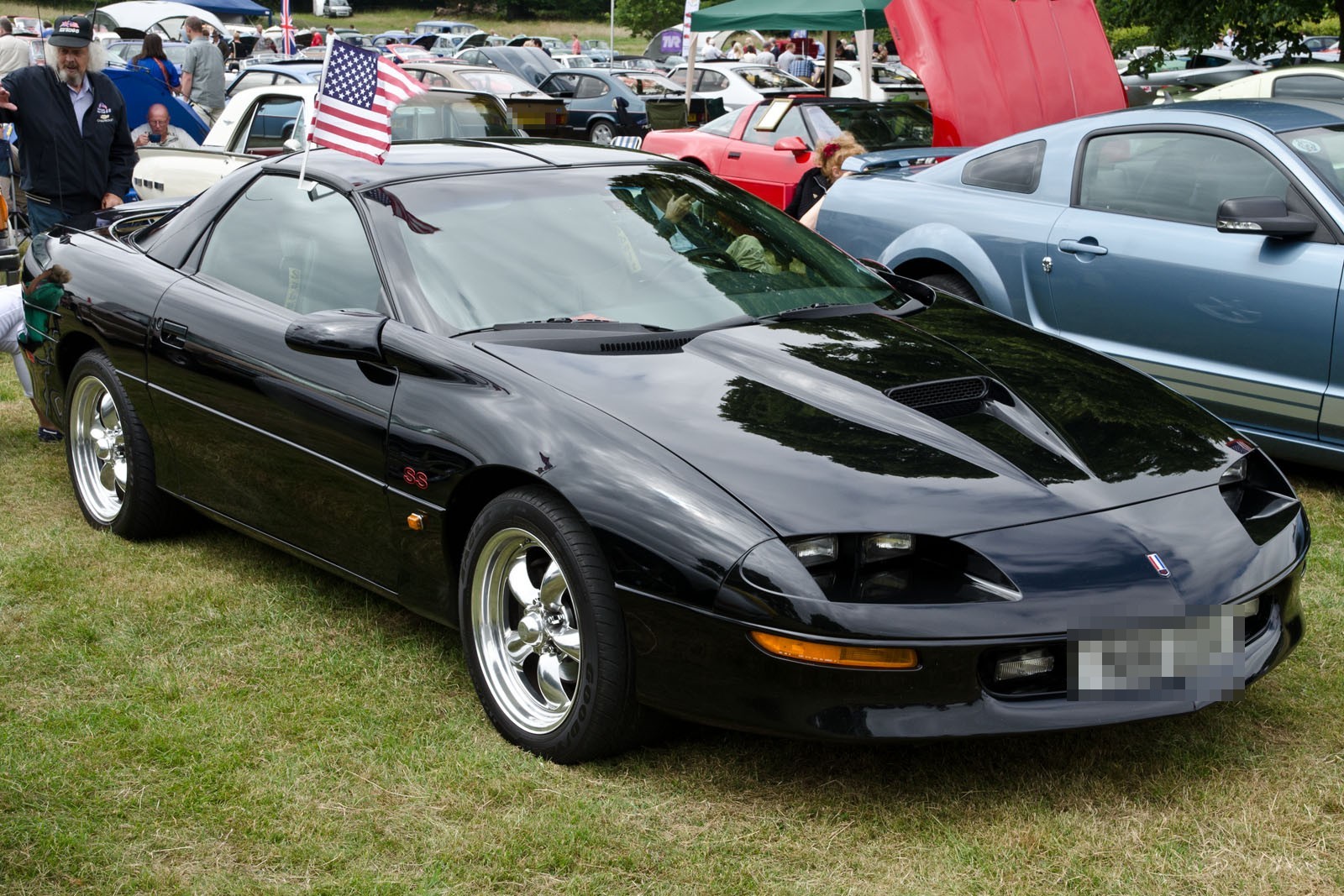
Black 1996 Camaro SS with forced-air hood, front three-quarter, plate blurred for privacy
1996 Camaro SS Photo: SG2012, CC BY 2.0, via Wikimedia Commons; license plates pixelated Original photograph License
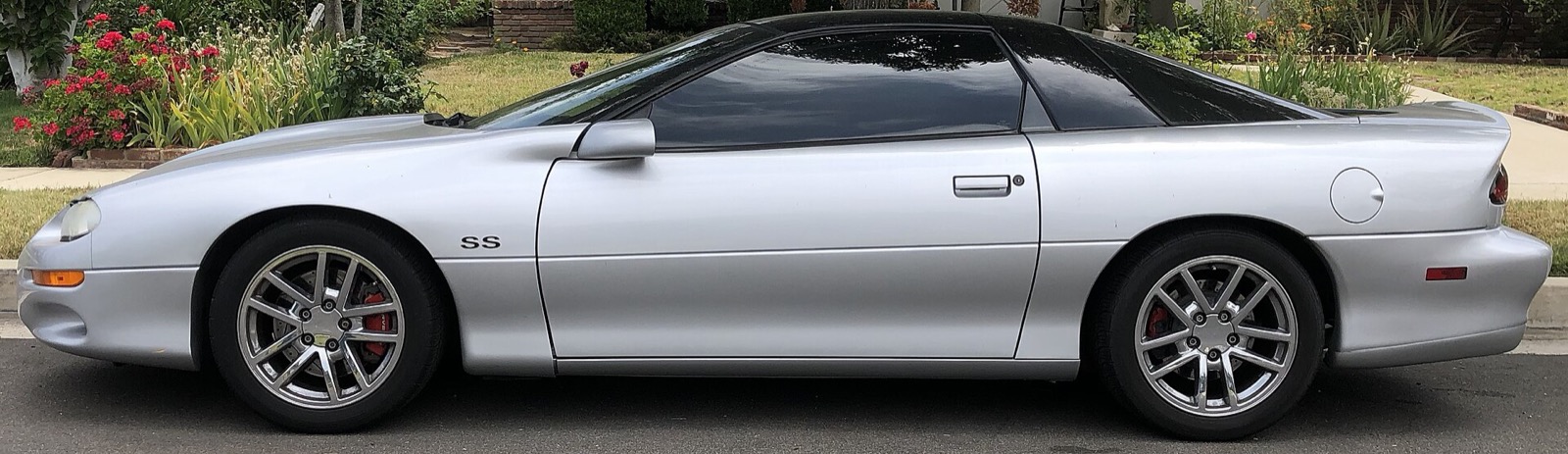
Silver fourth-generation Camaro SS, side profile, driveway setting
1998–2002 Camaro SS Photo: LouieRBLX, CC BY-SA 4.0, via Wikimedia Commons Original photograph License
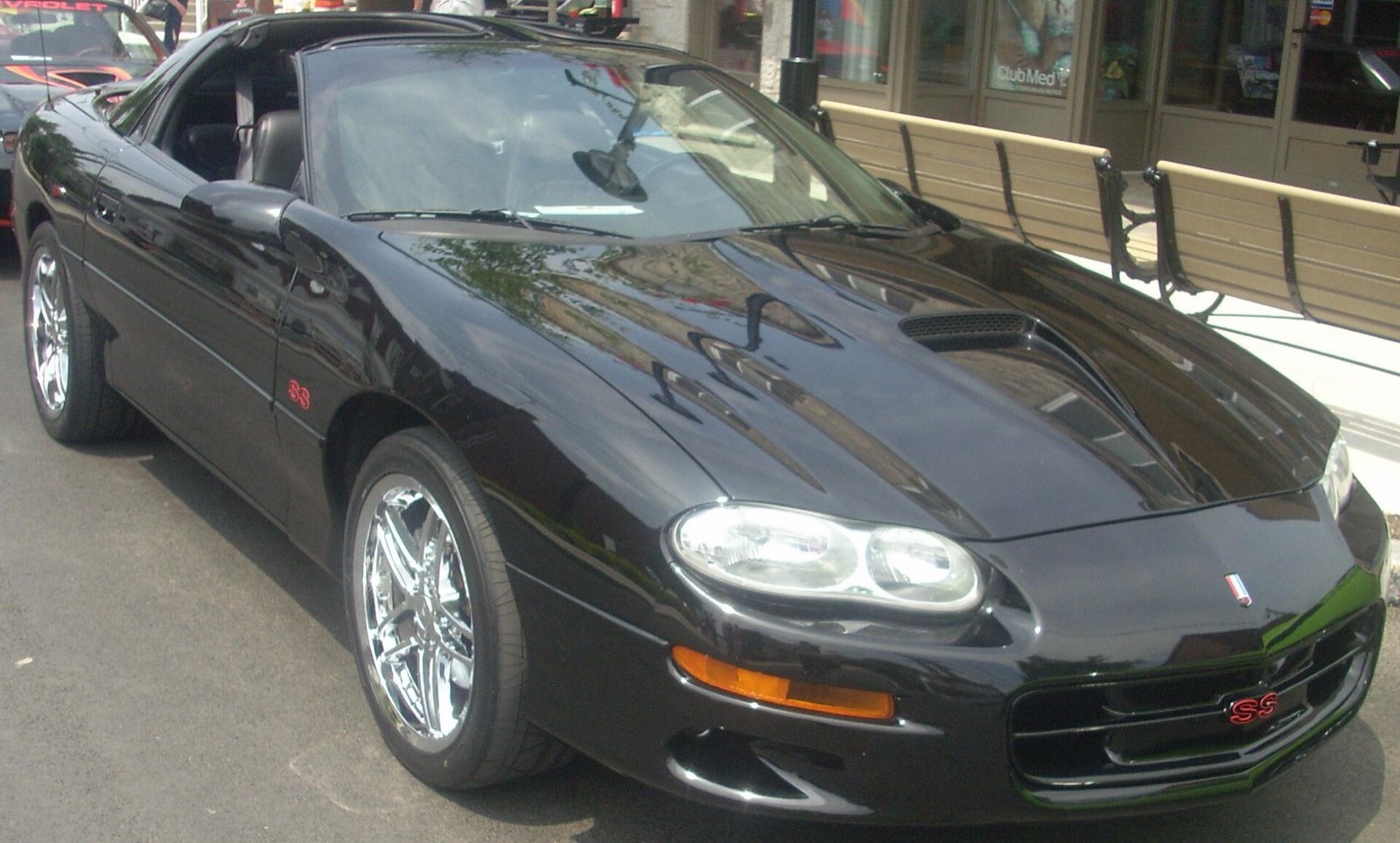
Black 2001 Camaro SS with the SS ram-air hood, front three-quarter
2001 Camaro SS Public domain (Bull-Doser), via Wikimedia Commons Original photograph
Black 1999 Camaro SS convertible
1999 Camaro SS convertible Photo: Pokemonprime, CC BY 4.0, via Wikimedia Commons Original photograph License
Silver 2002 Camaro SS coupe
2002 Camaro SS Photo: MercurySable99, CC BY-SA 4.0, via Wikimedia Commons Original photograph License
Arctic White 1997 Camaro SS 30th Anniversary convertible with Hugger Orange stripes, front three-quarter
1997 Camaro SS 30th Anniversary Edition convertible Photo: MercurySable99, CC BY-SA 4.0, via Wikimedia Commons Original photograph License

Did you know

  • Chevrolet's own kits treated the SLP SS as an order-guide item: the 1998 press kit lists an 'SS Performance/Appearance Package' with 'late availability' under RPO WU8, and for 2001 GM describes it on Z28 coupes and convertibles at 325 hp against the Z28's 310, with a forced-air composite hood, a unique rear spoiler and 17-inch wheels.
  • SLP's first complete vehicle was the 1992 Firehawk: SLP planned 250, took 27 orders and built 25, at roughly $40,000 to $50,000, and Pontiac couldn't officially sanction it, so dealers offered it as a dealer option. SVE's own history puts SLP's first emissions-legal Camaro/Firebird package in 1988, with a 50-hp gain; it was a SEMA Best New Product nominee in 1989.
  • SLP's own history says it turned out more than 55,000 specialty vehicles for GM and its Chevy and Pontiac dealers in seven years from a 140,000-square-foot Montreal assembly plant, and that GM ending Camaro and Firebird production in August 2002 ended the SS and Firehawk programs and closed the Montreal facility. That is the company's claim, not an audited count.
  • The LT4 30th Anniversary SS carries RPO R7T. One count puts SLP's LT4 conversions at 108: 100 for the U.S., six for Canada and two prototypes, and prices the LT4 SS at about $40,000, the most expensive factory-built Camaro of its time.
Sources for these details