VIN decoder
Break a Camaro VIN into its year, plant, body, engine and sequence. Classic 13-character (1967–1980) and modern 17-character (1981+) formats. Nothing is uploaded; decoding runs entirely on your device.
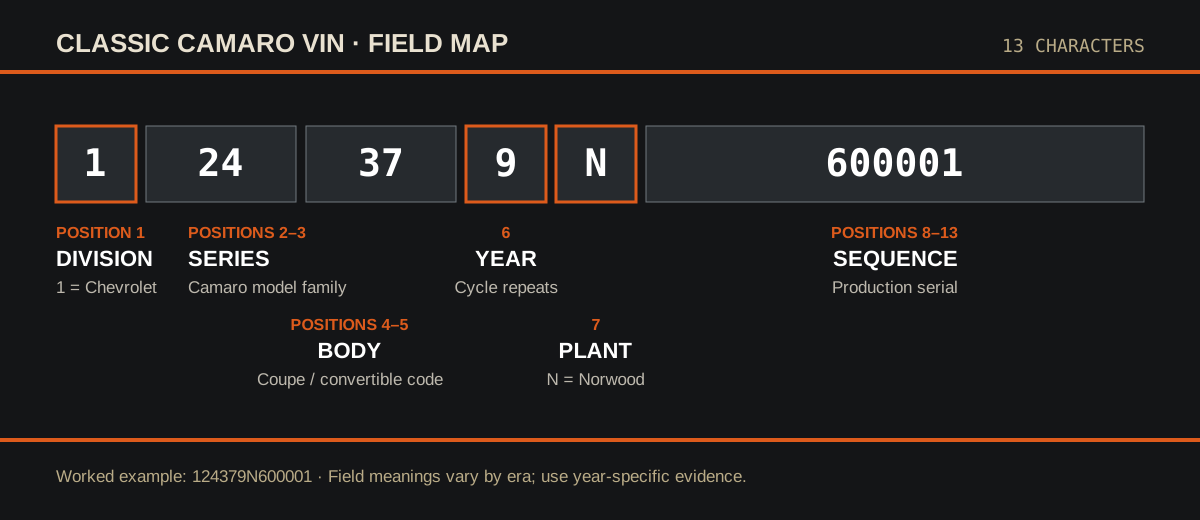
13 characters for a 1967–1980 car, 17 for 1981 and later. Try the samples below.
The samples are illustrative, not real cars: each is a valid, internally consistent combination built to show a format, not a VIN copied from a vehicle.
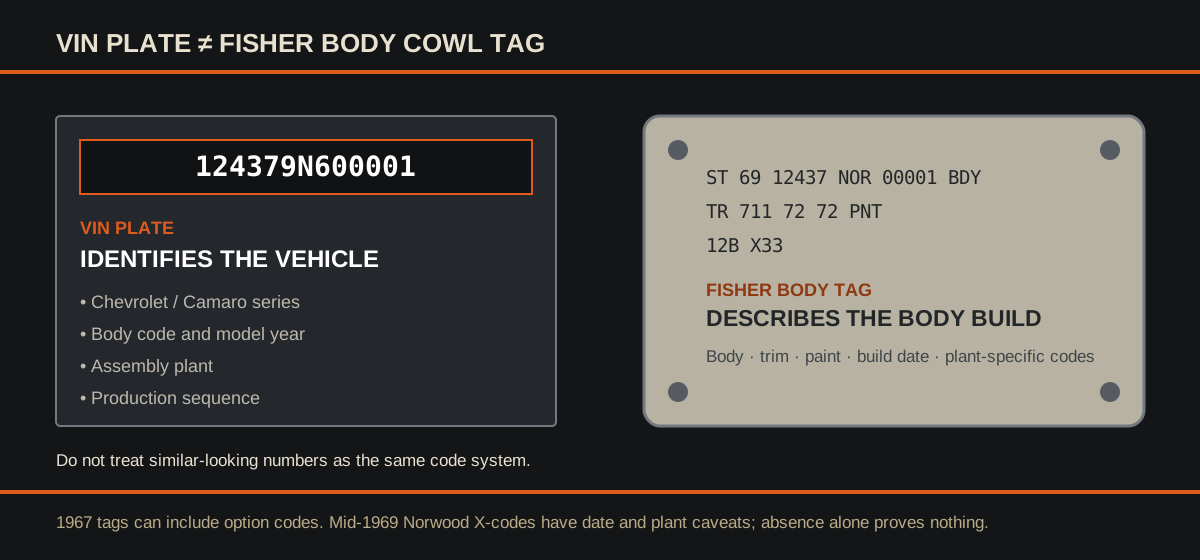
Have the cowl tag too? The VIN identifies the vehicle; the Fisher Body cowl tag records how the body was built: paint, trim, build date, and on mid-1969 Norwood cars the X-code. Checking one against the other is the whole point. Decode the cowl tag
This is a decode, not a certificate. A rule-based VIN decode is an evidence-guided interpretation. Never treat it as “authenticated,” “certified,” or proof of “matching numbers.” Modern year codes repeat on a 30-year cycle, so a 17-character result may be shown with more than one possible model year. For a factory record, use GM Heritage or a documented registry.
What a VIN can establish
- Engine codes are model-year specific and US-market. Californian and high-altitude equipment differed, and a code reused across years does not mean the same engine — 'L' is a 255 hp 350 in 1972 and a 170 hp 350 in 1979.
- Horsepower from 1972 onward is SAE net, not the gross figures quoted for 1971 and earlier. The two are not comparable.
- The VIN engine code records what the factory installed. It is not evidence that the engine now in the car is that engine — corroborate with the pad stamping and casting number.
- The Z28 and SS were option packages, not series codes. A 1972–1980 VIN cannot establish either; the engine code is supporting evidence, not proof.
- The 17-character layout changed inside the third generation. On 1981–1986 cars position 4 is the restraint code and position 5 the model; on 1987–1992 cars positions 4–5 are the carline, position 6 the roof and position 7 the restraint. Reading one against the other misidentifies the car.
- Model-year letters repeat on a 30-year cycle, so position 10 alone is ambiguous. The assembly plant resolves it where the plant is known, because no plant built Camaros in both halves of the cycle. Where it does not resolve, both candidate years are shown.
- The Camaro was not produced for 2003–2009, so several year letters are unambiguous for that reason alone.
- Fourth-generation engine letters: GM's 2000–2002 kits print G (LS1) and K (L36) as VIN letters, and GM's kits give each year's engine availability (the 3.4 through 1995, the 3.8 from 1995, the LT1 through 1997, the LS1 from 1998). The letters S (L32) and P (LT1) for 1993–1997 are not printed in any kit, so they rest on enthusiast tables.
- Second-generation body style: every 1972–1980 kit prints 87 (Sport Coupe) as the only Camaro body code, so 87 is the only one the decoder reads.
Read the plates before the claims
Did you know
- GM's 1980 kit prints its VIN example as 1P87KAN500025, and the model-year position (6) holds the letter A. The 1981 kit explains why: 1980 was the first year GM used letters for the model year. A 13-character VIN with a 0 in position 6 therefore reads as 1970, not 1980.
- Each first-generation plant restarted its serial sequence every year at a different number: 100001 for 1967, 300001 for 1968, 500001 for 1969. GM's kits print the 1967 and 1969 starts, and the 1968 kit's White Book page prints an example ending N300001. So a 1968 serial under 300001 sits outside the documented run. The 1970 kit also starts at 500001.
- Besides the plate, a partial VIN is stamped into the sheet metal in two places: on the cowl in front of the passenger side under the vent panel, and on the firewall below the fan-motor opening (or the heater opening on air-conditioned cars). CRG's formats are 7L102030 for 1967 and 18N304050 for 1968-69. Partial VINs on engines and transmissions can be restamped.
- NHTSA's vPIC decoder does resolve the assembly plant on Camaro VINs. Character 11 = 0 returned 'LANSING - GRAND RIVER' for 2016, 2017, 2020 and 2023 patterns ('LANSING' for 2024); 9 returned 'OSHAWA #1 (OSH)'; 2 returned 'STE. THERESE'; N returned 'NORWOOD'. Characters J and 5 returned no plant.
- A clean vPIC decode is not proof that a combination was built. Test VINs with valid check digits decoded with error code 0 for a 2014 ZL1 carline paired with the LS3 engine letter, and for a 2018 ZL1 carline paired with the 3.6 V6 letter. The decoder reads each field on its own, so a clean result only says the characters are self-consistent.
- GM's 2001 table splits positions 6 and 7 of a fourth-generation VIN: position 6 is the body type (2 = two-door hatchback, style 87; 3 = convertible, style 67) and position 7 is a restraint digit (2, or 4 with side inflatables). Position 1 is 2 for Canada and position 11 is 2 for Ste. Therese.
- Model-year characters have their own quirks. NHTSA's decoder rejects 0, I, O, Q, U and Z as 17-character year codes, but digits are fine: Camaros built in 2001 and 2002 carry 1 and 2 in position 10, and GM's 2001 table reads 'Model Year 1 = 2001'.
Sources for these details
- GM Heritage Vehicle Information Kit, 1980 Camaro (PDF p. 5) GM Heritage factory archive
- GM Heritage Vehicle Information Kit, 1981 Camaro (PDF p. 3) GM Heritage factory archive
- GM Heritage Vehicle Information Kit, 1967 Camaro (PDF p. 4) GM Heritage factory archive
- GM Heritage Vehicle Information Kit, 1968 Camaro (PDF p. 129) GM Heritage factory archive
- GM Heritage Vehicle Information Kit, 1969 Camaro (PDF p. 41) GM Heritage factory archive
- GM Heritage Vehicle Information Kit, 1970 Camaro (PDF p. 3) GM Heritage factory archive
- Camaro Research Group, VIN, Cowl Tag, and other Numbers Decoding Club/registry
- NHTSA vPIC decode of a 2017 Camaro-pattern VIN (September 2026) NHTSA
- NHTSA vPIC decode of a 2014 Camaro-pattern VIN (September 2026) NHTSA
- NHTSA vPIC decode of the last Camaro's VIN (September 2026) NHTSA
- NHTSA vPIC decode of a 1985 Camaro-pattern VIN with plant N (September 2026) NHTSA
- NHTSA vPIC decode of a 2020 Camaro-pattern VIN (September 2026) NHTSA
- NHTSA vPIC decode of a 2023 Camaro-pattern VIN (September 2026) NHTSA
- NHTSA vPIC decode of a 2016 Camaro-pattern VIN (September 2026) NHTSA
- NHTSA vPIC decode of a 2024 Camaro-pattern VIN (September 2026) NHTSA
- NHTSA vPIC decode with J in position 11 (September 2026) NHTSA
- NHTSA vPIC decode of a constructed 2014 VIN (September 2026) NHTSA
- NHTSA vPIC decode of a constructed 2018 VIN (September 2026) NHTSA
- GM Heritage Vehicle Information Kit, 2001 Camaro (PDF p. 22) GM Heritage factory archive
- NHTSA vPIC decode of a 13-character VIN (September 2026) NHTSA