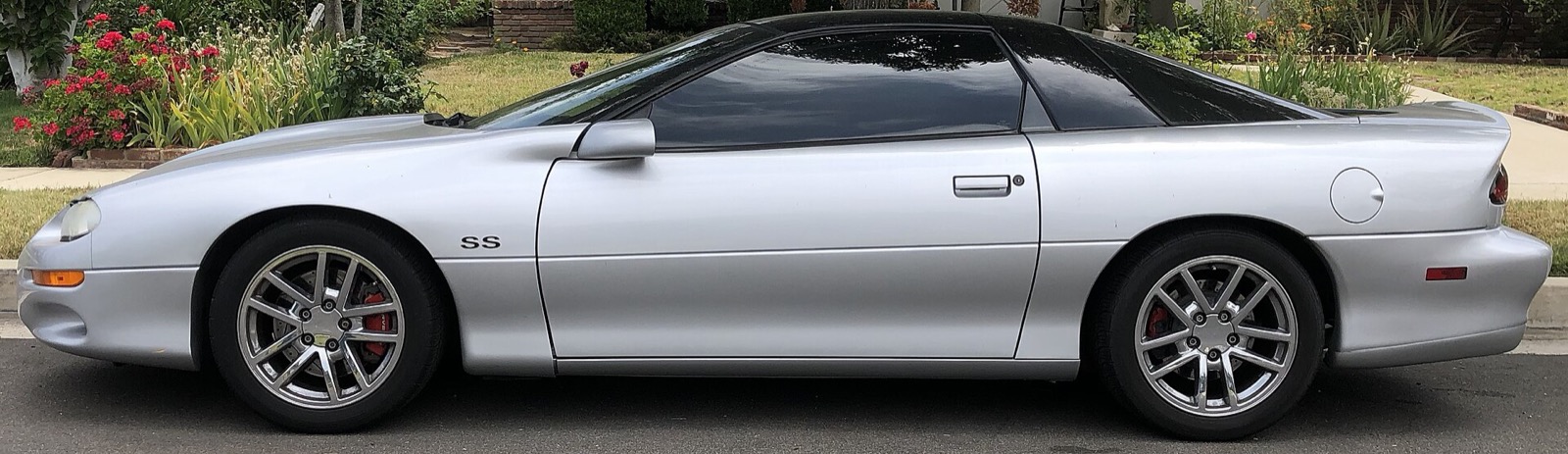
1999 Camaro SS LS1 engine
Photo: Thesazi, CC BY-SA 3.0, via Wikimedia Commons
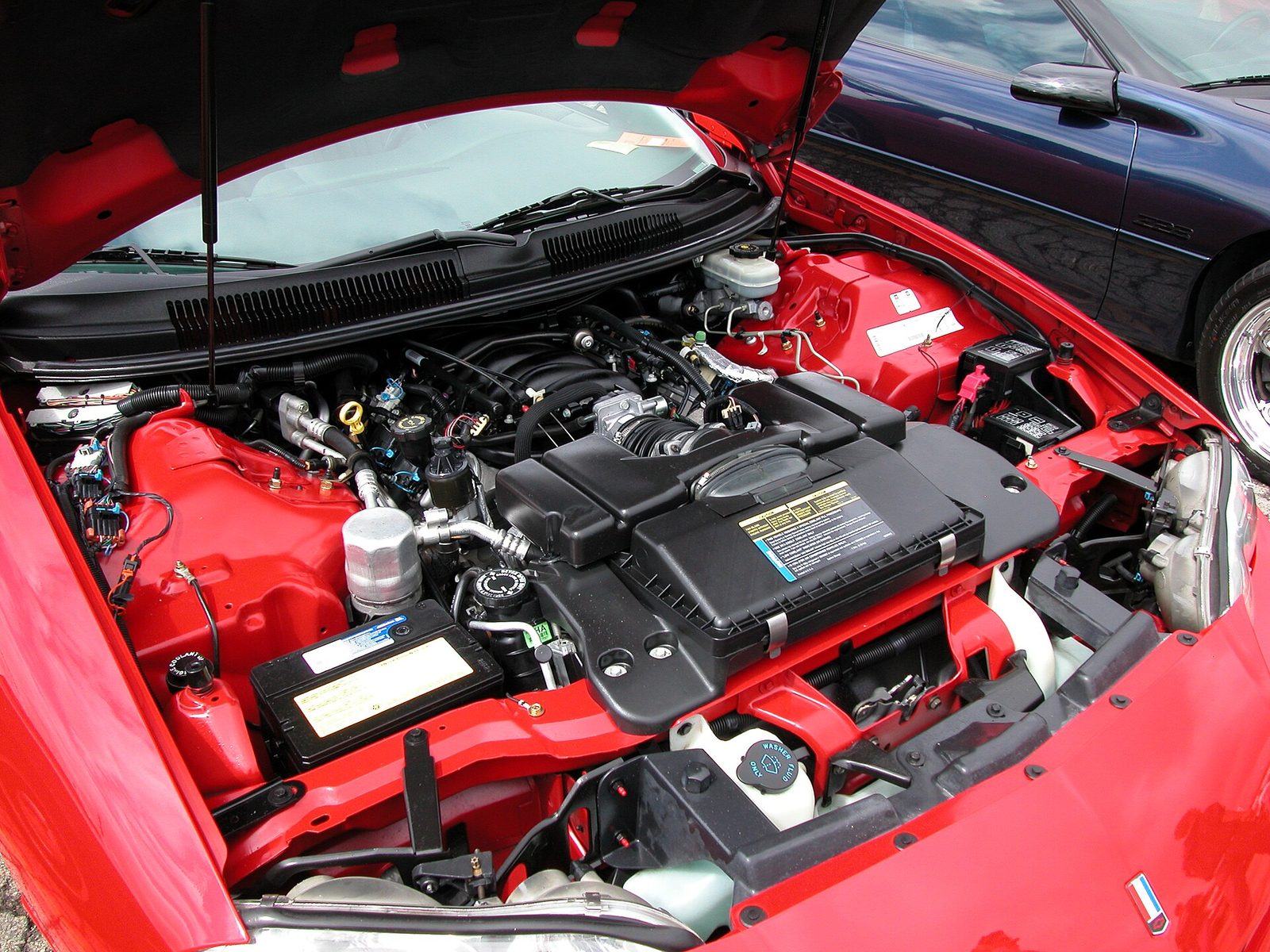
The mid-generation refresh that mattered most. New front sheet metal and composite headlamps reshaped the nose, but the real news was underneath: the all-aluminum LS1 V8, fresh from the C5 Corvette, replaced the cast-iron LT1 in the Z28 and SS. Officially it made 305 hp in the Z28. It is widely regarded as underrated, and it is the reason late fourth-generation cars remain popular tuner and drag platforms.
GM's 1998 engine sheet rated the Corvette's LS1 at 345 hp at 5,600 rpm and 350 lb-ft at 4,400, a 40-horsepower gap over the Camaro's. Only the Camaro's version was listed with exhaust gas recirculation, and both carried 10.1:1 compression and a 6,000-rpm limit.
1998 is the year every Camaro got four-wheel disc brakes. Through 1997 base coupes and convertibles had rear drums, and discs all around came only on the Z28 or in the V6 Performance Handling Package; the 1998 dealer guide lists a “new standard 4-wheel disc brake system” with electronic brake-force control.
GM's own model history says the SS “returns to the lineup as a factory option” for 1998, after listing the 1996 SS as an SLP Engineering option. The March 1997 dealer guide called the SS the “hottest Camaro of all,” rated it “late availability,” and promised P275/50ZR-17 tires on 17 x 9 wheels; by 1999 GM lists P275/40ZR-17 Goodyear Eagle F1s. One guide says the price fell to $3,500 and 3,025 buyers took it.
MotorWeek's 1998 comparison of the Camaro Z28 SS and the Mustang Cobra found the Ford quicker to 60 mph, 5.4 seconds to the Camaro's 5.7, while the Camaro closed to within a tenth in the quarter-mile (13.8 at 106 mph to 13.7 at 104) and was about two seconds quicker around the road course.
Production
One production figure is listed for 1998: Total production, 49,218.
Record
Count
Total production
49,218
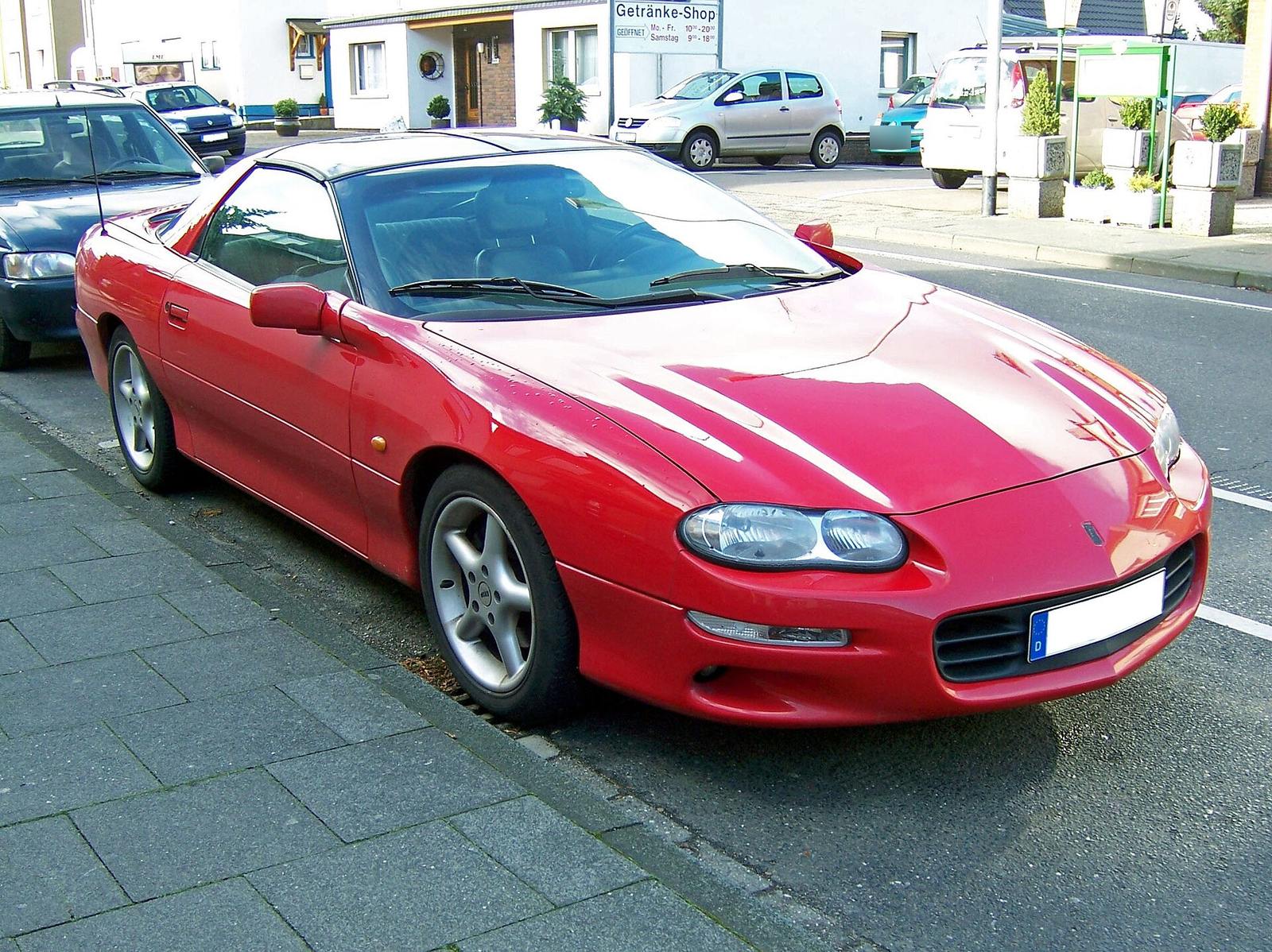
Red 1998 Camaro coupe with T-top roof, front three-quarter view, parked on a town street Photo: Kroelleboelle, CC BY-SA 3.0, via Wikimedia Commons; licence plates blurred
Original photographLicense
Engines
The 1998 table lists three engines: the 3.8 L V6 (L36) and two versions of the 5.7 L LS1 V8. The highest power rating shown is 305 hp, for the 5.7 L LS1 V8.
1998 engine ratings Published horsepower for the engine choices shown. Separately recorded ratings keep their qualifiers. Missing or unrecognized ratings are omitted, rather than plotted as zero. See the engine tables for transmission and equipment restrictions.
Standard; F-car rating, not the higher C/G/H-car L36 rating
G
5.7 L LS1 V8
305 hp at 5,200 rpm
335 lb-ft at 4,000 rpm
Z28; aluminum block and heads, cast-iron cylinder liners
G
5.7 L LS1 V8
—
—
SS (SLP); separate rating not established by the F-car release
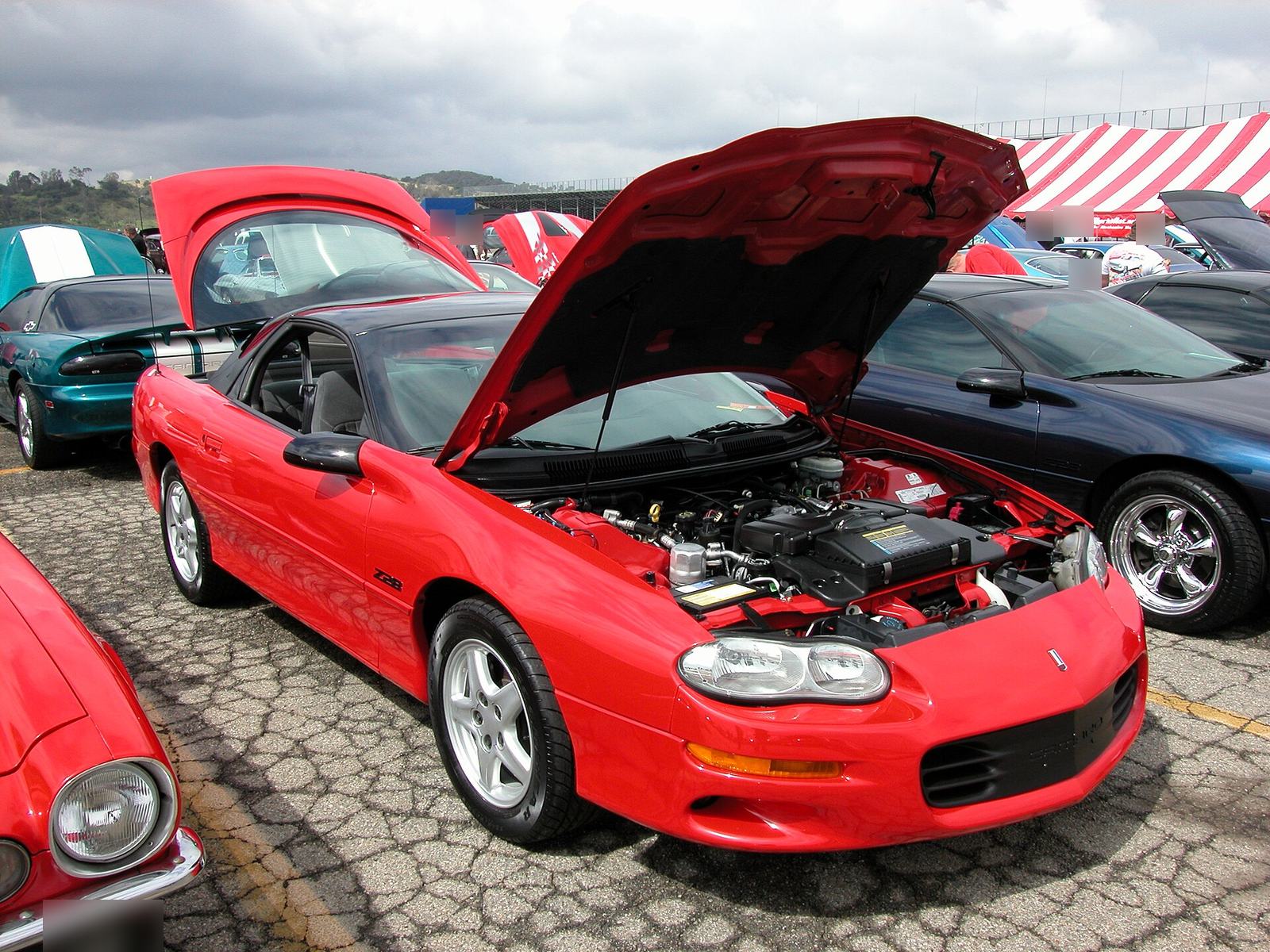
Engine bay of a red 1998 Camaro showing the LS1 V8, hood open, at a car show Photo: Rich Niewiroski Jr., CC BY 2.5, via Wikimedia Commons
Original photographLicense
Options, packages and special editions
The 1998 list has eight options, packages and special editions. Of these, 1 shows a price.
Code
Description
Price
Note
Y3F
Sport Appearance Package
—
Coupe and convertible
—
RS Appearance Package
—
Coupe and convertible
—
SS Performance/Appearance Package — composite hood with functional scoop, P275/40ZR17 tires on 17 x 9 wheels, SS spoiler
—
Z28 coupe and convertible; late availability; built by SLP
—
Leather seating surfaces
$499.00
—
Performance Handling Package (Y87)
—
V6 models; includes limited-slip axle
—
16-inch chrome aluminum wheels
—
Optional all models
—
Remote 12-disc CD changer
—
—
Remote keyless entry with theft alarm
—
Exterior colors
This table has 10 exterior colors for 1998, each with its paint code. They include Black, Navy Blue Metallic and Sport Gold Metallic.
Code
Color
Note
41U
Black
28U
Navy Blue Metallic
63U
Sport Gold Metallic
31U
Bright Green Metallic
88U
Bright Purple Metallic
81U
Bright Red
96U
Cayenne Red Metallic
13U
Sebring Silver Metallic
79U
Mystic Teal Metallic
Not with Y3F Sport Appearance
10U
Arctic White
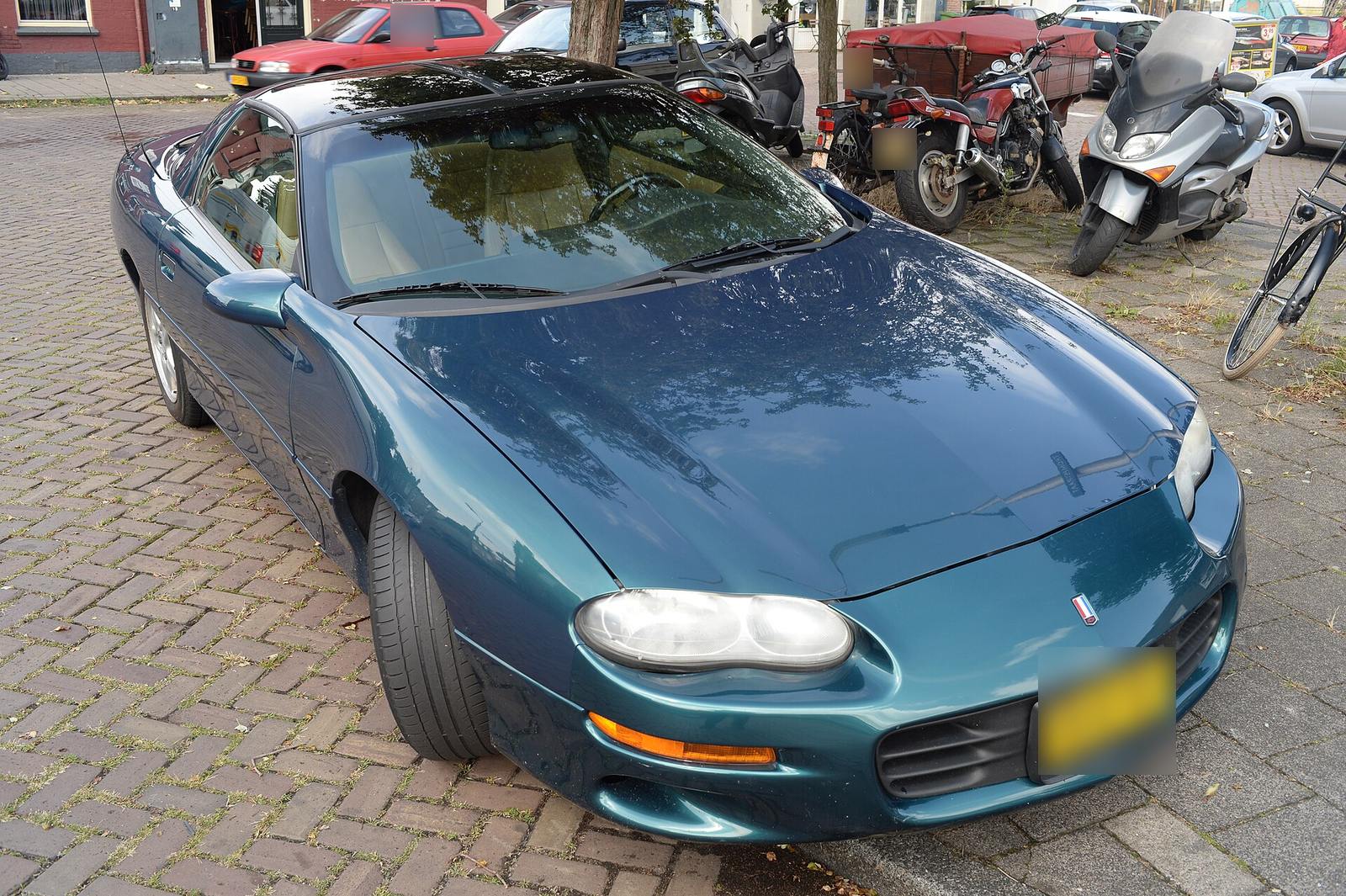
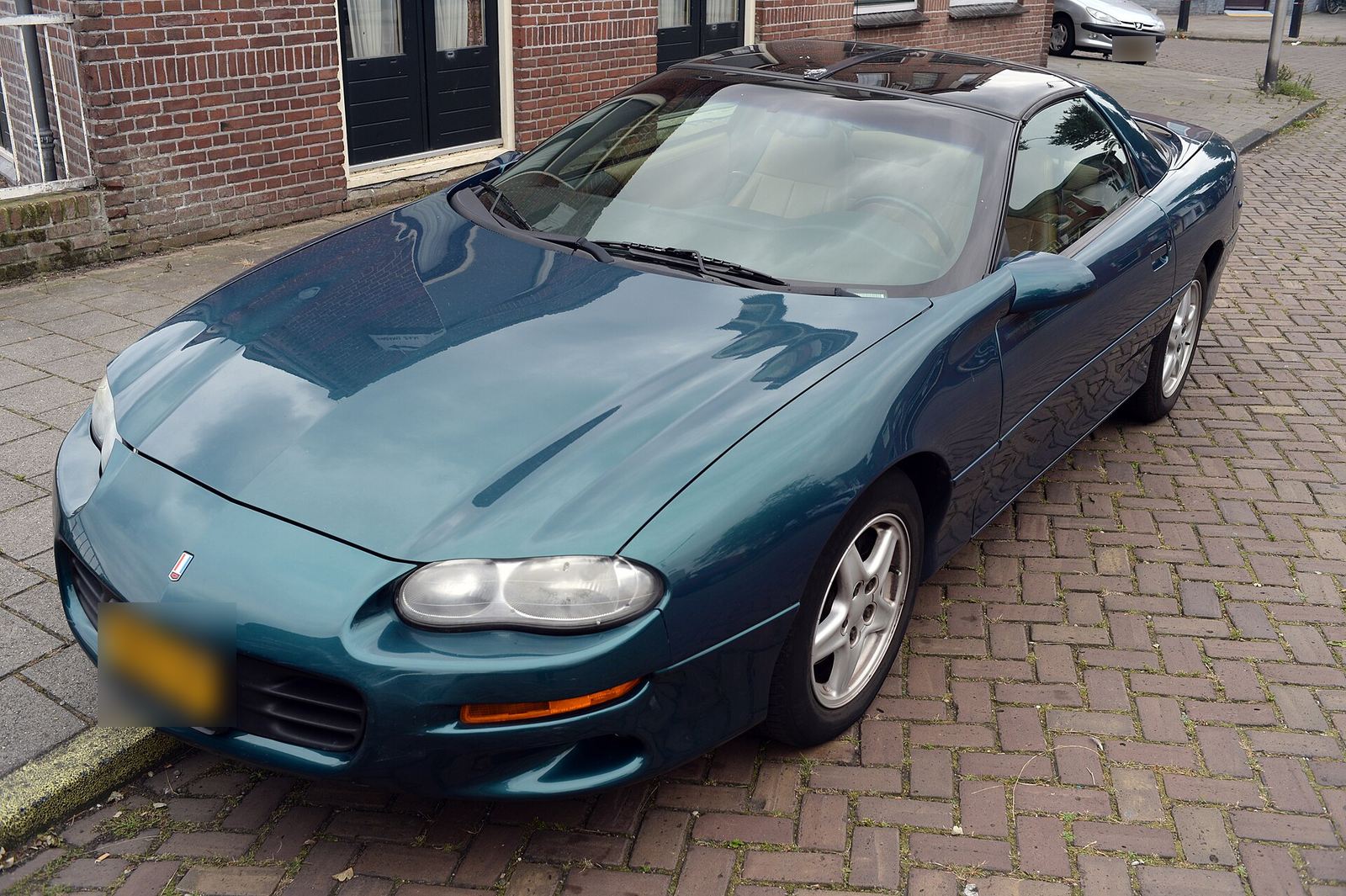
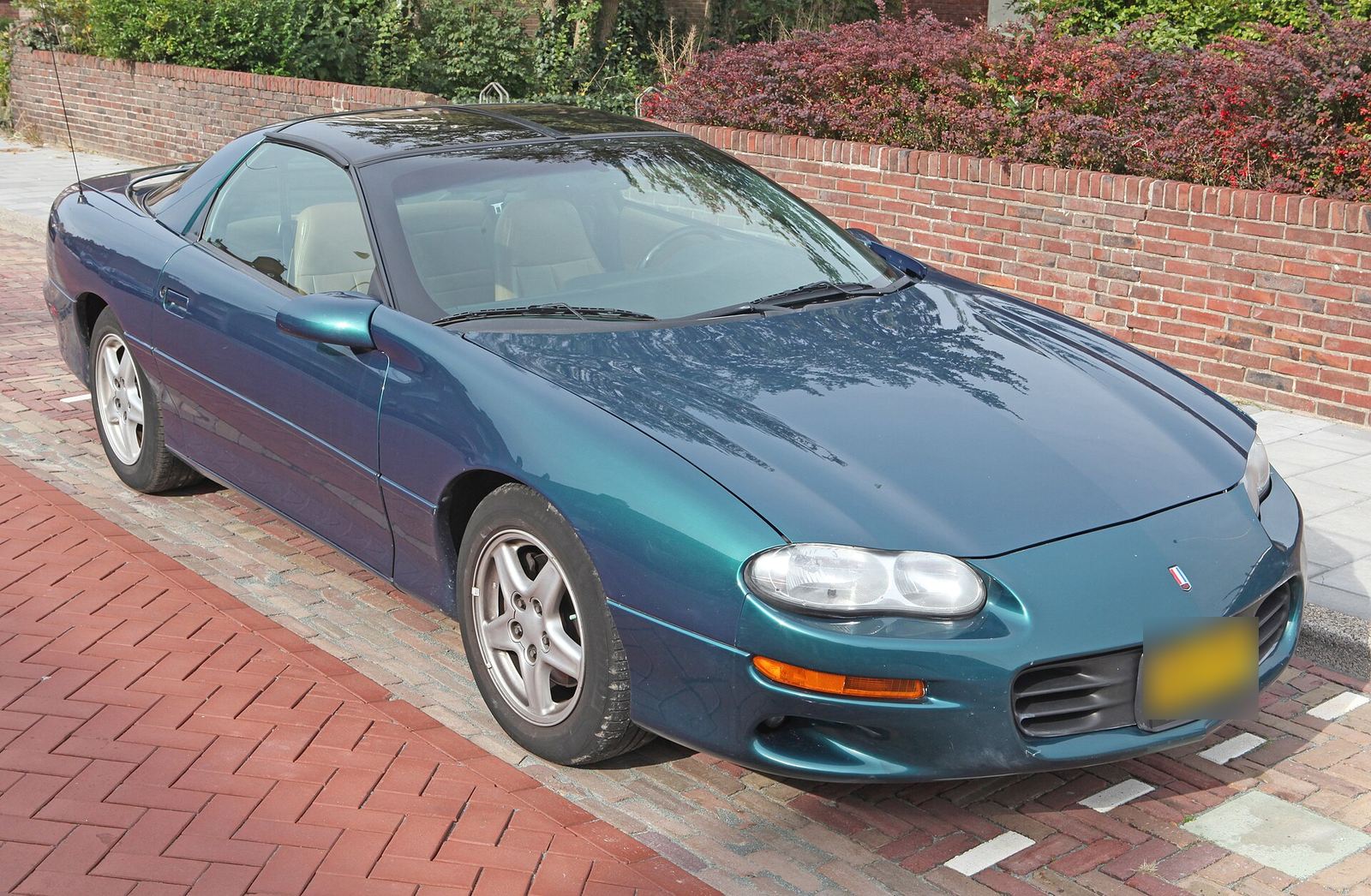
Teal 1998 Camaro coupe with T-top roof, front three-quarter view from the driver side, parked on a brick street beside motorcycles Photo: free photos & art, CC BY 2.0, via Wikimedia Commons; licence plates and faces blurred
Original photographLicense
Interior trim
This table has six interior trims for 1998, each with its trim code.
The six separate material/color codes follow the 1998 Chevrolet order guide, revised September 2, 1997. Cloth buckets and leather seating surfaces have different codes; the leather label does not describe every interior surface. Red Accent is limited to door trim and seat inserts. These are dated ordering-chart entries, not a physical-tag crosswalk or authentication of an individual car. Convertible top colors are separate codes, and the complete top/paint/interior matrix is not reproduced here.
Code
Trim
Note
14B
Dark Gray cloth bucket
142
Dark Gray leather seating surface bucket
The Z28 coupe chart excludes leather with the 1SF package.
52B
Neutral cloth bucket
522
Neutral leather seating surface bucket
The Z28 coupe chart excludes leather with the 1SF package.
73B
Red Accent cloth bucket
Red door trim and seat inserts only, with Dark Gray accents; charted with Black, Bright Red, Sebring Silver Metallic or Arctic White.
102
White leather seating surface bucket
The Z28 coupe chart excludes leather with the 1SF package.
Specifications
This table gives four specifications for 1998, among them wheelbase (101.1 in) and overall length (193.5 in).
Item
Value
Wheelbase
101.1 in
Overall length
193.5 in
Overall width
74.1 in
Standard tires
P215/60R16 (coupe), P235/55R16 (Z28); P245/50ZR16 optional on Z28; P275/40ZR17 with SS
Teal 1998 Camaro coupe with T-top roof, front three-quarter view from the passenger side, parked on a brick street Photo: free photos & art, CC BY 2.0, via Wikimedia Commons; licence plates blurred
Original photographLicense
Identification
What to check on a 1998 Camaro: VIN and year cues.
Item
What to look for
Note
VIN
2G1 … body 22 coupe / 32 convertible, position 8 engine code, position 10 = W, position 11 = 2
The dividing line of the fourth generation: LT1 cars before it, LS1 cars from here to the end.
LT1 car or LS1 car
The LS1 was a Gen III small block, the same all-aluminum architecture as the brand-new C5 Corvette's, and like the LT1 before it, it came straight from the contemporary Corvette, one more case of the long Camaro and Corvette engine-sharing pattern. It defines the 1998–2002 cars, and a "fourth-gen Camaro" means something quite different depending on whether it's a pre-'98 LT1 or a '98-up LS1.
The gearbox flipped too. Through 1997 the six-speed was the Z28's base gearbox and the automatic the option (a $750 one in 1994); the 1998 dealer guide makes the four-speed automatic standard and the six-speed optional, and the 1999 press kit calls the six-speed a “no-cost option.” The fourth generation has the full engine ladder and the 2001–02 SS output tiers.
Dark teal 1998 Camaro coupe with T-top roof, front three-quarter view, parked on a brick street Photo: free photos & art, CC BY 2.0, via Wikimedia Commons; licence plates blurred
Original photographLicense
1998 Z28: automatic standard, six-speed optional
The March 1997 product sheet for model year 1998 marks the four-speed automatic standard and the six-speed manual optional on both Z28 body styles. The base V6 has its own standard five-speed manual and optional automatic. Optional status alone does not establish price. Original CamaroFacts diagram. Chevrolet 1998 product sheet, March 1997, feature matrix.
What the LS1 changed
GM Powertrain's release put numbers on the swap. In Camaro form the LS1 made 305 hp at 5,200 rpm and 335 lb-ft at 4,000 rpm, 20 hp and 10 lb-ft more than the LT1. Fully dressed, it weighed about 10 percent less. LS1 product manager John Juriga summed it up: "lighter, more powerful and quieter than its predecessor." Like the Corvette engine, it had a deep-skirt aluminum block with six-bolt, cross-bolted main caps, cast-iron cylinder liners, powdered-metal rods, a hollow camshaft, roller rocker arms and cylinder-head ports machined identically for even airflow. The Camaro and Firebird version needed its own accessory drive, air induction and air-gap exhaust manifolds to fit the car. A "demand fuel" system kept hot fuel from returning to the tank, which cut vapor enough for the 1998 cars to meet the 1999 federal emissions standards a year early. The engines were built at GM Powertrain's Romulus, Michigan, plant.
Inside the LS1’s aluminum-block description
The aluminum block still uses cast-iron cylinder liners. Six bolts secure each main-bearing cap, including cross-bolts into the deep skirt. This is a materials summary, not a dimensioned service drawing. Original CamaroFacts diagram. GM Powertrain — 1998 F-car LS1 features.
Chevrolet made the Z28 coupe and convertible its feature vehicles for advertising, with four-wheel anti-lock disc brakes, 16-inch aluminum wheels and P235/55R16 tires. Dealers were told to stock base coupes with the 1SB group of cruise control, remote hatch release and fog lamps. Bright Red, Black and Arctic White were expected to be the most popular colors.
Red 1998 Camaro Z28 coupe with hood and hatch open, front three-quarter view, at an outdoor car show Photo: Rich Niewiroski Jr., CC BY 2.5, via Wikimedia Commons; licence plates and faces blurred
Original photographLicense
1998 standard tire sizes follow the series
The same feature matrix lists P215/60R16 for base coupes and convertibles and P235/55R16 for Z28 coupes and convertibles. Optional tires and the separate SS package are not represented as standard equipment here. These are period specifications, not present-day tire recommendations. Original CamaroFacts diagram. Chevrolet 1998 product sheet, March 1997, feature matrix.