1999 Camaro SS convertible
Photo: Pokemonprime, CC BY 4.0, via Wikimedia Commons
A carryover year in the LS1 era. The 1998 body and engines continued, with the 3.8-liter V6 at 200 hp and the LS1 at 305 hp in the Z28, and the changes were limited to equipment, colors and options.
Most sources give production as 42,098; one gives 46,105, and the gap may reflect US-only versus total counting. Either way 1999 fell short of 1998's 49,218, and the generation's low came in 2001.
1999 Camaro SS LS1 engine Photo: Thesazi, CC BY-SA 3.0, via Wikimedia Commons
Original photographLicense
The 1998-up composite-lamp nose identifies the late fourth-generation family rather than 1999 alone; the tenth VIN character (X) identifies the year.
Did you know
Before painting, Ste-Thérèse cleaned each Camaro body with ostrich feathers to remove dust. Chevrolet's 1999 press kit says designers tried a number of synthetic and organic materials and found feathers best for leaving a smooth, clean surface.
The 1999 Z28's six-speed had a 2.66:1 first gear, a 0.74 fifth and a 0.50 sixth behind a 3.42 axle. Its “skip shift” system steered the lever from first straight to fourth under light acceleration from a stop, and a dash lamp lit whenever it was doing so. GM's press kit lists the automatic as the standard Z28 transmission that year, with the six-speed a no-cost option.
Chevrolet described the 1LE package as “engineered specifically for professional racing,” with Koni double-adjustable shocks front and rear, a 32 mm front stabilizer bar, higher-rate front control-arm bushings and springs, stiffer rear springs and transmission mount, and stiffer Panhard-bar bushings. One production guide counts 74 Z28s with the 1LE for 1999, plus eight SS cars.
GM's 1999 press kit lists ten Camaro colors, while the 2000 kit's chart of eight drops Hugger Orange, Bright Blue, Sport Gold and Bright Green.
Chevrolet's 1999 press kit lists “Next Generation” air bags that inflate with reduced speed and force, plus a laser-etched VIN plate it says makes forgery harder than with stamped plates.
Production
One production figure is listed for 1999: Total production, 42,098.
Record
Count
Note
Total production
42,098
One source gives 46,105
Engines
The 1999 table lists three engines: the 3.8 L V6 (L36) and two versions of the 5.7 L LS1 V8. The highest power rating shown is 320 hp, for the 5.7 L LS1 V8.
Code
Engine
Power
Torque
Note
K
3.8 L V6 (L36)
200 hp at 5,200 rpm
225 lb-ft at 4,000 rpm
Standard
G
5.7 L LS1 V8
305 hp at 5,200 rpm
335 lb-ft at 4,000 rpm
Z28; 10.1:1
G
5.7 L LS1 V8
320 hp at 5,200 rpm
—
SS (WU8, SLP); factory specification table separates SS horsepower but does not separately label SS torque
Options, packages and special editions
The 1999 list has five options, packages and special editions.
Code
Description
Note
WU8
SS Performance/Appearance Package
Z28; built by SLP
Y3F
Sport Appearance Package
Y87
Performance Handling Package
V6 coupe; 14.4:1 steering
1SD
Z28 Preferred Equipment Group
Leather not available with 1SD
—
Leather seating surfaces
Exterior colors
This table has 10 exterior colors for 1999, each with its paint code. They include Black, Bright Blue Metallic and Navy Blue Metallic.
Code
Color
Note
41U
Black
Listed with WU8 SS and without WU8 in the April 1, 1998 order guide
20U
Bright Blue Metallic
Not listed with WU8 SS in the April 1, 1998 order guide
28U
Navy Blue Metallic
Listed with WU8 SS and without WU8 in the April 1, 1998 order guide
63U
Sport Gold Metallic
Not listed with WU8 SS in the April 1, 1998 order guide
31U
Bright Green Metallic
Not listed with WU8 SS in the April 1, 1998 order guide
99U
Hugger Orange
Listed with WU8 SS and without WU8 in the April 1, 1998 order guide
11U
Light Pewter Metallic
Listed with WU8 SS and without WU8 in the April 1, 1998 order guide
81U
Bright Red
Listed with WU8 SS and without WU8 in the April 1, 1998 order guide
79U
Mystic Teal Metallic
Not with Y3F Sport Appearance; Not listed with WU8 SS in the April 1, 1998 order guide
10U
Arctic White
Listed with WU8 SS and without WU8 in the April 1, 1998 order guide
Interior trim
This table has six interior trims for 1999, each with its trim code.
The six separate material/color codes follow the 1999 Chevrolet order guide, published April 1, 1998. Cloth buckets and leather seating surfaces have different codes; the leather label does not describe every interior surface. Red Accent is limited to door trim and seat inserts. These are dated ordering-chart entries, not a physical-tag crosswalk or authentication of an individual car. Convertible top colors are separate codes, and the complete top/paint/interior matrix is not reproduced here.
Code
Trim
Note
14B
Dark Gray cloth bucket
142
Dark Gray leather seating surface bucket
The Z28 coupe chart excludes leather with the 1SD package.
52B
Neutral cloth bucket
522
Neutral leather seating surface bucket
The Z28 coupe chart excludes leather with the 1SD package.
73B
Red Accent cloth bucket
Red door trim and seat inserts only, with Dark Gray accents; charted with Black, Light Pewter Metallic, Bright Red or Arctic White.
102
White leather seating surface bucket
The Z28 coupe chart excludes leather with the 1SD package.
Specifications
This table gives 12 specifications for 1999, among them wheelbase (101.1 in) and overall length (193.2 in).
Chevrolet kept improving the car, with traction control on every model and an oil-life monitor, even as sales slid.
Refinements, not a redesign
Chevrolet's press release for 1999 opened by calling the Camaro "the embodiment of its performance heritage" after two years of refinements. Brand manager Dick Almond said the car had "stayed true to its 'pony car' roots." Acceleration Slip Regulation traction control was now offered on every model, including the V6 cars. On the V8 it was calibrated to allow some wheelspin when that helped. V6 cars got electronic throttle control. Every Camaro gained an engine oil-life monitor, which tracked rpm, coolant temperature and driving time, along with check-gauge and hatch-ajar warning lights and a larger 16.8-gallon plastic fuel tank. Limited-slip axles now used a Zexel Torsen differential. The Monsoon sound system, with eight speakers and a 200-watt amplifier, became available on every model. Hugger Orange, Light Pewter Metallic and Bright Blue Metallic were the new colors.
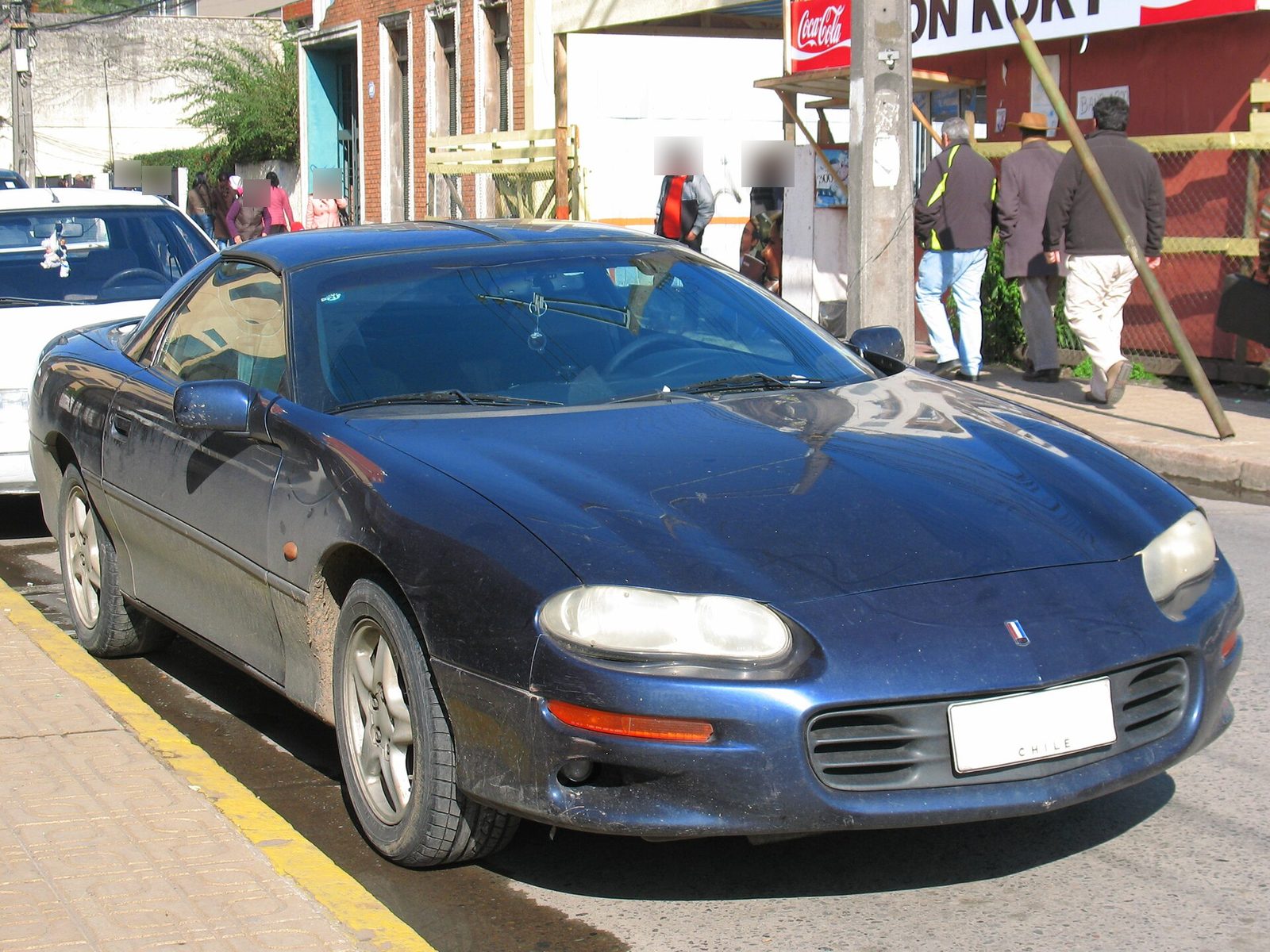
Dark blue 1999 Camaro coupe, front three-quarter view, parked at a kerb on a busy town street with pedestrians Photo: order_242, CC BY-SA 2.0, via Wikimedia Commons; faces blurred
Original photographLicense
The civilian Z28 specification table distinguishes a 3.42 axle with the six-speed from the automatic's standard 2.73. The 3.23 automatic axle was the optional GU5 Performance Axle. The B4C police configuration below uses a separate 3.23 automatic specification.
1999 Z28 axle choices depend on the transmission
Civilian Z28 specifications: the six-speed uses 3.42; the automatic uses 2.73 unless ordered with the optional GU5 3.23 Performance Axle. The B4C police configuration has a separate specification. These are final-drive ratios, not transmission gear ratios. Original CamaroFacts diagram. Chevrolet Camaro specifications, printed p. 20.
Measured against the Mustang
Chevrolet made its case with numbers. The standard 3800 V6 made 200 hp, against 150 hp from the Mustang's base V6, and came within 25 hp of the Mustang GT's V8. The Z28's 5.7-liter LS1, a modified version of the Corvette engine, made 305 hp against the GT's 225. The LS1 had been named one of Ward's best engines of 1998, and Consumers Digest gave the Camaro a Best Buy recommendation.
The SS Performance/Appearance Package returned with more power and torque than the Z28, a forced-air induction hood, new dual 2⅝-inch exhaust outlets, 17-inch five-spoke wheels on Goodyear Eagle F1 tires, a stiffer ride and handling package and its own rear spoiler. A Sport Appearance Package, with a fascia extension, rocker moldings, spoiler extension and 16-inch five-spoke wheels, was offered on every model except the SS.
The police Camaro
The B4C Police Package put a Z28 drivetrain under a plain Camaro body. It had the 305-hp LS1, rated at 335 lb-ft at 4,000 rpm, with either the six-speed manual on a 3.42 limited-slip axle or the automatic on a 3.23. It also had the performance handling suspension, 16-inch aluminum wheels on P245/50ZR16 tires, a power steering oil cooler and a 155-mph speedometer. Its four-wheel disc brakes had 407.6 square inches of swept area. GM's own fuel-economy estimates were 19 city and 28 highway with the six-speed. The package is covered with the rare and significant cars.
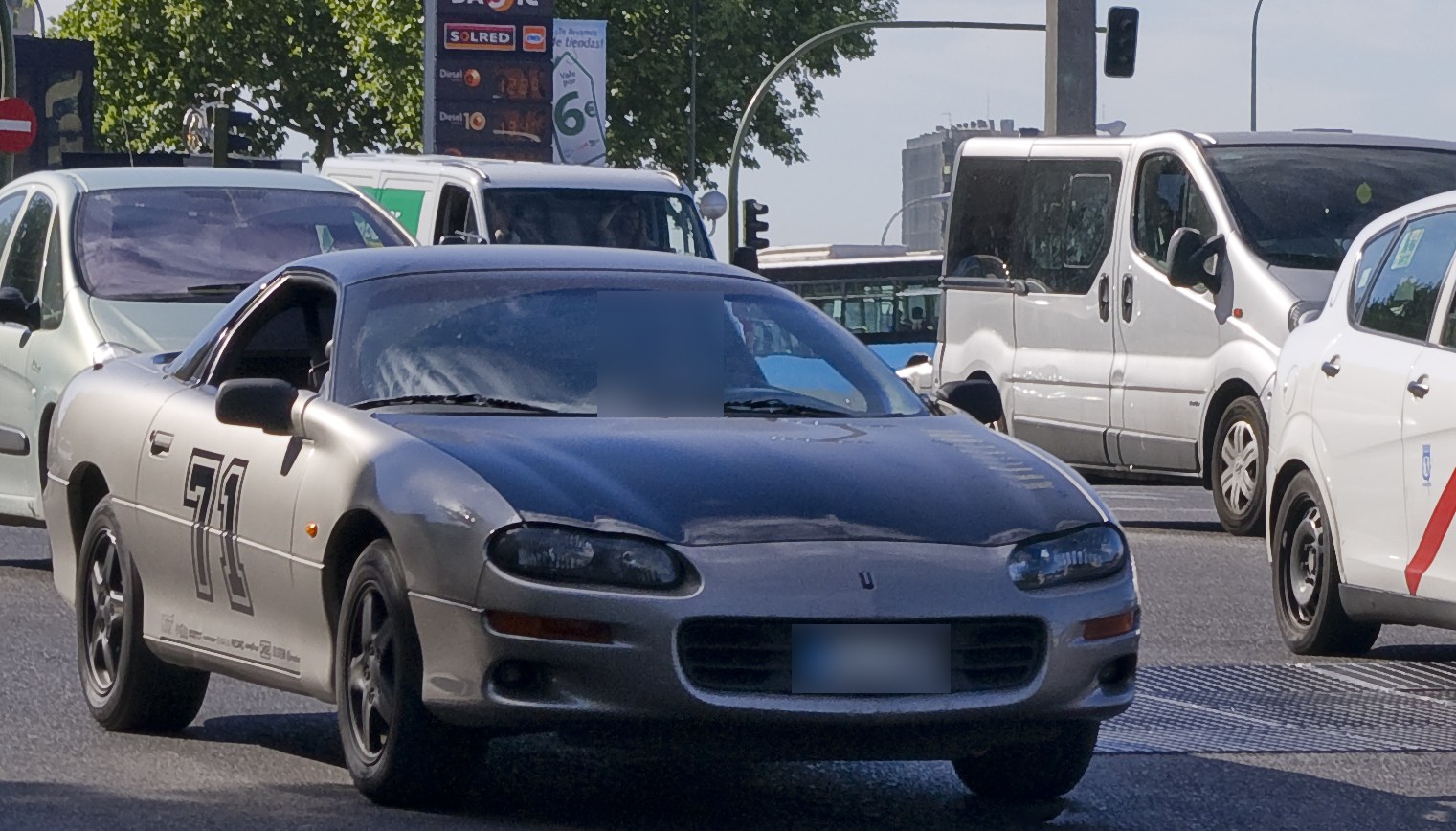
Silver 1999 Camaro coupe with dark hood and '71' door numbers, front three-quarter view, in city street traffic Photo: Spanish Coches, CC BY 2.0, via Wikimedia Commons; licence plates and faces blurred
Original photographLicense
Where and for whom it was built
Every 1999 Camaro came from GM's plant at Ste. Thérèse, Quebec, which had been built in 1965 and completely refitted for the fourth generation in 1993. The roof, doors, hatch and spoiler were sheet-molded composite, glass fiber in polyester resin. The front fenders and fascia were mica-reinforced RIM plastic, and the quarter panels and hood were two-side galvanized steel.
Chevrolet's buyer profile showed three different customers. The typical coupe buyer was 35 with a household income of $55,000, and half the principal drivers were women. The convertible buyer was 46, earned $75,000 and was usually a college graduate. The Z28 buyer was 40 and earned $75,000, and only a quarter of the principal drivers were women. The press kit gave 1997 model-year sales as 58,152.