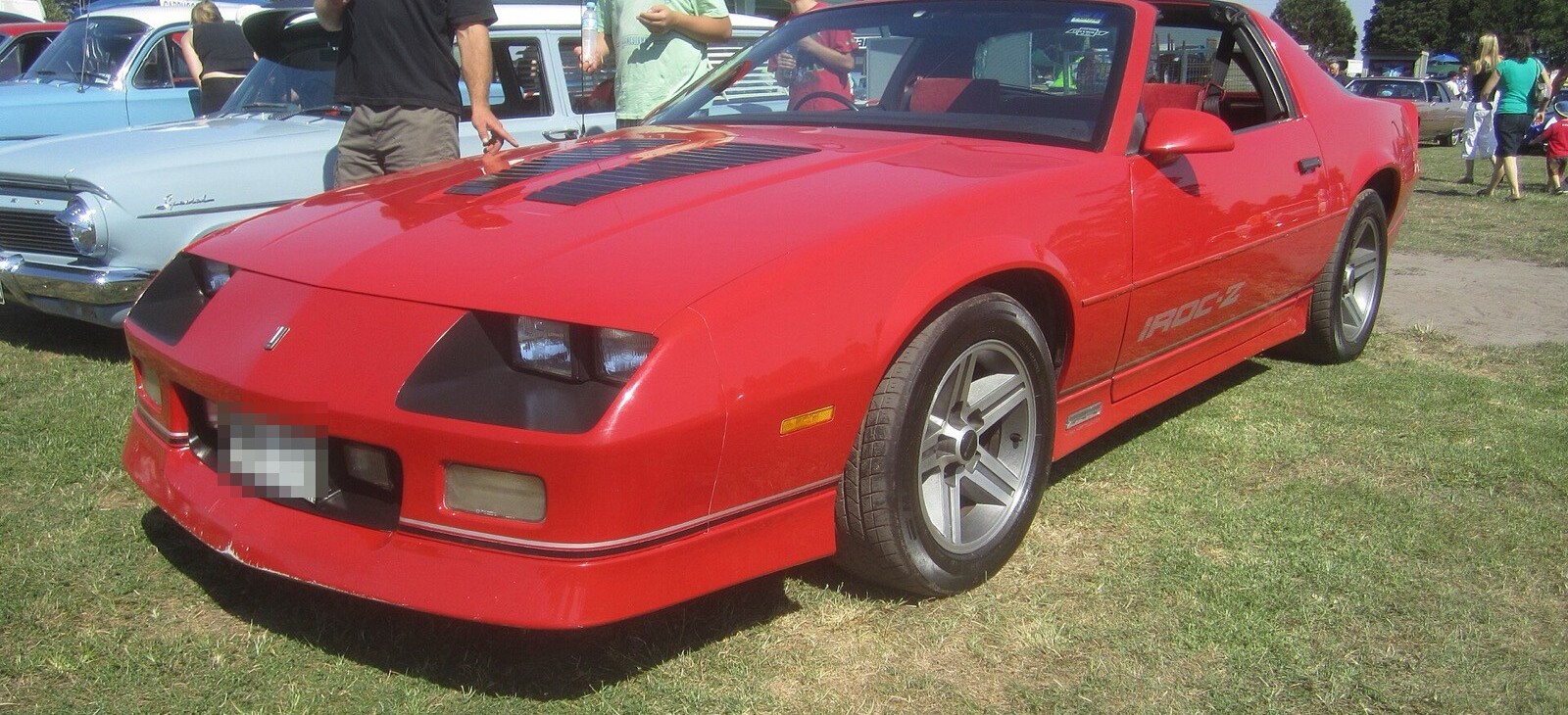
1990 Camaro IROC-Z, the IROC-Z's final year
Photo: Sicnag, CC BY 2.0, via Wikimedia Commons; cropped and license plate pixelated
The 1990 model year was cut short on purpose. The final 1990 Camaro was built on December 31, 1989, and the facelifted 1991 car went into production in February 1990, months ahead of the normal autumn changeover. Only 35,048 cars carried the 1990 model-year code.
Two changes mark the car: a 3.1-liter V6 replaced the 2.8 as the base engine, and a driver's air bag brought a new steering wheel and instrument panel. RS and IROC-Z continued, with the 5.0 and 5.7 TPI V8s at the top.
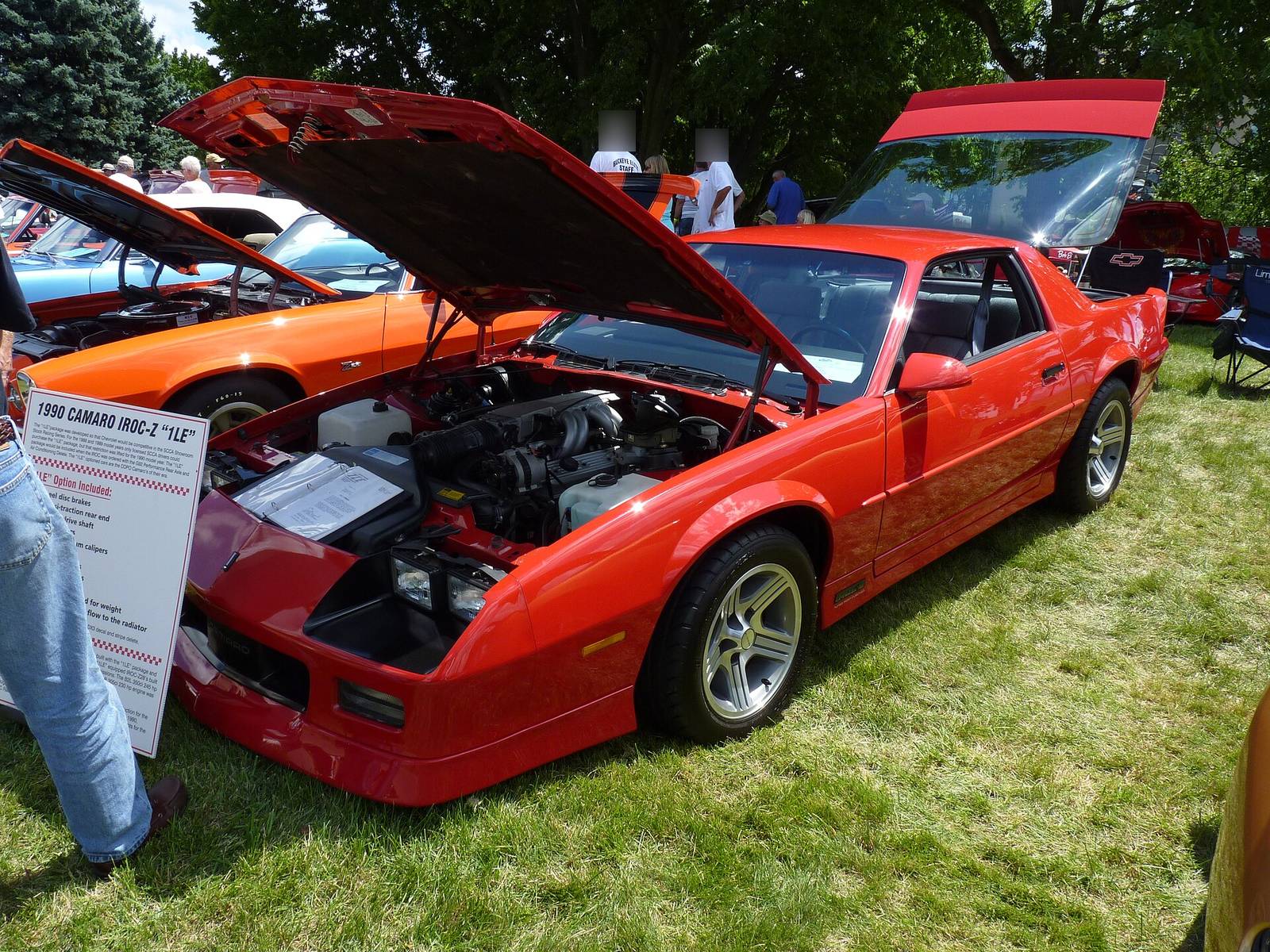
Red 1990 Camaro IROC-Z coupe with hood raised showing the engine, front three-quarter view, on grass at a car show beside a display board Photo: _salguod, CC BY-SA 2.0, via Wikimedia Commons; faces blurred
Original photographLicense
GM's license for the IROC name lapsed as the race series moved to Dodge, so this was the last IROC-Z.
Did you know
The 1990 IROC-Z was sold under the banner of a race series that had already dropped the Camaro: the International Race of Champions switched to identically prepared Dodge Daytonas for 1990, the Daytona's first year in the series, and Dale Earnhardt won the title. The last Camaro season in IROC was 1989.
Chevrolet's 1990 dealer guide told salespeople the new driver's air bag pops out of the steering wheel hub in less than a tenth of a second and then deflates, and it said PASS-Key 'should reduce insurance rates.'
A single NHTSA campaign, 90V-105 in May 1990, covered the front seat-belt buckles on Camaros from 1984 through 1990: the plastic parts had no ultraviolet stabilizer, so sun and heat could weaken them. A month later GM recalled fuel hoses on 1988-89 V6 cars (feed hoses) and 1990 V8 cars (return hoses) that could pull out of, or break at, their crimped couplings.
Only 4,213 IROC-Z coupes and 1,294 IROC-Z convertibles were built in the final year, and the 62 1LE cars split 34 with the 305 Tuned Port and 28 with the 350.
Camaro's shortened model year left it far behind Mustang: 35,048 Camaros to Ford's 115,230 Mustangs, roughly one to three.
Production, model year by model year Model-year totals. The linked year pages retain alternative counts and explain shortened model years; these bars use the totals in their production tables.
One production figure is listed for 1990: Total production, 35,048.
Record
Count
Note
Total production
35,048
Deliberately shortened model year
Engines
The 1990 table lists six engines: the 3.1 L V6 (RPO LH0), the 305 cu in V8, throttle-body fuel injection (RPO LO3), three versions of the 305 cu in V8, tuned-port fuel injection (RPO LB9) and the 350 cu in V8, tuned-port fuel injection (RPO L98). The highest power rating shown is 245 hp, for the 350 cu in V8, tuned-port fuel injection (RPO L98).
Code
Engine
Power
Torque
Note
T
3.1 L V6 (RPO LH0)
140 hp at 4,400 rpm
180 lb-ft at 3,600 rpm
RS Coupe; MVMA power-team sheet gives 191 cu in; GM's code tables give 189
E
305 cu in V8, throttle-body fuel injection (RPO LO3)
170 hp at 4,000 rpm
255 lb-ft at 2,400 rpm
RS Convertible standard; RS Coupe optional
F
305 cu in V8, tuned-port fuel injection (RPO LB9)
210 hp at 4,400 rpm
285 lb-ft at 3,200 rpm
M39 five-speed manual, single exhaust; IROC-Z coupe or convertible
F
305 cu in V8, tuned-port fuel injection (RPO LB9)
210 hp at 4,400 rpm
285 lb-ft at 3,200 rpm
MD8 four-speed automatic, single exhaust; IROC-Z coupe or convertible
F
305 cu in V8, tuned-port fuel injection (RPO LB9)
230 hp at 4,400 rpm
300 lb-ft at 3,200 rpm
MK6 five-speed manual, dual exhaust; IROC-Z Coupe only
8
350 cu in V8, tuned-port fuel injection (RPO L98)
245 hp at 4,400 rpm
345 lb-ft at 3,200 rpm
MD8 four-speed automatic, dual exhaust; IROC-Z Coupe only
Options, packages and special editions
The 1990 list has 12 options, packages and special editions. Of these, 9 show a price and 1 shows how many were built.
Code
Description
Price
Built
Note
1FP87
RS Coupe, 6-cylinder
$10,995.00
—
MSRP
1FP67
RS convertible, 8-cylinder
$16,880.00
—
MSRP
1FP87 Z28
IROC-Z Coupe
$14,555.00
—
MSRP
1FP67 Z28
IROC-Z convertible
$20,195.00
—
MSRP
—
RS Coupe Preferred Equipment Group 1 — air conditioning, stereo cassette, power locks, speed control, body side moldings, mats
$1,410.00
—
—
RS Coupe Preferred Equipment Group 2 — Group 1 plus power windows, power hatch release, cargo cover, mirror with reading lamps
$1,782.00
—
—
IROC-Z Preferred Equipment Group 1 — air conditioning, body side moldings
This table has seven exterior colors for 1990, each with its paint code. They include Black, Bright Blue Metallic and Light Blue Metallic.
Code
Color
Note
41
Black
Listed for RS and IROC-Z coupe/convertible; the matrices list Black, Gray or Red interior, not Light Brown.
98
Bright Blue Metallic
Listed for RS and IROC-Z coupe/convertible; the matrices list Black or Gray interior.
23
Light Blue Metallic
Listed for RS coupe/convertible, not in the IROC-Z paint charts. The RS matrix lists Black or Gray interior.
87
Medium Gray Metallic
Listed for RS coupe/convertible, not in the IROC-Z paint charts. The RS matrix lists Black, Gray or Red interior.
81
Bright Red
Listed for RS and IROC-Z coupe/convertible with all four interior color groups; stripe, decal and wheel combinations remain separately restricted.
75
Dark Red Metallic
Listed for RS and IROC-Z coupe/convertible with all four interior color groups; stripe, decal and wheel combinations remain separately restricted.
40
White
Listed for RS and IROC-Z coupe/convertible with all four interior color groups; stripe, decal and wheel combinations remain separately restricted.
Interior trim
This table has 11 interior trims for 1990, each with its trim code.
These eleven material/color codes follow the 1990 Chevrolet order guide revised September 15, 1989, printed pp. 2/4/6/8. The four body/model charts list the same four cloth, four custom cloth and three custom leather choices, with a split-folding rear seat back included in the custom-material rows. Product information printed p. 14 labels Red interiors on convertibles a late change; the dated guide lists CRR2, FRR2 and ARR2 for both convertible models. No exact introduction date, build cutoff or VIN breakpoint is stated or inferred. Black has no leather cell in these charts. The convertible top is Black, separately from upholstery. Paint entries retain their own-year interior-color restrictions, while stripe/decal/wheel combinations are not fully reproduced. Dark Red Metallic remains code 75 as printed for 1990; the prior year's code is not substituted. These are dated literature statements, not a physical-tag/VIN crosswalk or authentication of an individual car's equipment.
Code
Trim
Note
CBB2
Black cloth bucket
Listed in the September 15, 1989 guide for 1990 RS and IROC-Z coupes/convertibles; specific paint/interior combinations remain restricted.
CEE2
Light Brown cloth bucket
Listed in the September 15, 1989 guide for 1990 RS and IROC-Z coupes/convertibles; specific paint/interior combinations remain restricted.
CQQ2
Gray cloth bucket
Listed in the September 15, 1989 guide for 1990 RS and IROC-Z coupes/convertibles; specific paint/interior combinations remain restricted.
CRR2
Red cloth bucket
Listed in the September 15, 1989 guide for 1990 RS and IROC-Z coupes/convertibles; specific paint/interior combinations remain restricted.
FBB2
Black custom cloth bucket
Listed in the September 15, 1989 guide for 1990 RS and IROC-Z coupes/convertibles; specific paint/interior combinations remain restricted. The custom-material row includes a split-folding rear seat back.
FEE2
Light Brown custom cloth bucket
Listed in the September 15, 1989 guide for 1990 RS and IROC-Z coupes/convertibles; specific paint/interior combinations remain restricted. The custom-material row includes a split-folding rear seat back.
FQQ2
Gray custom cloth bucket
Listed in the September 15, 1989 guide for 1990 RS and IROC-Z coupes/convertibles; specific paint/interior combinations remain restricted. The custom-material row includes a split-folding rear seat back.
FRR2
Red custom cloth bucket
Listed in the September 15, 1989 guide for 1990 RS and IROC-Z coupes/convertibles; specific paint/interior combinations remain restricted. The custom-material row includes a split-folding rear seat back.
AEE2
Light Brown custom leather bucket
Listed in the September 15, 1989 guide for 1990 RS and IROC-Z coupes/convertibles; specific paint/interior combinations remain restricted. The custom-material row includes a split-folding rear seat back.
AQQ2
Gray custom leather bucket
Listed in the September 15, 1989 guide for 1990 RS and IROC-Z coupes/convertibles; specific paint/interior combinations remain restricted. The custom-material row includes a split-folding rear seat back.
ARR2
Red custom leather bucket
Listed in the September 15, 1989 guide for 1990 RS and IROC-Z coupes/convertibles; specific paint/interior combinations remain restricted. The custom-material row includes a split-folding rear seat back.
Specifications
This table gives six specifications for 1990, among them wheelbase (101.0 in) and overall length (192.0 in).
Item
Value
Wheelbase
101.0 in
Overall length
192.0 in
Overall width
72.8 in
Overall height
50.3 in
Track, front / rear
60.0 / 60.9 in
Wheels
15 x 7 cast aluminum standard; 16 x 8 standard on IROC-Z convertible, optional (N96) on IROC-Z coupe
Identification
What to check on a 1990 Camaro: VIN and year cues.
Item
What to look for
Note
VIN
1G1 … position 8 engine code, position 10 = L, position 11 plant
Plants: N Norwood (to 1987), L Van Nuys
Year cues
Driver's air bag and new steering wheel; last IROC-Z
The short year closed the IROC-Z chapter, and the Z28 name came back for 1991.
More car for the money
Chevrolet's sales guide for 1990 put the RS on value. A new 3.1-liter V6 replaced the 2.8 as the RS Coupe's standard engine. It had the same bore but a longer stroke, taking displacement from 173 to 191 cubic inches, and was rated at 140 hp at 4,400 rpm. Tinted glass, pulse wipers, a tilt steering column and halogen headlamps, all options before, became standard on every Camaro. The RS also got the wheels that had been standard on the 1989 IROC-Z, painted to match the car in white, black, red or silver. A five-speed manual with overdrive was standard, and a four-speed automatic was optional.
An air bag and a new cabin
Every 1990 Camaro had a driver's-side air bag and knee bolsters, which brought a new steering wheel and instrument panel. Yellow gauge graphics replaced the old white ones for better legibility, and Scotchgard fabric protection was standard on the seats and door panels. Buyers could now order full leather seats. The optional Bose Gold sound system nearly doubled its output and got larger rear speakers. The compact disc player gained Delco LOC, a feature meant to make a stolen radio useless. Bright Red replaced Flame Red Metallic on the paint chart, and a red interior replaced Carmine.
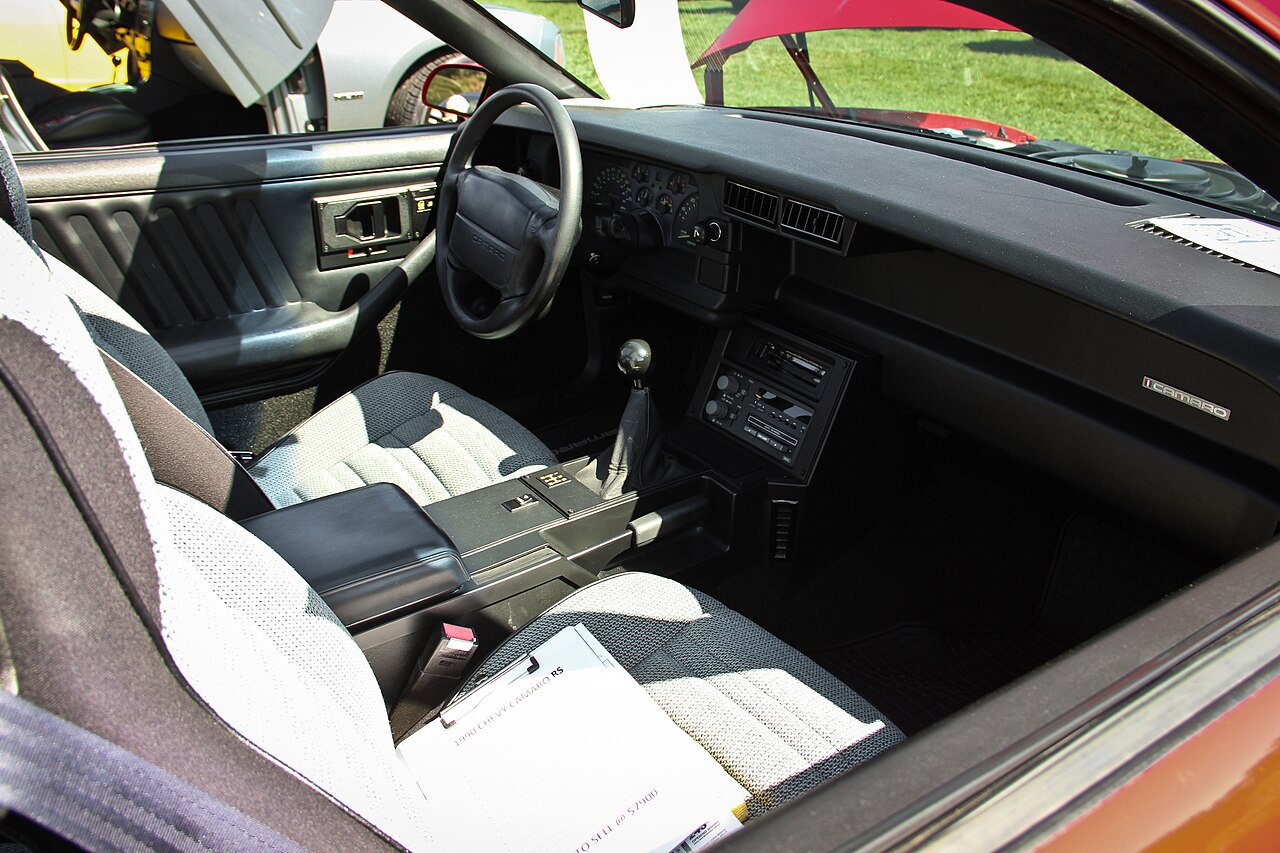
Third-generation Camaro cabin photographed in 2012; the show placard identifies a 1990 Camaro RS. Originality and factory trim codes are not authenticated by the photograph. Photo: Nick Ares (aresauburn), CC BY-SA 2.0, via Wikimedia Commons. Wikimedia 1280-pixel rendition, unchanged.
Original photographLicense
The last IROC-Z
The IROC-Z's standard engine moved up to the Tuned Port 305, and a limited-slip differential became standard. The 5.7-liter Tuned Port 350 was now rated at 245 hp at 4,400 rpm and 345 lb-ft at 3,200 rpm. It came only in the IROC-Z Coupe with the automatic, a free-flowing dual-converter exhaust and a 3.23 axle. The IROC-Z Convertible came standard with 16-inch aluminum wheels, in silver or gold, on P245/50ZR16 Eagle GT+4 tires.
Chevrolet's Distribution Dispatch 90-06, dated August 29, 1989, revised the pre-introductory price schedule for 1990 passenger cars. Its G92 line without C60 lists $675 MSRP for four-wheel discs with special heavy-duty front brakes, an aluminum driveshaft and spare wheel, oil cooler, performance exhaust, special shocks and a fuel pickup/tank baffle, deleting the fog lamps. With C60 it lists $466 for four-wheel discs, oil cooler and performance exhaust. These are two configurations and suggested retail prices for model year 1990, despite the 1989 calendar date. The separate MVMA brake sheet, issued June 1989 for 1990, explicitly names optional RPO 1LE; the dispatch labels its price lines G92.
Chevrolet's September 1989 power-team matrix limits the IROC-Z Convertible to the single-exhaust LB9 with either the M39 five-speed or MD8 automatic, both rated at 210 hp and 285 lb-ft. The Coupe also offered the dual-exhaust MK6 LB9 at 230 hp and 300 lb-ft, or the automatic L98 at 245 hp and 345 lb-ft. The letters E–H below identify columns in that factory matrix; they are not VIN engine codes.
1990 IROC-Z: read the factory power-team columns
E and F were offered on both IROC-Z body styles. G and H were Coupe-only. E/F: 210 hp at 4,400 rpm, 285 lb-ft at 3,200 rpm. G: 230 hp at 4,400 rpm, 300 lb-ft at 3,200 rpm. H: 245 hp at 4,400 rpm, 345 lb-ft at 3,200 rpm. These are matrix column letters, not VIN engine codes. Original CamaroFacts diagram. Chevrolet MVMA power teams and availability, printed pp. 2–2.1.
Who Chevrolet thought it was fighting
Chevrolet's own sales guide named the RS's rivals as the Dodge Daytona, Ford Mustang and Pontiac Firebird. It set the IROC-Z against the Mustang GT and Chrysler LeBaron GTC. It also warned dealers about newer imports and joint-venture cars, the Ford Probe GT, Honda Prelude and Toyota Celica. The guide described the typical buyer as someone who wanted a car for more than getting around.