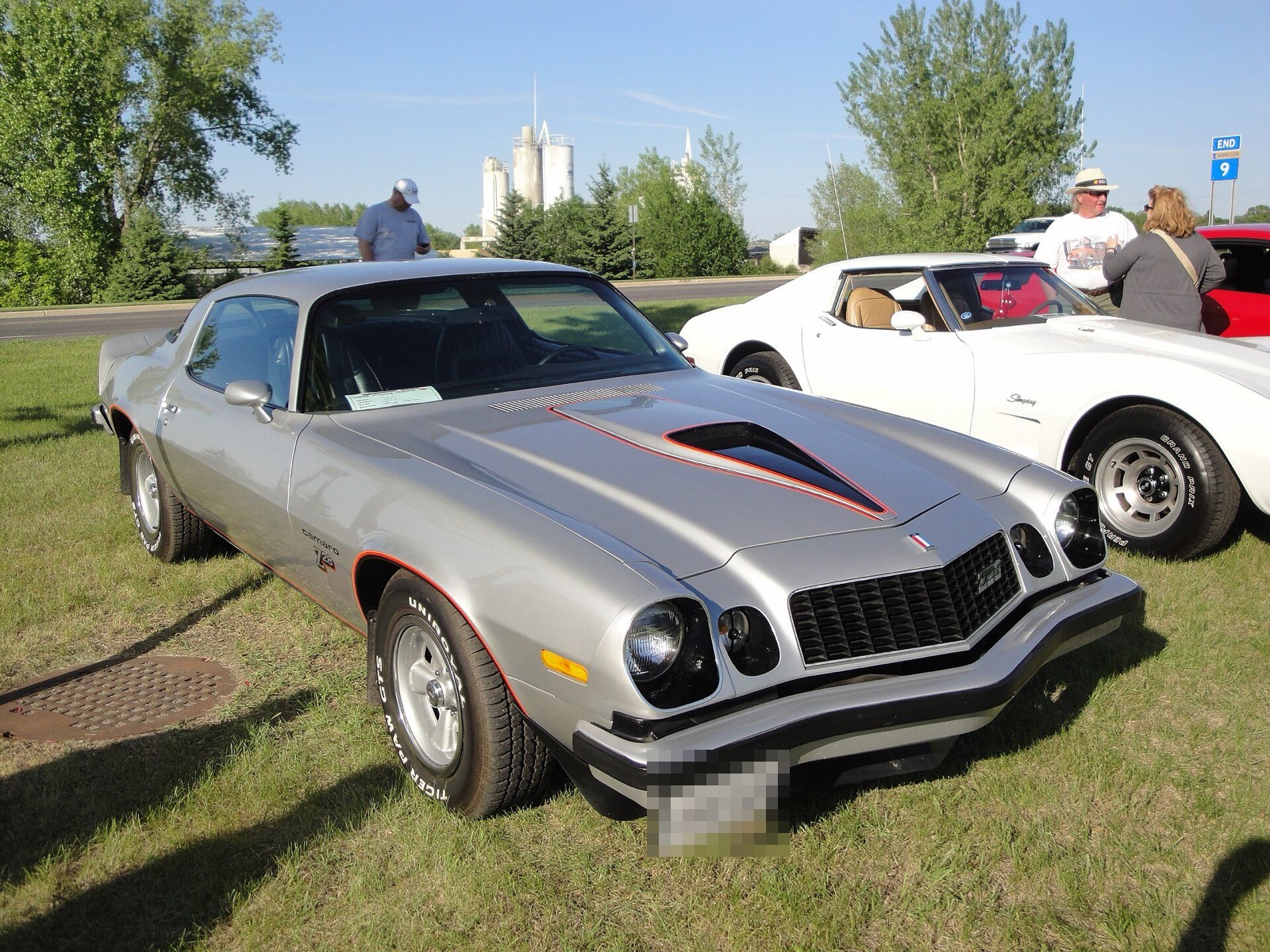
1977 Camaro Z28
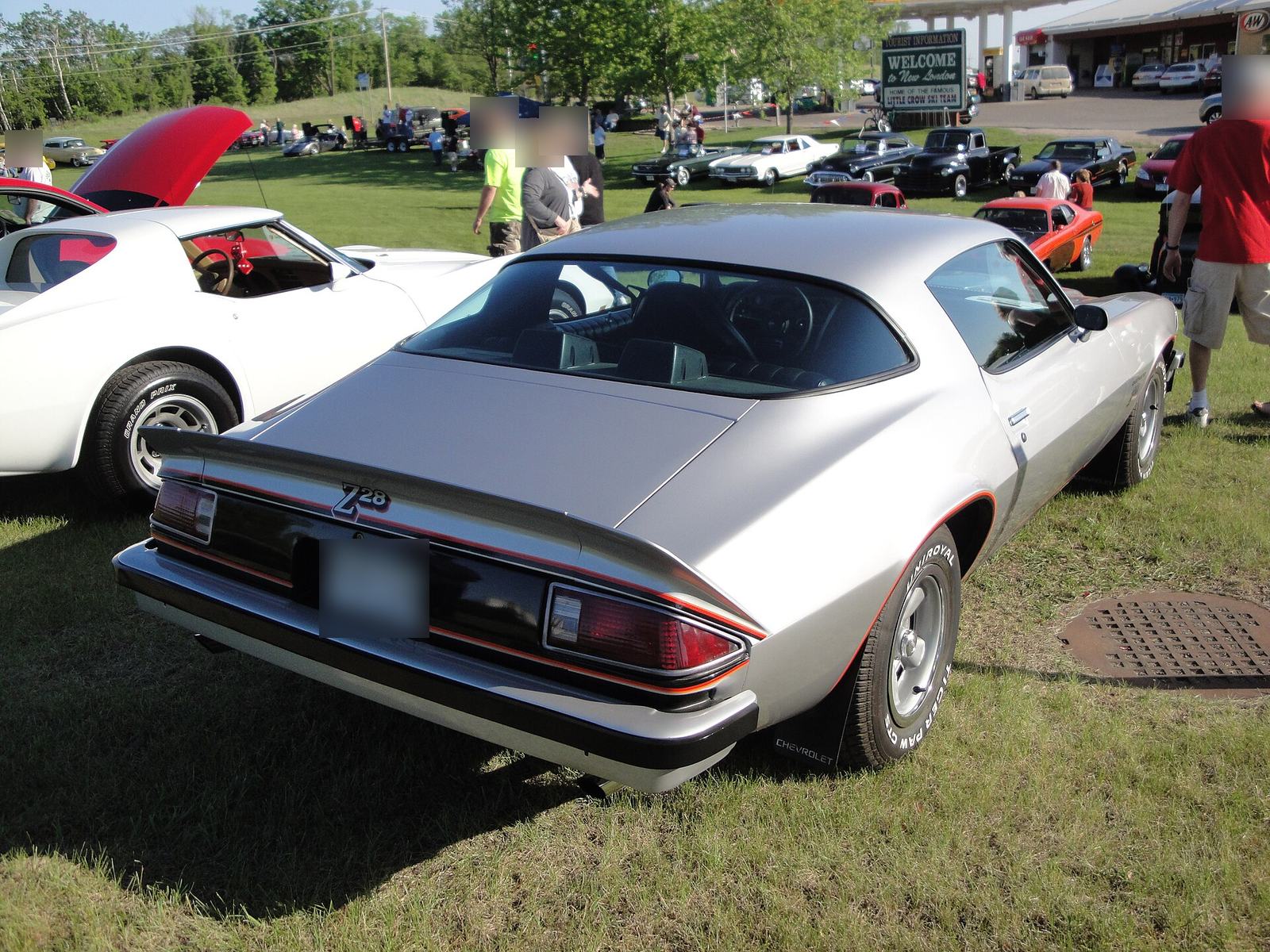
Photo: Greg Gjerdingen, CC BY 2.0, via Wikimedia Commons; license plate pixelated
The comeback year. The Z28 returned in spring 1977 after a two-year absence, the Camaro outsold the Mustang for the first time, and production reached 218,853. The second generation had stopped being a survival story.
The reborn Z28 was a handling package built around the 350 V8, not a homologation special, and buyers took 14,349 in its short first season.
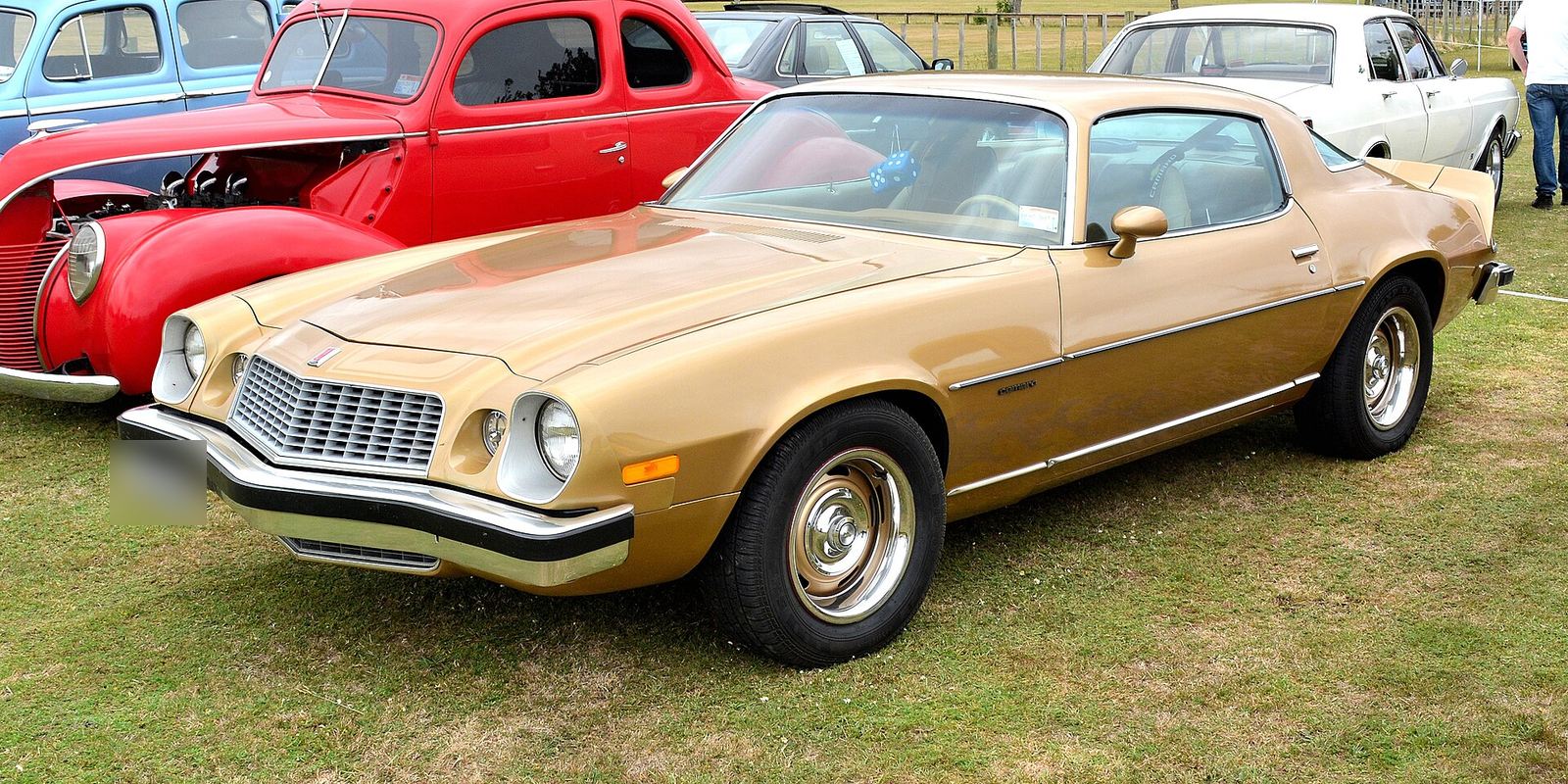
Gold 1977 Camaro coupe with body side mouldings and chrome wheels, front three-quarter view, on grass at an outdoor car show Photo: GPS 56, CC BY 2.0, via Wikimedia Commons; licence plates blurred
Original photographLicense
A battered 1977 Camaro later played the "before" form of Bumblebee in the 2007 Transformers film. The fifth and sixth generations page tells the marketing story that grew out of that role, and a Bumblebee-liveried Camaro of this era is preserved at the Petersen Automotive Museum.
Did you know
Car and Driver's April 1977 comparison of the 185-hp Z/28 and the 200-hp Trans Am 400 split the results: the Camaro was quicker in the quarter-mile (16.3 seconds at 83 mph against 16.9 at 82), but the Pontiac had the higher top speed (110 mph to 105) and the better skidpad number (0.80 g to 0.74 g).
The Camaro's margin over the Mustang II in 1977 was about 65,700 cars: 218,853 against 153,117. A year earlier the same comparison had been a near miss.
Silver led the 1977 color chart at 27,450, with Firethorn Metallic close behind at 25,743. Brown Metallic (code 69), at 19,785, outsold Black (17,472), and Aqua Metallic went on 10,206 cars.
Buyers kept loading up: factory air conditioning went on 101,901 Camaros in 1976 (56 percent), 144,767 in 1977 (66 percent) and 194,584 in 1978 (71 percent). By 1977 nine in ten Camaros also had the Turbo Hydra-Matic, 196,506 of 218,853.
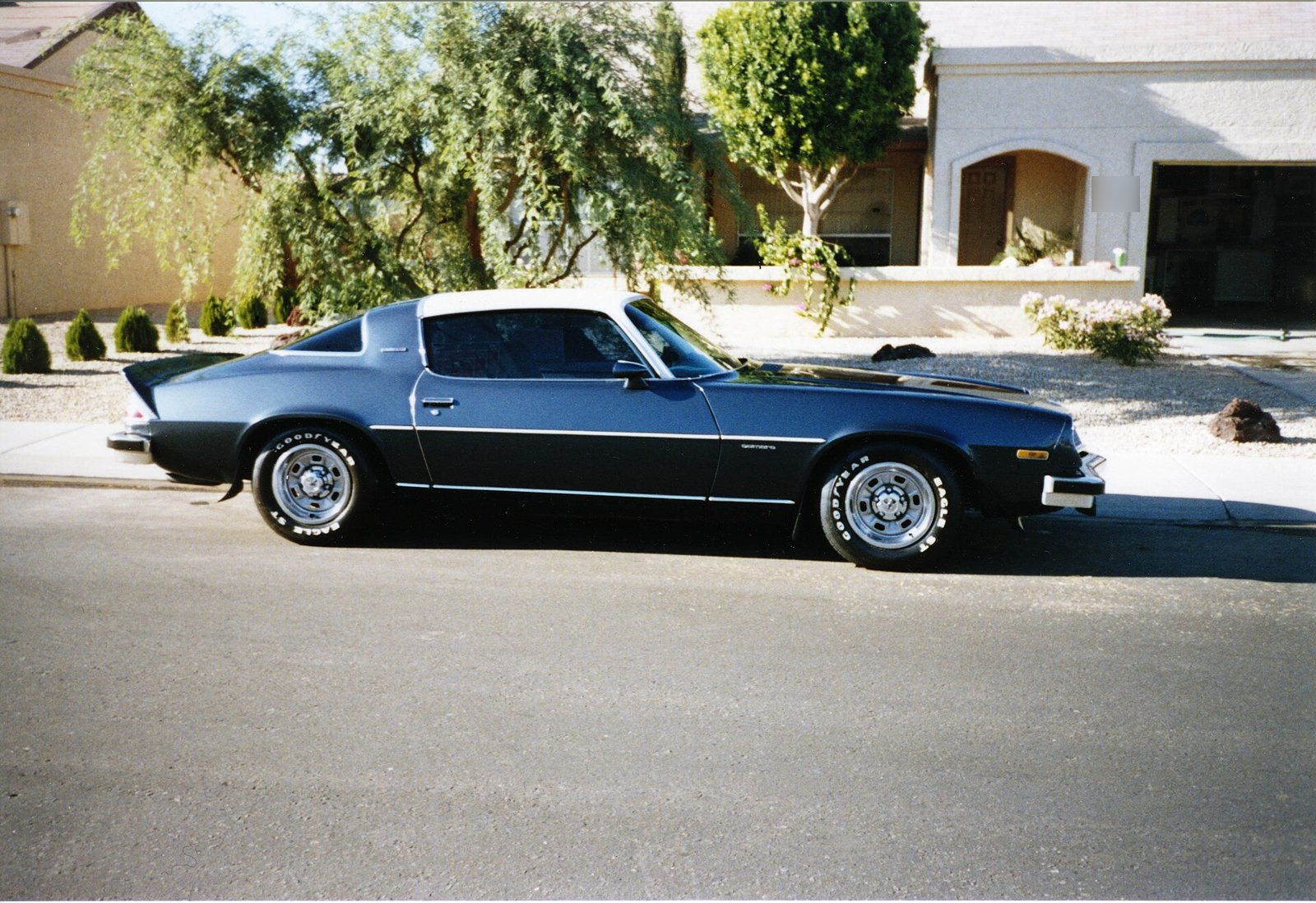
Dark blue 1977 Camaro coupe with white vinyl roof and body side moulding, side profile, parked on a residential street Photo: Hip, CC BY 3.0, via Wikimedia Commons; street numbers blurred
Original photographLicense
Production
One production figure is listed for 1977: Total production, 218,853.
Record
Count
Total production
218,853
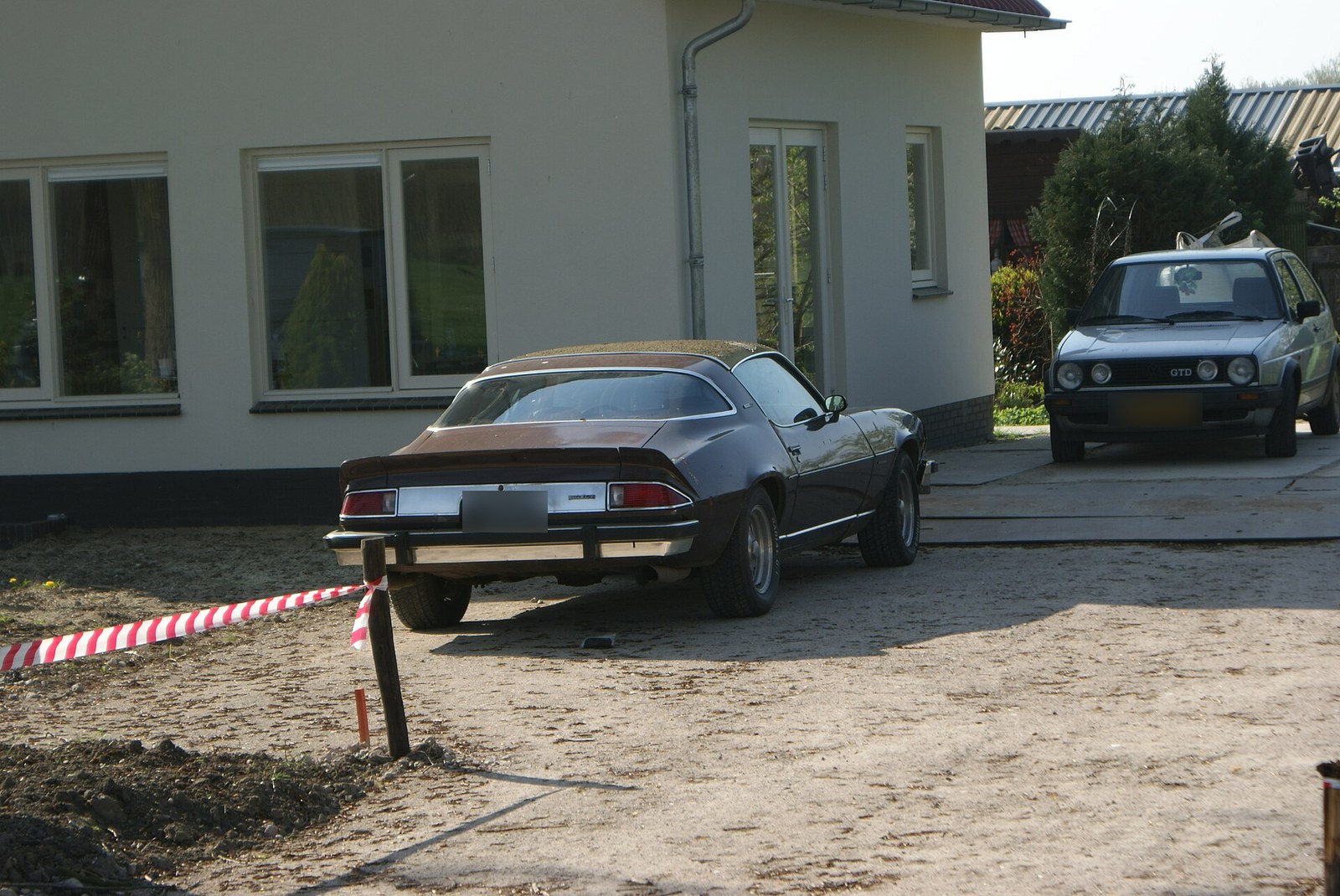
Dark brown 1977 Camaro coupe, rear three-quarter view, parked in a yard beside a house Photo: Niels de Wit, CC BY 2.0, via Wikimedia Commons; licence plates blurred
Original photographLicenseSilver 1977 Camaro Z28 coupe with rear spoiler, rear three-quarter view, on grass at a cruise night Photo: Greg Gjerdingen, CC BY 2.0, via Wikimedia Commons; licence plates and faces blurred
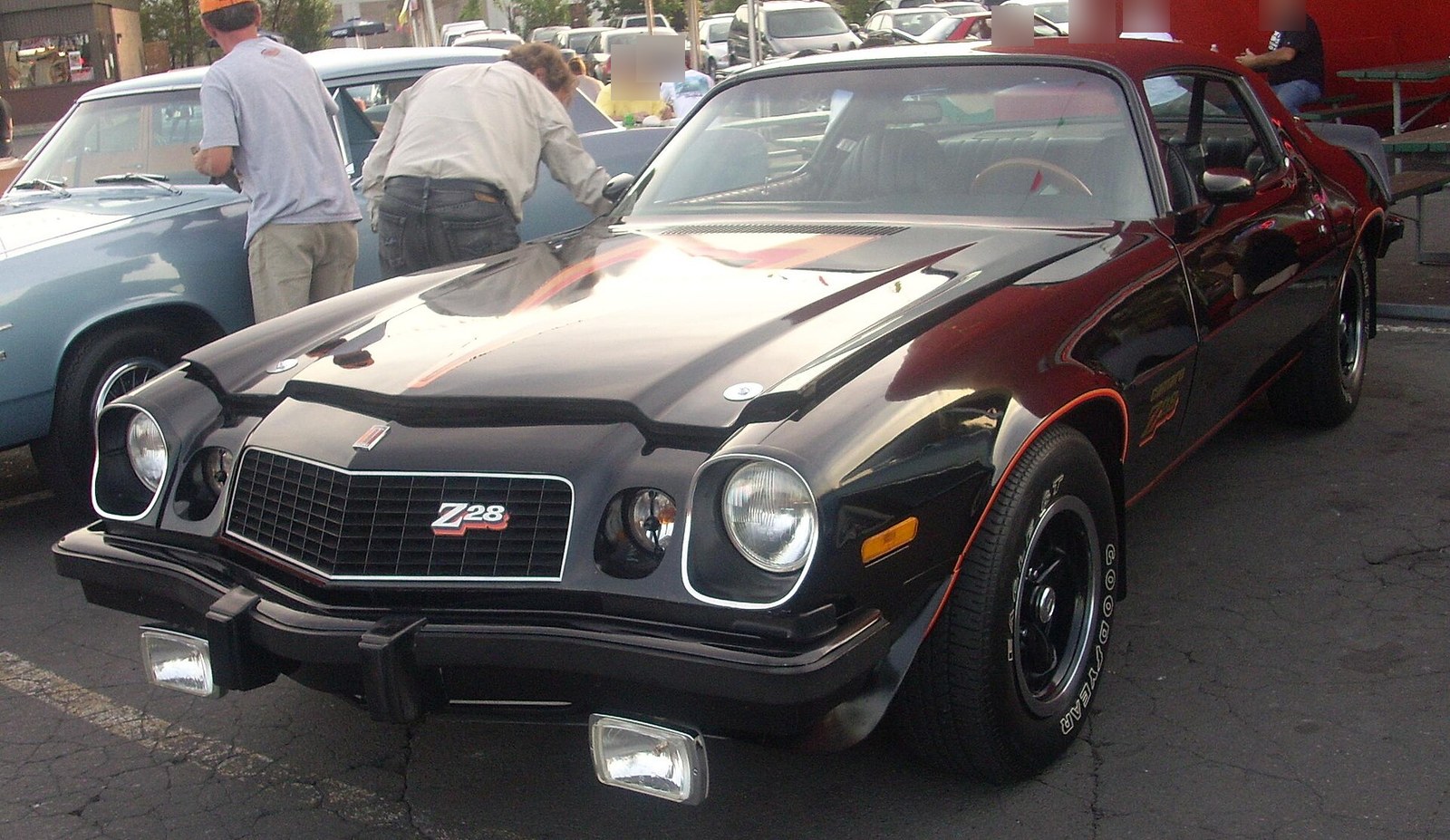
Original photographLicenseBlack 1977 Camaro Z28 coupe with orange pinstripes, front three-quarter view, at an evening cruise night Public domain (Bull-Doser), via Wikimedia Commons; faces blurred
Original photograph
Engines
The 1977 table lists four engines: the 250 cu in inline-6 (RPO L22), the 305 cu in V8, the 350 cu in V8 and the 350 cu in V8 (LM1/Z28). The highest power rating shown is 185 hp (net), for the 350 cu in V8 (LM1/Z28).
Code
Engine
Power
Torque
Note
D
250 cu in inline-6 (RPO L22)
110 hp (net) at 3,800 rpm (federal); 90 hp (net) at 3,600 rpm (California)
195 lb-ft (net) at 1,600 rpm (federal); 180 lb-ft (net) at 1,600 rpm (California)
L22; September 1976 Power Trains table retains the federal figures above 4,000 feet.
U
305 cu in V8
145 hp (net) at 3,800 rpm (federal); 135 hp (net) at 3,800 rpm (California)
245 lb-ft (net) at 2,400 rpm (federal); 240 lb-ft (net) at 2,000 rpm (California)
LG3 two-barrel; federal and California figures from the September 1976 rating table.
L
350 cu in V8
170 hp (net) at 3,800 rpm (federal); 160 hp (net) at 3,800 rpm (California or federal above 4,000 feet)
270 lb-ft (net) at 2,400 rpm (federal); 260 lb-ft (net) at 2,400 rpm (California or federal above 4,000 feet)
LM1 four-barrel; ordinary Camaro rating table, not the separate spring Z28 specification.
L
350 cu in V8 (LM1/Z28)
185 hp (net) at 4,000 rpm (Car and Driver); 160 hp (net) at 3,800 rpm (February MVMA)
270 lb-ft (net) at 2,400 rpm (Car and Driver); 260 lb-ft (net) at 2,400 rpm (February MVMA)
Z28; April 1977 Car and Driver test-car specifications disagree with the February 1977 MVMA Z28 row. No cause is established. Chevrolet's product sheet requires the automatic in California.
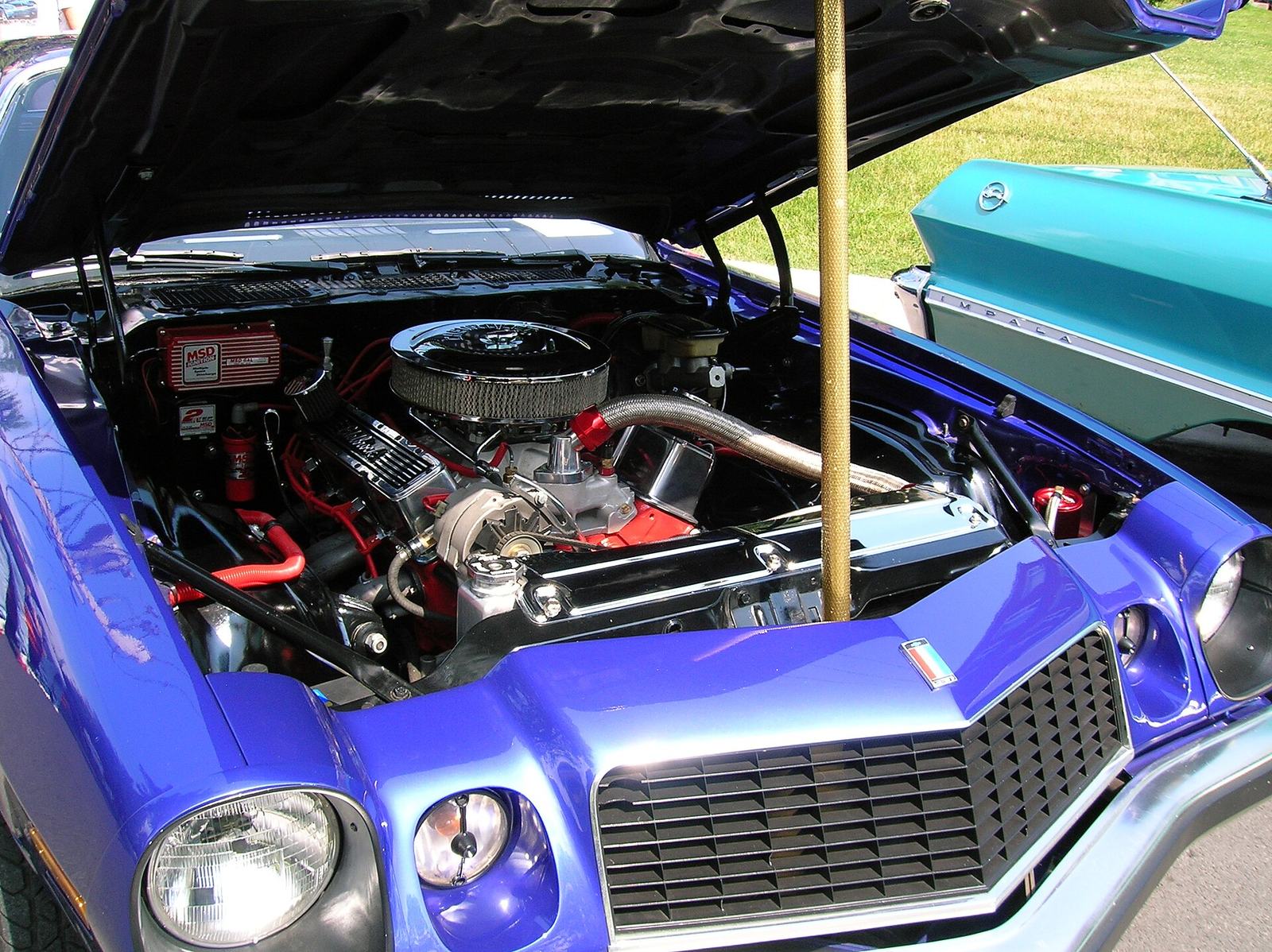
Purple 1977 Camaro with hood raised showing a dressed-up V8 engine bay, at an outdoor car show Photo: Katherine Tompkins, CC BY 2.0, via Wikimedia Commons
Original photographLicense
Options, packages and special editions
The 1977 list has 22 options, packages and special editions. Every entry shows a price, and 1 shows how many were built.
Code
Description
Price
Built
Note
1FQ87
Sport Coupe, 6-cylinder
$4,124.45
—
Base price, June 1977
1FS87
Type LT Coupe, 6-cylinder
$4,489.45
—
Base price
1FQ87 / Z28
Z28 Sport Coupe, V8 (350-4)
$5,181.06
14,349
Returned spring 1977; power brakes, spoilers, sport suspension and special instrumentation standard
Z85
Rally Sport equipment
$281.00
—
$186.00 on Type LT
—
Custom interior — vinyl or cloth buckets
$275.00 / $295.00
—
Z54
Interior Decor / Quiet Sound Group
$57.00
—
Z21
Style trim
$61.00
—
LG3
Engine, 305-2 V8
$120.00
—
LM1
Engine, 350-4 V8
$210.00
—
No charge on the Z28
M40
Turbo Hydra-Matic
$289.00
—
$37.00 on the Z28
M20
4-speed manual
$252.00
—
Close-ratio M21 no charge on the Z28
G80
Positraction rear axle
$54.00
—
C60
Four-Season air conditioning
$488.00 V8 / $517.00 six
—
AU3
Power door locks
$74.00
—
A31
Power windows
$114.00
—
K30
Cruise-Master speed control
$84.00
—
CD4
Intermittent windshield wipers
$30.00
—
U14
Special instrumentation
$99.00
—
Standard on Type LT and Z28
D80
Front and rear spoilers
$87.00
—
Standard on the Z28
—
Vinyl roof cover
$96.00
—
PE1
Custom styled wheels 14 x 7
$125.00
—
UM2
Stereo tape with AM/FM stereo radio
$324.00
—
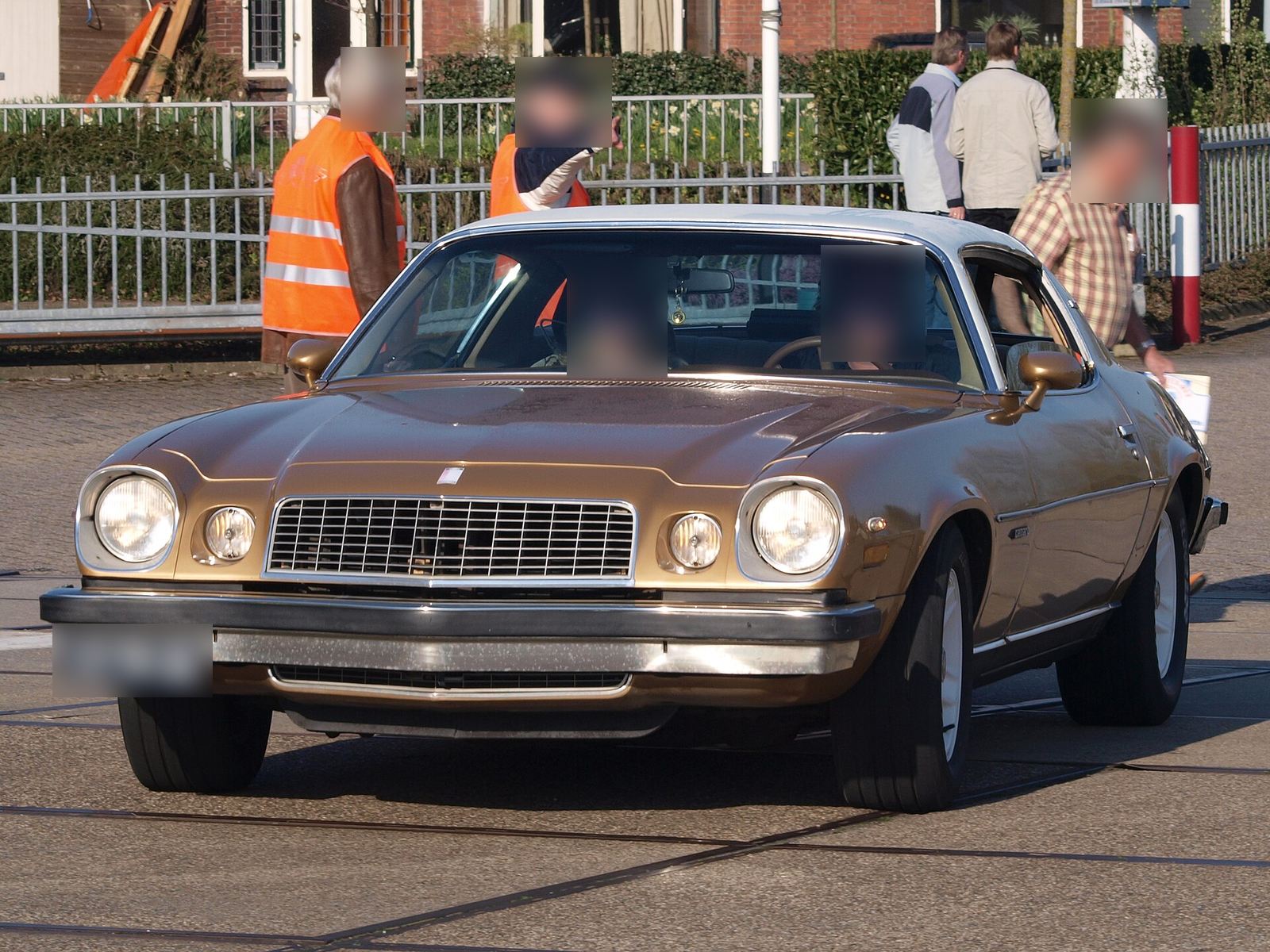
Gold 1977 Camaro coupe with white vinyl roof, front three-quarter view, arriving at a classic car run on a paved street with marshals in the background Photo: Alf van Beem, CC0, via Wikimedia Commons; licence plates and faces blurred
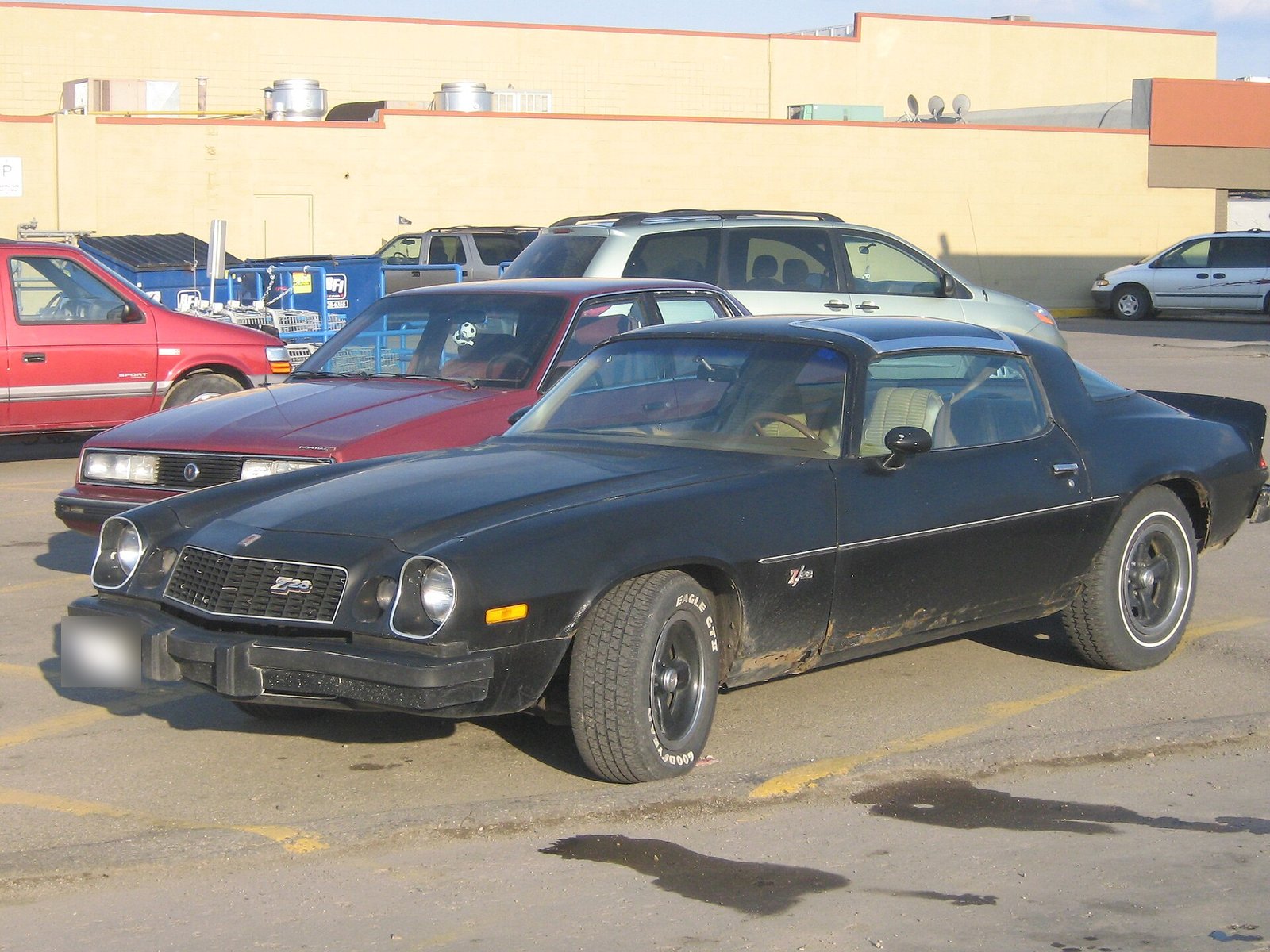
Original photographLicenseBlack 1977 Camaro Z28 coupe with rear spoiler, side and rear three-quarter view, in a parking lot Photo: dave_7, CC BY-SA 2.0, via Wikimedia Commons; licence plates blurred
Original photographLicense
Exterior colors
This table has 14 exterior colors for 1977, each with its paint code. They include White, Silver Metallic and Black.
Code
Color
11
White
13
Silver Metallic
19
Black
22
Light Blue Metallic
29
Dark Blue Metallic
36
Firethorn Metallic
38
Dark Aqua Metallic
44
Medium Green Metallic
51
Bright Yellow
61
Light Buckskin
63
Buckskin Metallic
69
Brown Metallic
75
Red
78
Orange Metallic
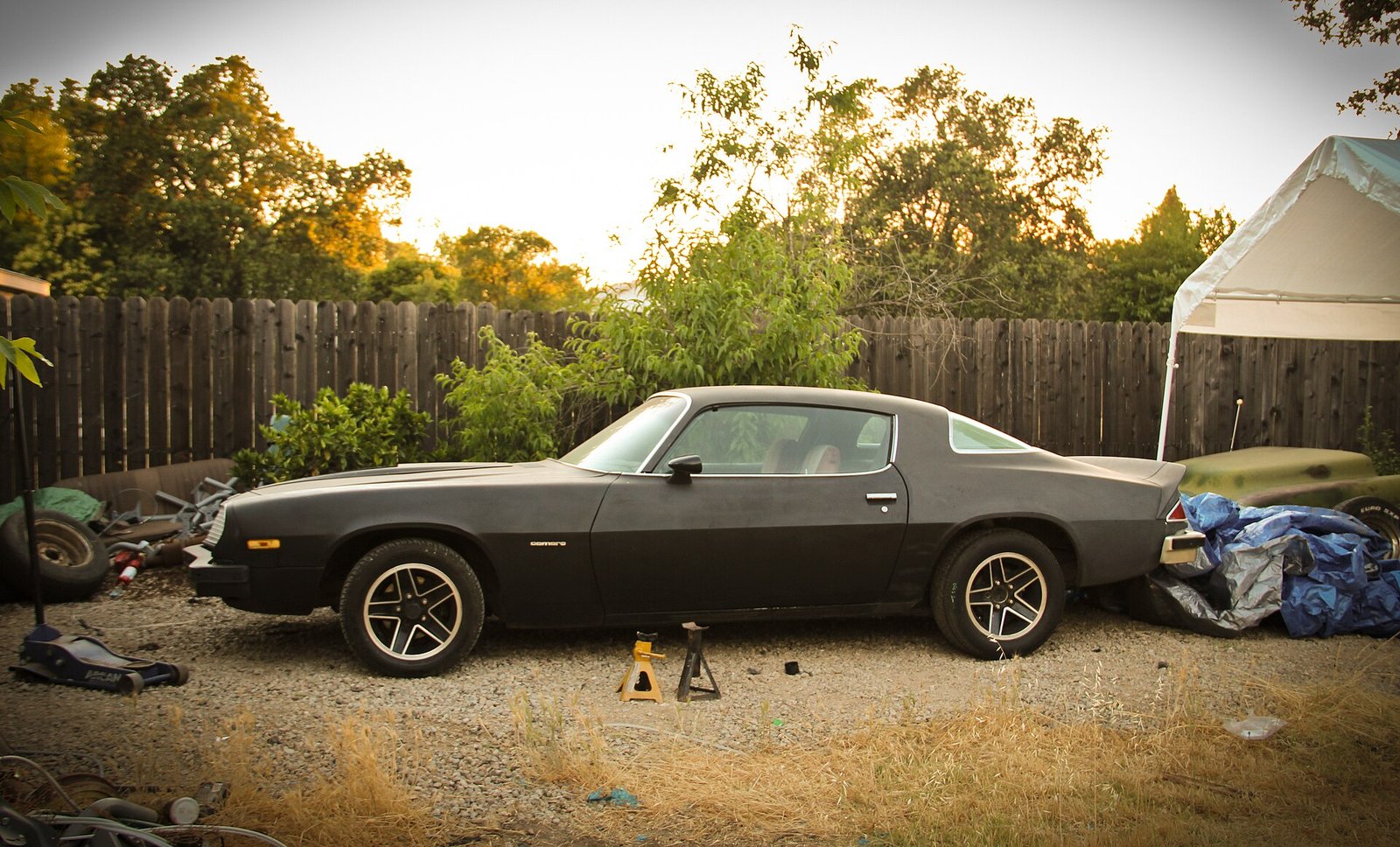
Black 1977 Camaro coupe with aftermarket wheels, side profile, in a backyard with jack stands Photo: Nick Ares, CC BY-SA 2.0, via Wikimedia Commons
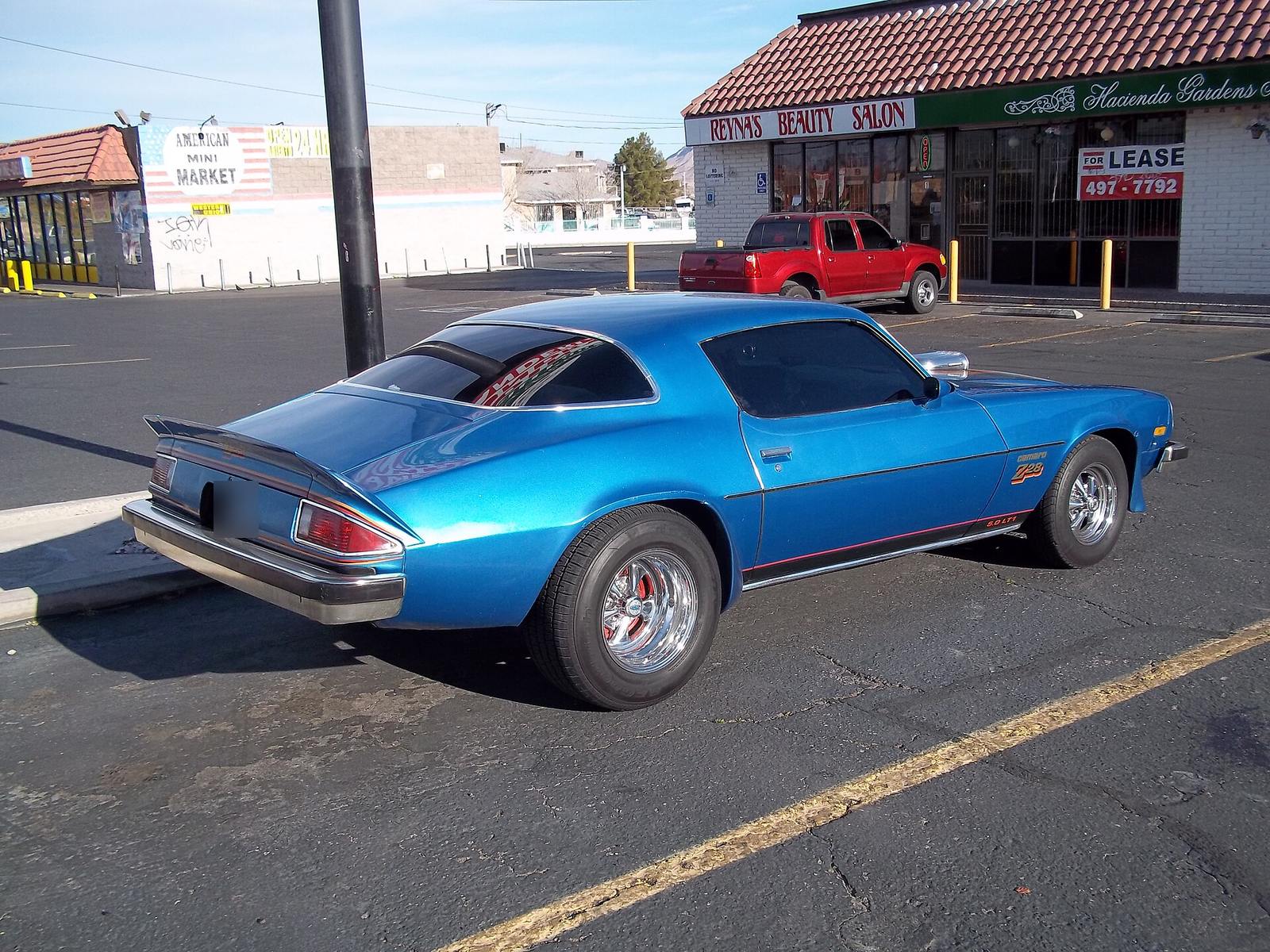
Original photographLicenseBlue 1977 Camaro Z28 coupe with rear spoiler and aftermarket chrome wheels, rear three-quarter and side view, in a strip-mall parking lot Photo: time anchor, CC BY 2.0, via Wikimedia Commons; licence plates blurred
Original photographLicense
Interior trim
This table has eight interior trims for 1977, each with its trim code.
The September 1976 factory matrix for 1977, printed Body p. 4 (GM kit PDF p. 36), also lists all eight code and material rows and the A51 bucket seats. Its usage legend distinguishes R Oxen vinyl/Oxen bolster, N Plisse horizontal-rib vinyl/Wallaby bolster, B Radcliffe 722 WC woven Sport Cloth/Radcliffe bolster, and C Regis 723 WC knit cloth/Dover bolster. Standard coupe and Type LT code rows remain distinct. Paired 62/64 entries are printed together under Light Buckskin; the page does not establish why both prefixes appear, so they are not assigned separate shades, dates or materials. The paint matrix distinguishes recommended R from acceptable A combinations. These recommendation letters are matrix ratings, not upholstery suffix decoding. The page says ZP2 override permits any interior/exterior combination; it does not establish a separate vinyl-roof rule or a later model/package application. No physical-tag/VIN crosswalk, individual authenticity or neighboring-year rule is inferred.
Code
Trim
Note
19R
Black vinyl, standard coupe
The September 1976 usage legend defines R as Oxen vinyl with Oxen bolster; this is a standard-coupe bucket row.
62R / 64R
Light Buckskin vinyl, standard coupe
The September 1976 usage legend defines R as Oxen vinyl with Oxen bolster; this is a standard-coupe bucket row. Both 62 and 64 codes are printed under Light Buckskin; this page does not explain the difference, so no separate color, date or material is invented.
62B / 64B
Light Buckskin cloth, standard coupe
The September 1976 usage legend defines B as Radcliffe 722 WC woven Sport Cloth with Radcliffe bolster; this is a standard-coupe bucket row. Both 62 and 64 codes are printed under Light Buckskin; this page does not explain the difference, so no separate color, date or material is invented.
19N
Black vinyl, Type LT
The September 1976 usage legend defines N as Plisse vinyl (horizontal rib) with Wallaby bolster; this is a Type LT bucket row.
24C
Light Blue cloth, Type LT
The September 1976 usage legend defines C as Regis 723 WC knit cloth with Dover bolster; this is a Type LT bucket row.
24N
Light Blue vinyl, Type LT
The September 1976 usage legend defines N as Plisse vinyl (horizontal rib) with Wallaby bolster; this is a Type LT bucket row.
62N / 64N
Light Buckskin vinyl, Type LT
The September 1976 usage legend defines N as Plisse vinyl (horizontal rib) with Wallaby bolster; this is a Type LT bucket row. Both 62 and 64 codes are printed under Light Buckskin; this page does not explain the difference, so no separate color, date or material is invented.
62C / 64C
Light Buckskin cloth, Type LT
The September 1976 usage legend defines C as Regis 723 WC knit cloth with Dover bolster; this is a Type LT bucket row. Both 62 and 64 codes are printed under Light Buckskin; this page does not explain the difference, so no separate color, date or material is invented.
Specifications
This table gives five specifications for 1977, among them wheelbase (108.0 in) and standard tire (FR78-14).
Item
Value
Note
Wheelbase
108.0 in
Standard tire
FR78-14
Overall length
195.4 in
187.8 in less bumpers
Overall width
74.5 in
Track, front / rear
61.3 / 60.0 in
Type LT 61.6 / 60.3 in
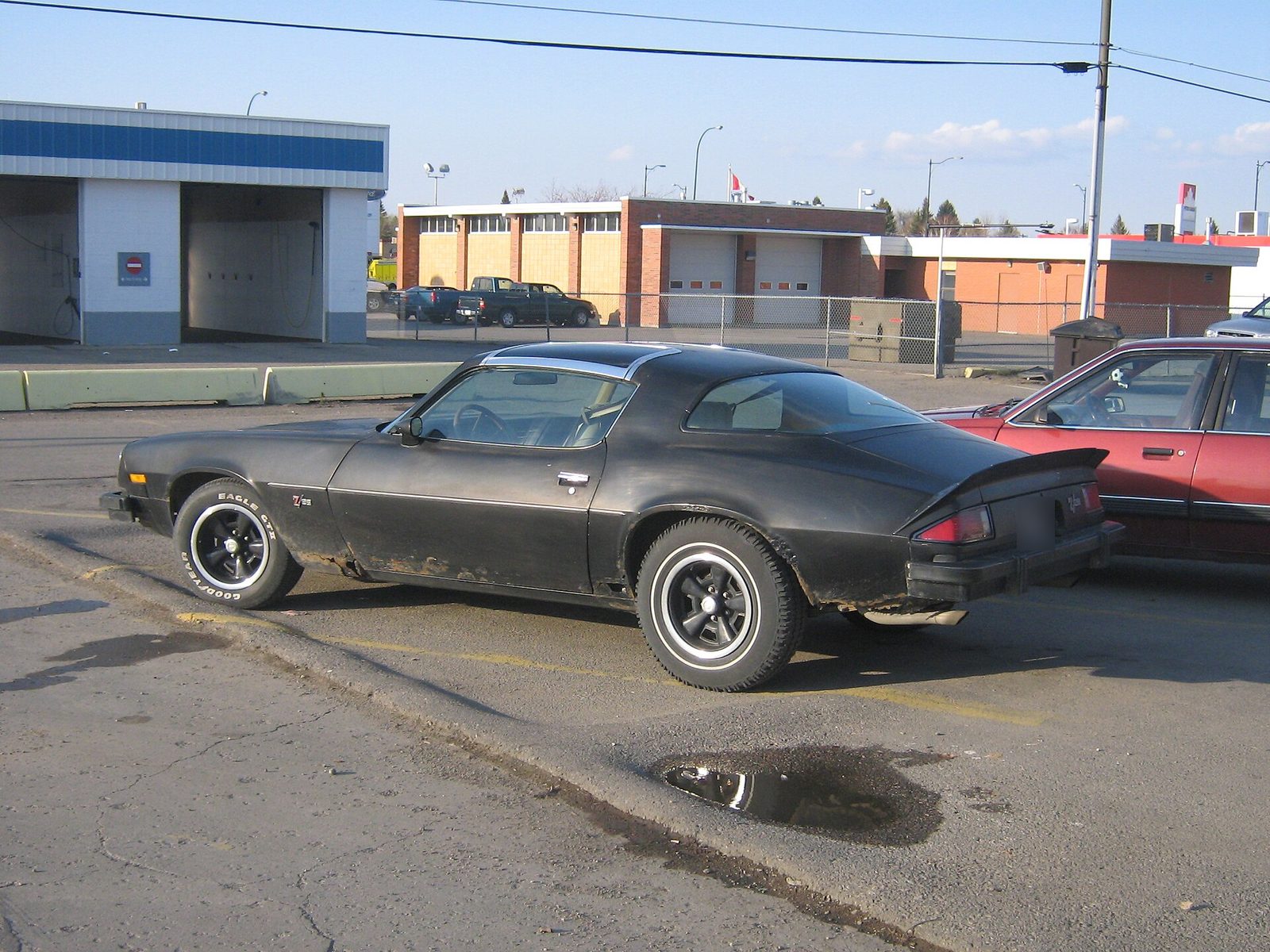
Black 1977 Camaro Z28 coupe with rust on the lower body, front three-quarter view, in a store parking lot Photo: dave_7, CC BY-SA 2.0, via Wikimedia Commons; licence plates blurred
Original photographLicense
Identification
What to check on a 1977 Camaro: VIN and Z28.
Item
What to look for
Note
VIN
1 Q/S 87 [engine] 7 N/L 100001-up
Series Q Camaro, S Type LT; body 87; engine code in position 5 (see engine table); year digit; plant
Z28
Returned mid-year with graphics, spoilers and badging
The start of the Camaro's late-1970s boom, which peaked two years later at a record 282,571 cars.
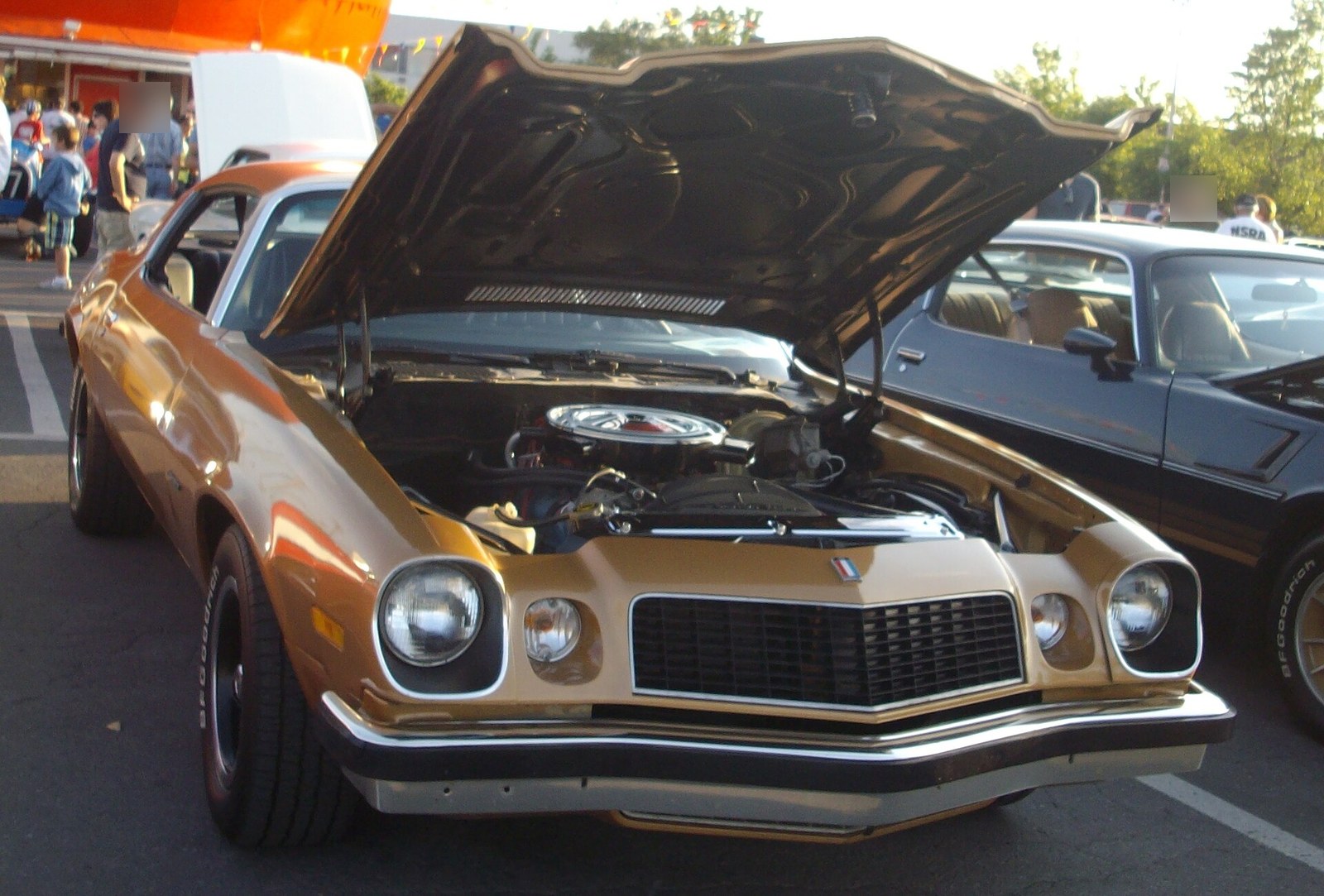
Gold 1977 Camaro coupe with hood raised showing the engine, front three-quarter view, at an evening cruise night Public domain (Bull-Doser at English Wikipedia), via Wikimedia Commons; faces blurred
Original photograph
The Z28 Comes Back, Because of the Firebird
The Z28 had been dropped after 1974, when unleaded fuel and catalytic converters ended the high-compression formula (see the second generation). What brought it back was not Camaro demand directly but Pontiac's Firebird Trans Am, which sold more than 46,000 cars in 1976, about 42 percent of all Firebirds, while Chevrolet had nothing to answer it. Chevrolet brought the Z28 back as a model of its own, a reaction to a GM sibling as much as to Ford.
Back by popular demand
Chevrolet's product sheet for the new Z28 opened with "Back by popular demand" and itemized a car built around handling. It had a four-barrel 350, a heavy-duty Borg-Warner four-speed with a 2.64 first gear, an 11-inch clutch and a 3.73 axle. An automatic was available, and in California it was required. Unusually, it was tuned for high shift points, 4,900 rpm from first to second. Fast 14:1 power steering, high-rate springs, a larger front stabilizer bar, a rear stabilizer bar, specially valved shocks and firmer suspension bushings came with it. It rode on body-color 15 x 7 wheels with GR70-15 white-letter radials. A low-back-pressure dual exhaust, power disc brakes and full instrumentation were standard.
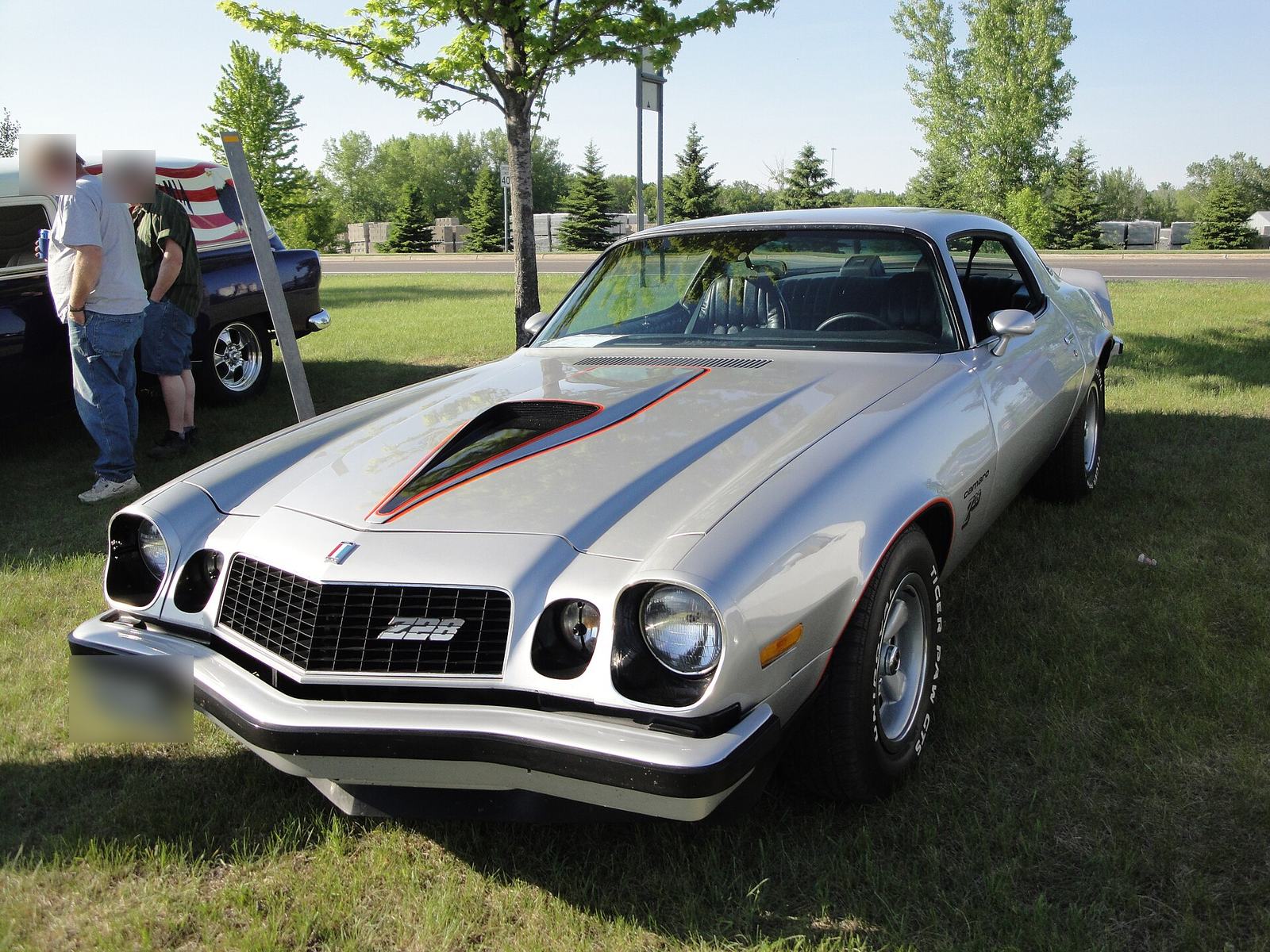
The look was blacked-out trim, with a black grille, bezels, window moldings, sills and rear panel, against color-keyed hood and body striping, front and rear spoilers and Z28 badges. From June 27, 1977 the Z28 had a list price of $5,167, against $4,111 for a six-cylinder Sport Coupe and $4,476 for a Type LT. The options table shows suggested retail prices, which add a factory charge for the tire weight tax ($13.45, or $14.06 on the Z28): $4,124.45, $4,489.45 and $5,181.06. The four-barrel 350 cost $210 on the other models, and air conditioning $488 with a V8.
Silver 1977 Camaro Z28 coupe with hood stripes and scoop, front three-quarter view, on grass at a cruise night Photo: Greg Gjerdingen, CC BY 2.0, via Wikimedia Commons; licence plates and faces blurred
Original photographLicense
The Type LT's peak
The Z28 got the headlines, but the Type LT was 1977's volume story. Chevrolet built 72,787, a third of the year's cars and the model's peak. Its run went 32,327 (1973), 48,963 (1974), 39,843 (1975), 52,421 (1976), 72,787 (1977) and 65,635 in its 1978 finale.