CamaroFacts

Cowl tag decoder

The Fisher Body tag on the firewall records how the body was built: paint, interior trim, build date, plant, and on mid-1969 Norwood cars the X-code that maps to a drivetrain and trim family. Type what your tag reads. Nothing is uploaded; decoding runs entirely on your device.

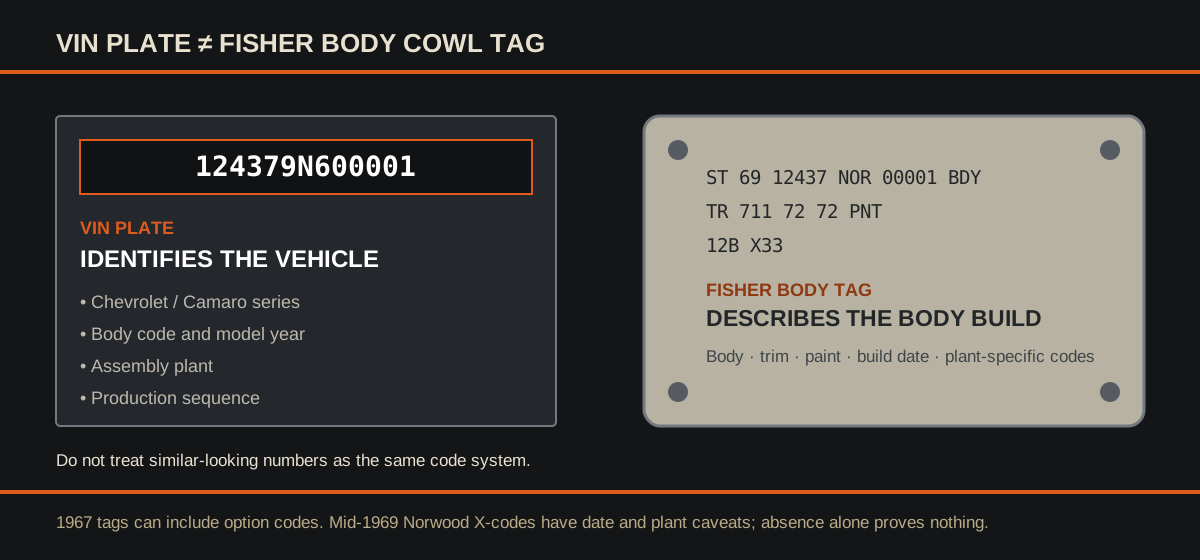
The tag is not the VIN. The cowl tag is a Fisher Body record describing the body shell; the VIN identifies the vehicle. Similar-looking digits do not make them interchangeable, and the two are checked against each other, not substituted for one another. Decode the VIN separately
Conceptual comparison of a Camaro VIN plate and a Fisher Body cowl tag, showing their different purposes
Two records to compare: the VIN identifies the vehicle; the Fisher Body tag describes the body. Original CamaroFacts diagram, based on the Camaro Research Group numbers guide.

1967–1985, every year the tag was fitted. The 1967–1969 tables come from the Camaro Research Group and GM's own pages and the 1970 layout from a GM chapter; the layouts for 1971–1985 come from enthusiast references, while the paint and trim numbers are from GM's kit color pages. Cowl-tag trim tables cover 1967–1974, 1976–77, 1981 and 1984–85. For other years this decoder leaves the trim code undecoded. Factory seat-combination charts describe upholstery choices; they do not by themselves specify physical tag stampings.

What an X-code can and cannot tell you

Partway through the 1969 run the Norwood plant began stamping an Xnn code on its cowl tags. It was an internal aid for Fisher Body, but because the codes track drivetrain and trim families, they are now one of the most useful checks on what a 1969 car originally was.

1969 Norwood X-codes Body trim and drivetrain families.
1969 Norwood X-codes and their meanings X11: non-SS396, non-Z/28, includes SS350, with Z21 style trim (or Z22); X22: SS396 with style trim; X33: Z/28 with style trim; X44: non-SS, non-Z/28 without style trim; X55: SS350 without style trim; X66: SS396 without style trim; X77: Z/28 without style trim X11 non-SS396, non-Z/28, includes SS350, with Z21 style trim (or Z22) X22 SS396 with style trim X33 Z/28 with style trim X44 non-SS, non-Z/28 without style trim X55 SS350 without style trim X66 SS396 without style trim X77 Z/28 without style trim
X-codes were applied at Norwood, Ohio only. A Van Nuys car never had one, so its absence on an LA car proves nothing. Norwood began stamping X codes with build week 12B (second week of December 1968); CRG found 12B cars both with and without them, none before, all after COPO exceptions: Most COPO Camaros were built from X11 or X44 bodies; some early COPOs had X22 or X66; 1969 non-SS convertibles without style trim built after Feb 69 did not have X44 (CRG says it is unknown why) Original CamaroFacts diagram. Camaro Research Group reference.
X11
non-SS396, non-Z/28, includes SS350, with Z21 style trim (or Z22)
X22
SS396 with style trim
X33
Z/28 with style trim
X44
non-SS, non-Z/28 without style trim
X55
SS350 without style trim
X66
SS396 without style trim
X77
Z/28 without style trim
Z10
RPO Z10, an RS/SS coupe with pace-car-style striping (CRG finds no Z10 paperwork mentioning the Indy 500)
Z11
Indy Pace Car replica convertible (RPO Z11)
D80
Spoilers, companion mark; not used consistently
A
Power windows, companion mark; not used consistently

X-codes were applied at Norwood, Ohio only. A Van Nuys car never had one, so its absence on an LA car proves nothing. Norwood began stamping X codes with build week 12B (second week of December 1968); CRG found 12B cars both with and without them, none before, all after The codes told Fisher Body which trim and paint treatment a body needed. They map to drivetrain and trim families, but they were never meant as a record of what the car was. A separate D80 stamp (spoilers) sometimes appears but was not applied consistently. COPO exceptions: Most COPO Camaros were built from X11 or X44 bodies; some early COPOs had X22 or X66; 1969 non-SS convertibles without style trim built after Feb 69 did not have X44 (CRG says it is unknown why)

Did you know

  • The third digit of the style number on a first-generation tag is not the VIN's engine digit. CRG reports 1967 tags use 4 for standard interior and 6 for custom (a custom-interior convertible reads 12667), and every 1968-69 Camaro, six or V8, reads 12437 or 12467. GM's 1969 page separately lists 12337 and 12367 as six-cylinder style numbers, so keep the tag and that list apart.
  • The 1969 X-codes carry a built-in constraint. Rally Sport cars can only be X11, X22 or X33, because the style-trim group came with RS, and X44 through X77 cars cannot have RS or style trim. COPO cars are the exception: most were built from X11 or X44 bodies, some early ones from X22 or X66. A 1988 magazine reprint in GM's 1969 kit adds that California-assembled cars used a different coding system.
  • GM's February 4, 1969 product bulletin defines RPO Z11 as an SS/Rally Sport convertible with a Custom Interior in orange houndstooth cloth, trim code 720, in Dover White 'Code 911'. CRG says houndstooth wasn't offered on convertibles except Z11 pace cars, and lists Z11 as a Norwood tag code used instead of an X-code. GM's dealer color chart lists only 713 and 729 as houndstooth, so 720 is absent from that chart.
  • 1967 is the only Camaro year whose tag lists option codes (1969 Norwood X-codes describe trim families instead). CRG reads them as a group digit plus a letter: in group 4, P is SS350 or L30, N is SS396 at 325 hp, K is L78 and L is Z28. The earliest Z28s and L78s were also coded 4P, and no 4-code at all means a base 327. A Fisher form called the UOIT, sometimes left under the carpet or headliner, confirmed many of the codes.
  • The 1967 trim tag was a puzzle for years. A 1988 Popular Hot Rodding article reprinted in GM's 1969 kit says Jim Wirth of the United States Camaro Club broke it after two former Fisher Body employees, who couldn't decode it themselves, showed the club how to separate the codes. Chevrolet and its dealers' old bulletins had not helped.
  • A tag's build date is when the body was started, not when the car was finished. CRG puts the tag about three days ahead of final assembly. Model years also sit off the calendar: a 1967 tag reading 12A means December 1966, and the 1969 run stretched to November 1969 at Norwood after the 1970 car's quarter-panel dies failed.
  • Norwood and Van Nuys tags differ in ways that trip up decoders. Van Nuys tags carry a scheduling code (a letter plus one to three digits, such as F103) that Norwood's don't; Norwood's 1967 tags carry an interior-paint letter; LOS became VN in December 1968; and 1969 body numbers are order-confirmation numbers, reset to 100000 at Norwood in August 1969, so they don't track VIN order.
  • GM's own 1969 Color and Trim page gives the interior codes printed on tags. Standard interior: black 711, blue 715, medium green 721, ivory/black 727, red 718, midnight green 723. Custom (Z87): 712, 716, 722, 719, 725. Houndstooth cloth is 713 (black) and 729 (ivory), Sport Coupe only. GM calls paint code 59 'Frost Green' and 67 'Burgundy'.
Sources for these details