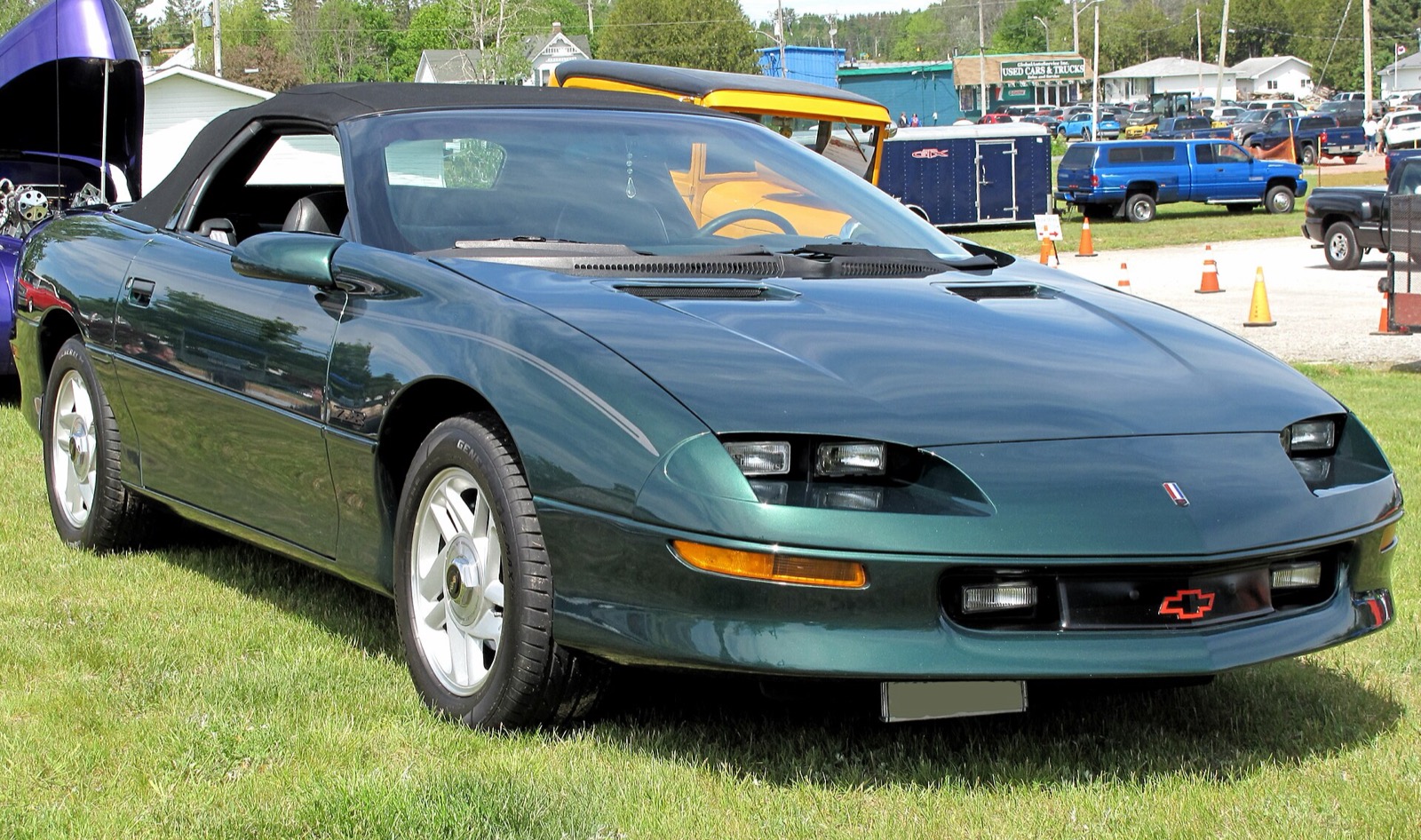
1995 Camaro Z28 convertible
Photo: Elise240SX, CC BY-SA 4.0, via Wikimedia Commons
A settled year for the fourth generation: coupe and convertible, base and Z28, with the 3.4-liter V6 and the 275 hp LT1 as the main engines. Production was 122,725, the second-highest of the generation.
There was no SS yet (that returned in 1996 through SLP) and no LS1, which arrived for 1998. The Z28 offered a choice of automatic or six-speed manual.
The 1993–97 pointed nose with inset lamps is not year-specific; the tenth VIN character (S) is what identifies a 1995.
Did you know
The 1LE package on the 1995 Z28 was serious hardware: GM's spec sheet gives its front springs 63 N/mm (360 lb/in) against 51 (291) on a regular Z28 and 39 (223) on a V6 car, roughly a quarter and 60 percent stiffer. It also had a 32 mm front bar, variable-rate rear springs (23–30 N/mm against 19.9) and rear-shock pistons of 46 mm against 36 mm, and it could not be combined with the new traction control, the power seat or T-tops. One production tally counts just 106 1LE cars for 1995.
The 3800 Series II V6 that reached Camaro showrooms late in 1995, on California-emissions cars only that year, had just made Ward's Auto World's 10 Best Engines for 1995, and it made the list again for 1996. One production tally counts only 4,787 Camaros with the 3800 in 1995.
Chevrolet's 1995 dealer guide predicted that Sebring Silver Metallic, new that year, would take 15 percent of Camaro sales, third behind Bright Red (20 percent) and Black (17) and ahead of Arctic White (12).
Acceleration Slip Regulation, new for 1995 and offered only on the Z28, was a $450 option that used the brakes and engine together to curb wheelspin.
The LT1's Optispark distributor, the source of many owners' moisture headaches, got a vented housing in 1995.
Production
One production figure is listed for 1995: Total production, 122,725.
Record
Count
Note
Total production
122,725
Hagerty's history of the Sainte-Thérèse plant gives 122,738
Engines
The 1995 table lists three engines: the 3.4 L V6 (L32), the 3.8 L V6 (L36) and the 5.7 L LT1 V8. The highest power rating shown is 275 hp, for the 5.7 L LT1 V8.
Code
Engine
Power
Torque
Note
S
3.4 L V6 (L32)
160 hp at 4,600 rpm
200 lb-ft at 3,600 rpm
Standard; SAE J1349 net, MVMA issued September 1994
K
3.8 L V6 (L36)
200 hp at 5,200 rpm
225 lb-ft at 4,000 rpm
Optional base models, automatic only; April 10, 1995 coupe guide requires YF5 California emissions and C60 air conditioning
P
5.7 L LT1 V8
275 hp at 5,000 rpm
325 lb-ft at 2,000 rpm
Z28; SAE J1349 net, MVMA issued September 1994
Options, packages and special editions
The 1995 list has nine options, packages and special editions.
Code
Description
Note
1SA / 1SB / 1SC
Coupe Preferred Equipment Groups — 1SB adds air conditioning, speed control, remote hatch release, fog lamps; 1SC adds power locks and windows, electric sport mirrors, leather-wrapped wheel, remote keyless entry
L36
3.8 L SFI V6
April 10, 1995 coupe guide: L36 requires MX0 automatic, YF5 California emissions and C60 air conditioning.
AR9
Leather seating surfaces
Graphite or Medium Beige; not with 1SH on Z28
CC1
Removable transparent roof panels
Includes black roof and mirror treatment
D82
Monochromatic roof — body-colored roof and mirrors
Requires CC1
DE4
Sunshade
Requires CC1
N96
16-inch silver aluminum wheels
Coupe; requires QCB P235/55R16 tires
UU8 / U1T
Delco-Bose music system — cassette / compact disc
GU5
3.23 axle
Z28 automatic
Exterior colors
This table has 10 exterior colors for 1995, each with its paint code. They include Black, Medium Quasar Blue Metallic and Polo Green Metallic.
Code
Color
41U
Black
80U
Medium Quasar Blue Metallic
48U
Polo Green Metallic
05U
Dark Purple Metallic
81U
Bright Red
71U
Medium Patriot Red Metallic
13U
Sebring Silver Metallic
37U
Bright Teal Metallic
79U
Mystic Teal Metallic
10U
Arctic White
Interior trim
This table has six interior trims for 1995, each with its trim code.
The six material/color codes follow Chevrolet's 1995 order guide revised April 10, 1995, with AR9 specified as the seat option. Graphite uses 12B/122, Medium Beige uses 64B/642 and Medium Gray cloth uses 14B. Medium Beige remains this year's name; the later Neutral codes are not substituted. Leather seating surfaces do not describe every interior surface. The 1SH leather exclusion is stated on the Z28 coupe chart, not extended to the convertible. These are dated ordering entries, not a physical-tag crosswalk or vehicle authentication; the complete paint/top/interior matrix is not reproduced here.
Code
Trim
Note
12B
Graphite cloth bucket
122
Graphite leather seating surface bucket
The Z28 coupe chart excludes leather with the 1SH package.
64B
Medium Beige cloth bucket
642
Medium Beige leather seating surface bucket
The Z28 coupe chart excludes leather with the 1SH package.
14B
Medium Gray cloth bucket
73B
Flame Red cloth bucket
Red door trim and seat inserts only, with Graphite accents; charted with Black, Bright Red, Sebring Silver Metallic or Arctic White.
Specifications
This table gives three specifications for 1995, among them wheelbase (101.1 in) and overall length (193.2 in).
Item
Value
Wheelbase
101.1 in
Overall length
193.2 in
Overall width
74.1 in
Identification
What to check on a 1995 Camaro: VIN and year cues.
Item
What to look for
Note
VIN
2G1 … body 22 coupe / 32 convertible, position 8 engine code, position 10 = S, position 11 = 2
The last year of the 3.4 V6 as the standard engine, before the 3800 took over for 1996.
What changed for 1995
The Z28 gained Acceleration Slip Regulation, a traction control system that cut wheelspin on slippery surfaces. The T-tops changed from gray-tinted dot-matrix panels to new glass-surface panels that were clearer from inside, with sunshades now included. T-top coupe and Z28 buyers could choose a new body-color roof in place of the black one. The outside mirrors were now body color, and the "Camaro" nameplates came off the front fenders to leave the flanks clean. Three colors were new: Dark Purple Metallic, Mystic Teal Metallic and Sebring Silver Metallic. A five-speaker Bose system joined the options, and both 16-inch wheel designs were offered in a chrome finish for part of the year.
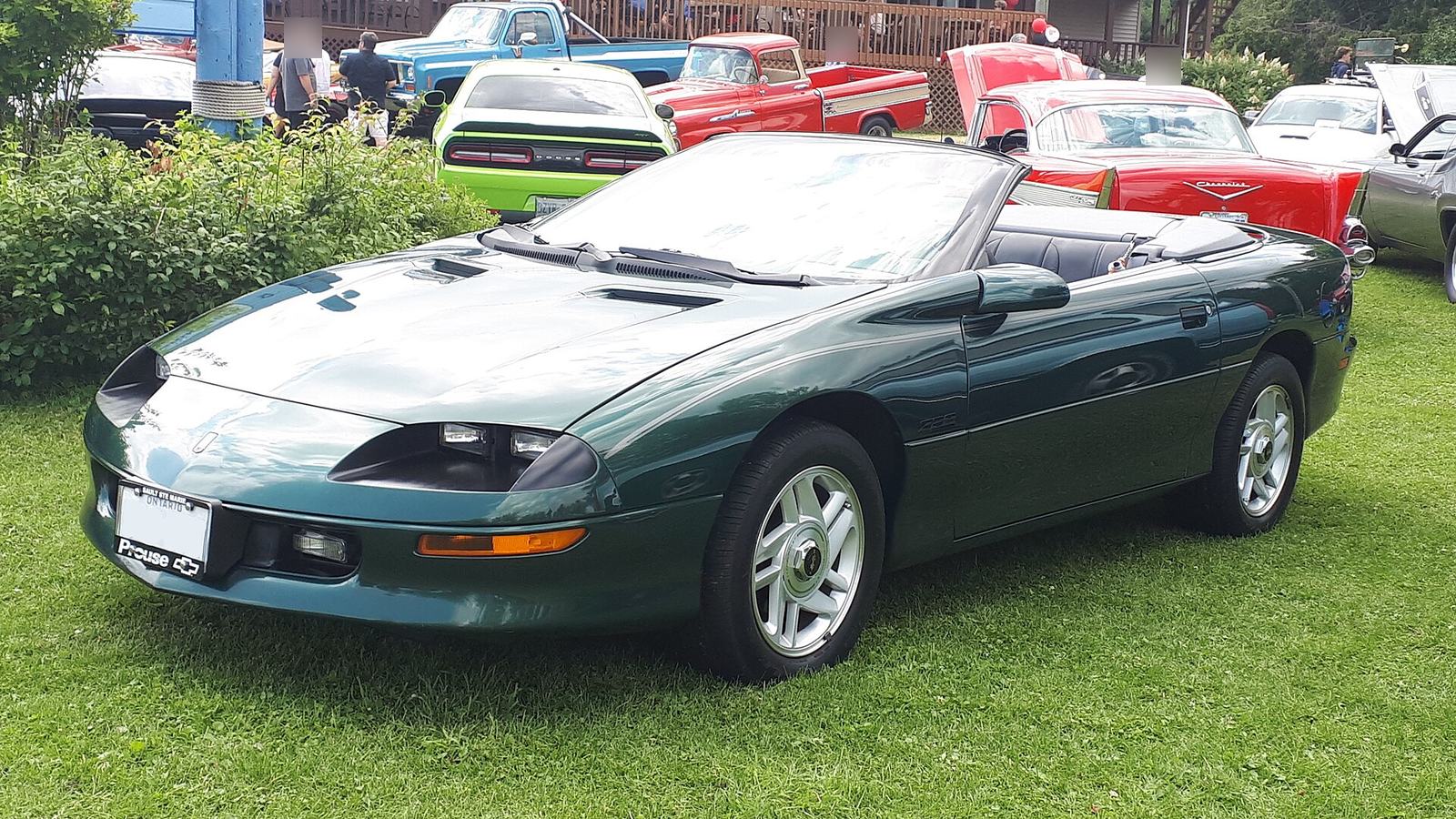
Dark green 1995 Camaro Z28 convertible with top down, front three-quarter view, on grass at an outdoor car show Photo: SsmIntrigue, CC BY-SA 4.0, via Wikimedia Commons; faces blurred
Original photographLicense
The 3800 arrives
The standard engine remained the 3.4-liter V6 with sequential fuel injection. It was rated at 160 hp at 4,600 rpm and came with a five-speed manual or four-speed automatic. Late in the model year Chevrolet added a new option for the base coupe and convertible, the 3800 V6. It made 200 hp and came only with the electronically controlled four-speed automatic, and Chevrolet described it as quiet and responsive. The Z28's 5.7-liter LT1 continued at 275 hp at 5,000 rpm and 325 lb-ft, with a six-speed manual that Chevrolet said had been chosen to give the LT1 the best gearing available.
The April 10, 1995 coupe order guide ties the L36 to the MX0 automatic, YF5 California emissions and C60 air conditioning, and marks the base five-speed unavailable with L36. That dated combination should not be read as a complete account of when every market received the engine.
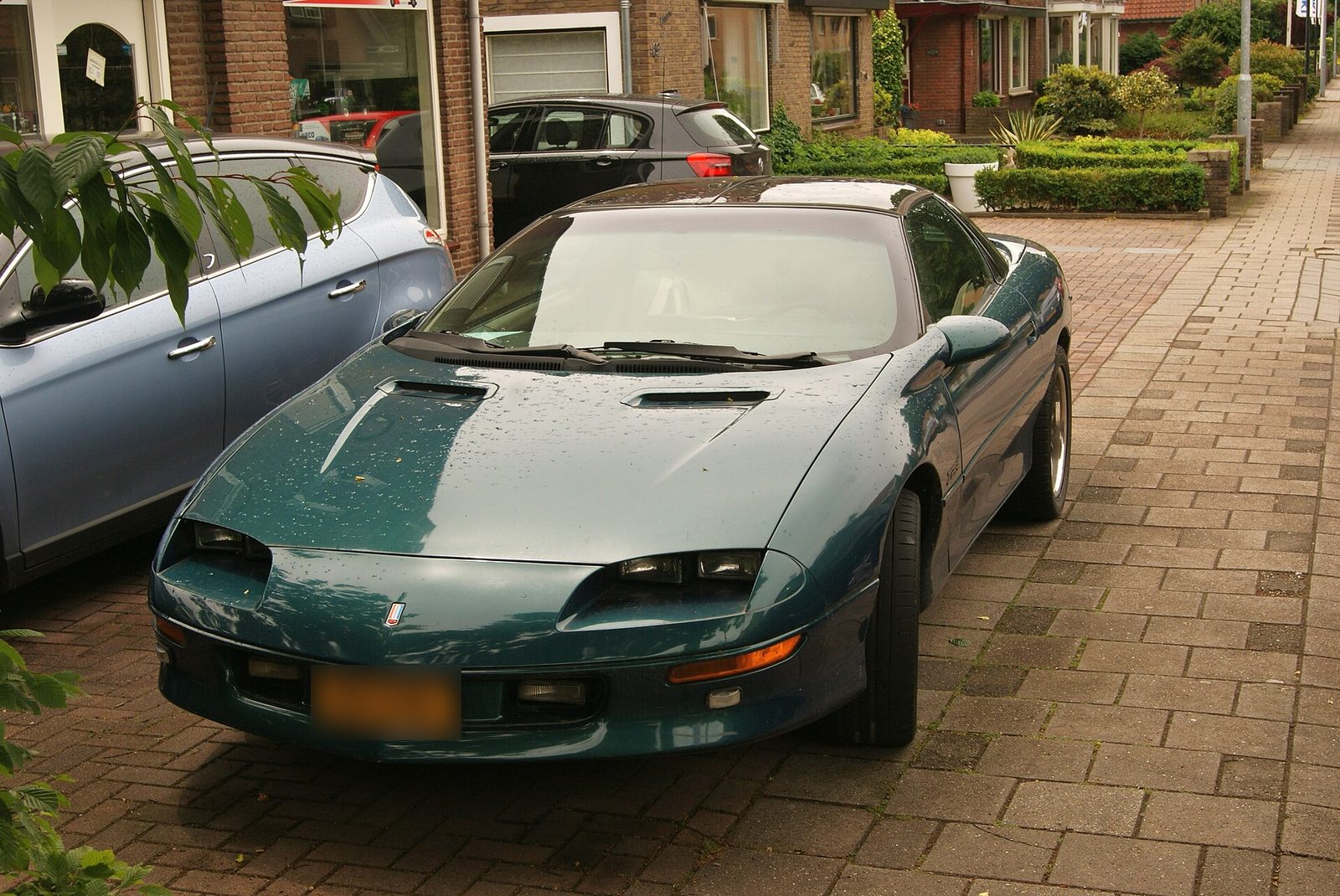
Dark green 1995 Camaro coupe, front three-quarter view, parked on a brick-paved residential street Photo: Niels de Wit, CC BY 2.0, via Wikimedia Commons; licence plates blurred
Original photographLicense
April 10, 1995 coupe order: the L36 requirements
For the L36 in this dated coupe guide, MX0 automatic, YF5 California emissions and C60 air conditioning go together. The five-speed is marked unavailable with L36. This records an ordering combination, not a nationwide introduction date or a rule for other model years. Original CamaroFacts diagram. Chevrolet coupe order guide, revised April 10, 1995.
Built to last
Dual air bags and four-wheel anti-lock brakes were standard. So was PASS-Key II, which checked a resistance-coded pellet in the key and disabled the fuel system and starter if the value was wrong. The short/long-arm front suspension was designed to keep the tires flat on the road in a turn. The doors, roof, hatch and front fenders were dent-resistant and rustproof. The exhaust, including the catalytic converter and muffler, was stainless steel, and a low-oil-level warning was standard. The convertible's power top was fully lined, with a glass rear window and defogger, and a hard three-piece tonneau covered it when down.
Who bought a Camaro
Chevrolet's dealer guide gave a rare picture of the buyer it was aiming at. The median Camaro buyer was 35, with a household income of about $58,000, and the car appealed to young singles and to women. The Z28 drew committed domestic loyalists, often older men, who wanted a muscle car with a high-performance image. Chevrolet saw the Camaro Coupe competing with the Mustang, Probe, Firebird and a long list of imports from the Honda Prelude to the Acura Integra. The Z28 was up against the Mustang GT, Firebird Trans Am and Formula, Dodge Stealth, Toyota Supra and Nissan 300ZX. Dealers were told to stock coupes with the second option group: power locks, power windows with driver express-down, electric mirrors, a leather-wrapped wheel and remote keyless entry.
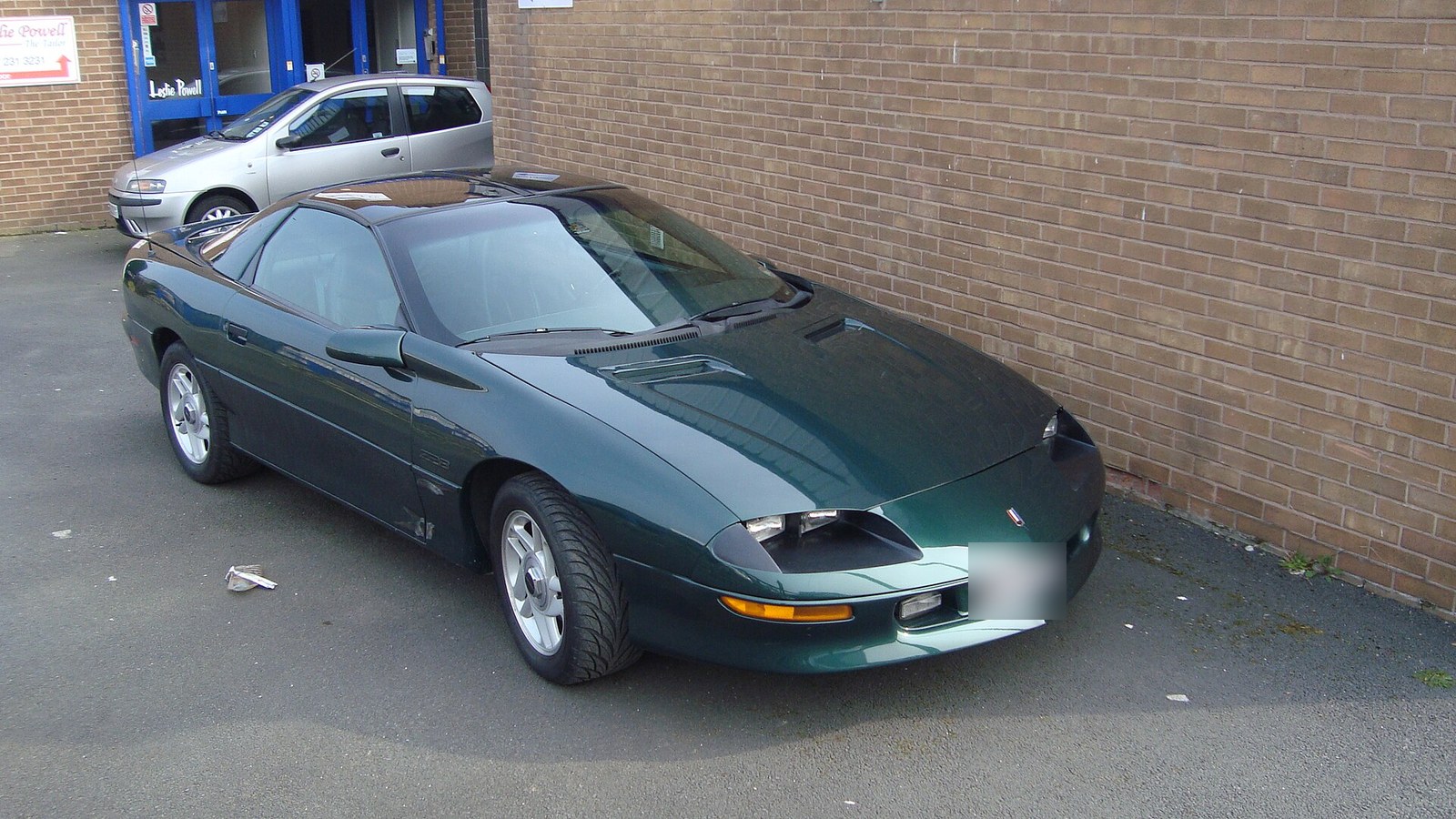
Dark green 1995 Camaro Z28 coupe, front three-quarter view, parked beside a brick building Photo: Kieran White, CC BY 2.0, via Wikimedia Commons; licence plates blurred
Original photographLicense